

26 min read
Quick answer: There’s a chair in your bedroom you haven’t seen the seat of in weeks, a corner of the counter where the mail and the chargers and the thing-you-meant-to-return all live now, a room you keep the door closed on. You know exactly how to clean — and yet standing in front of it, your whole body refuses. This is what the ADHD community calls a “doom pile,” and if it keeps rebuilding itself no matter how many times you clear it, you’re not imagining the difficulty. “Doom pile” isn’t a diagnosis, but the machinery underneath is well documented: with ADHD, things you put away drop out of mind, every object waiting to be sorted is a small decision, and a pile in your eyeline quietly competes for attention you don’t have to spare. Put those together and the pile isn’t a character flaw — it’s a system your brain built, running exactly as designed. Once you see the design, you can work with it instead of against it.
What is an ADHD doom pile? An ADHD doom pile is a growing heap of unsorted stuff — on a chair, a counter, a floor, or stuffed in a “doom bag” or drawer — that a person with ADHD struggles to put away or clear, even though they know how and want to. “Doom pile” is a community term, not a clinical diagnosis, and no research study measures it by that name. It appears to draw on several documented features of ADHD: working-memory differences that make out-of-sight items drop out of mind, so things get left in view; executive-function and decision-making differences that turn “putting each thing away” into an exhausting string of choices; and heightened distractibility, which makes a cluttered space extra taxing to be in. The pile is less a sign of not caring than an external record of a brain that loses what it can’t see — and freezes at the mountain of small decisions clearing it would take.
The chair, the corner, the door you keep closed
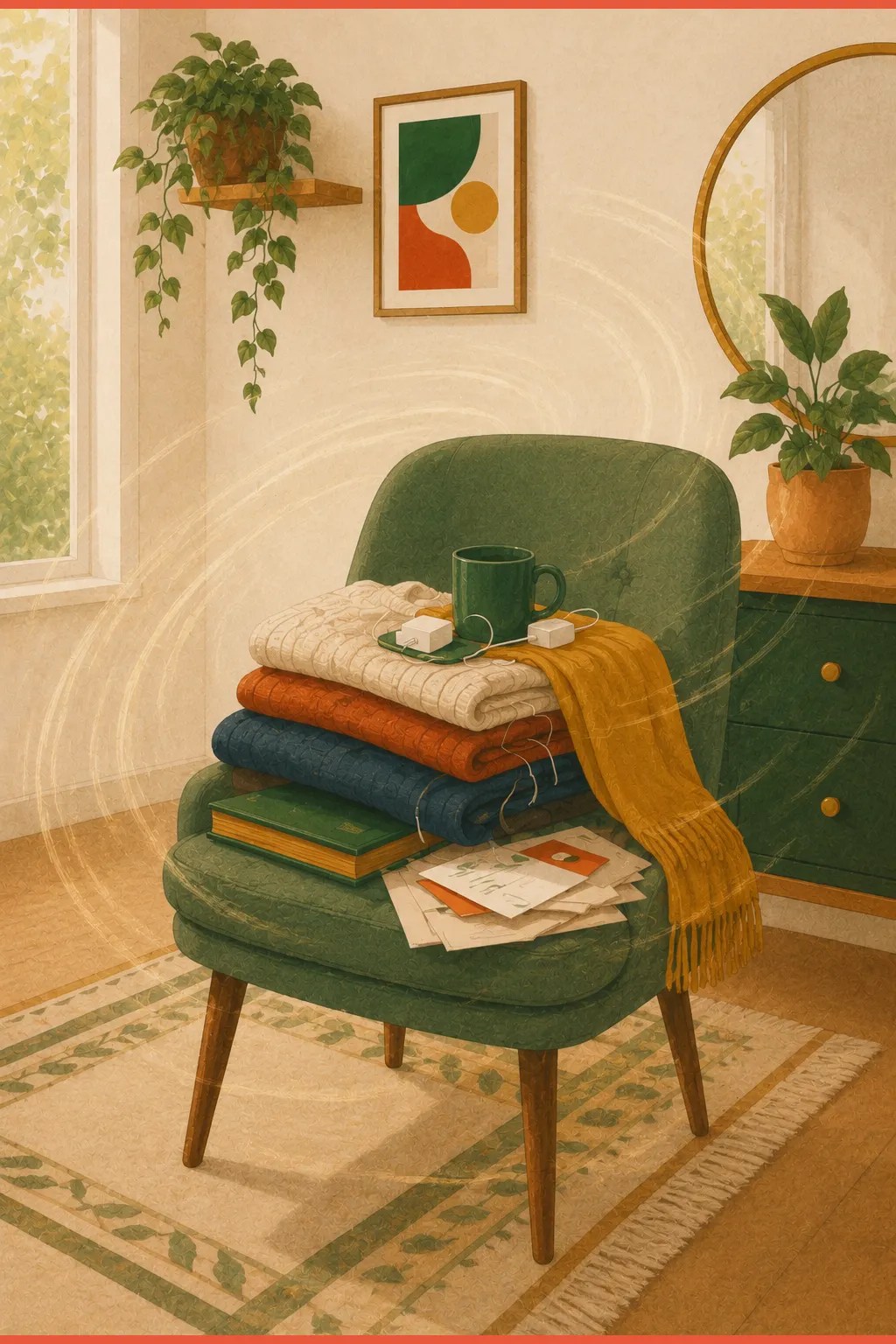
Everyone’s doom pile has a home. For some it’s the chair — the one meant to hold a single cardigan that now holds a season’s worth. For others it’s the “doom bag” by the door, the counter with no obvious place for anything, the spare room that became somewhere to put things instead of somewhere to be. Wherever it lives, it grows quietly and carries a weight far heavier than the objects in it — because it isn’t really about the objects. Every time you walk past it, some part of you registers I should deal with that, walks past anyway, and adds a thin layer of shame on top of the physical layer of stuff. Over time the pile stops being a to-do and becomes a verdict: proof that you can’t keep up, that other adults somehow manage this and you don’t.
That verdict is wrong, and this article is about why — not the “ten storage bins that will change your life” version (you’ve tried the bins), but the actual brain differences that build doom piles, and why the standard advice to just tidy as you go was never going to hold for an ADHD brain. Understanding the mechanism is what lets you stop treating the pile as a moral failing and start treating it as a design problem with design solutions.
What a “doom pile” actually is
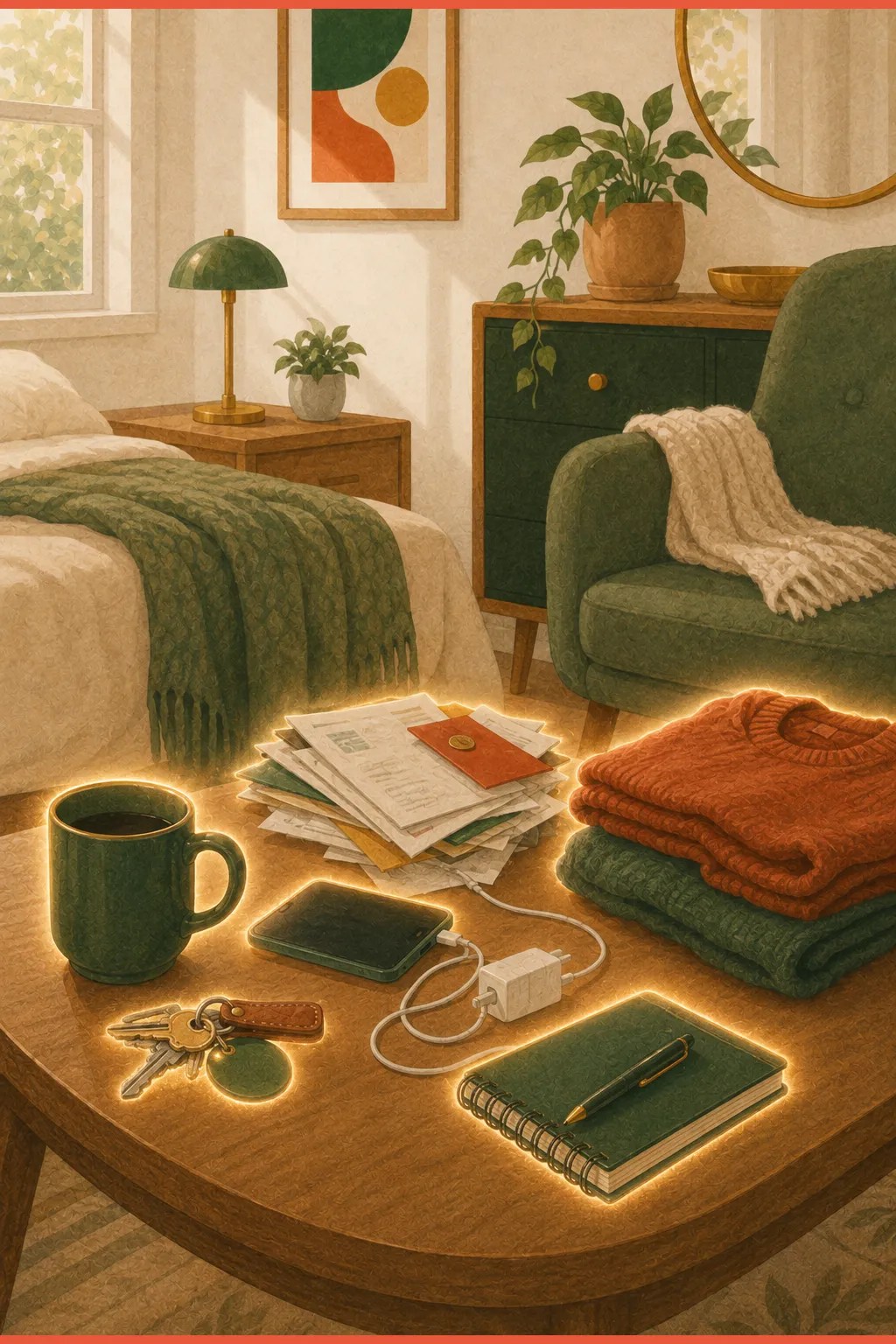
Strip away the label and a doom pile is a specific collision of well-studied ADHD differences — the differences in attention and self-regulation a large international consensus statement places at the core of the condition.¹ The label itself is community shorthand (sometimes stretched into the backronym “Didn’t Organize, Only Moved”), not a clinical term, and no study has measured a thing by that name. What follows is what the science on ADHD, memory, and attention actually shows.
Think of the pile as a visibility trap. An ADHD brain learns early that anything put away tends to vanish from mind, so it develops a workaround: keep things visible — the bill left on the counter so you don’t forget to pay it. In the short term, visibility genuinely helps — it’s the brain externalizing a memory it can’t hold internally. The trap is that visibility doesn’t scale: enough visible items stop working as reminders and start working as noise, and the pile meant to help you remember becomes a wall you can’t get past.
Three forces spring that trap: out of sight, out of mind (why things stay in view), every object is a decision (why the pile grows and clearing it stalls), and the pile becomes noise (why a cluttered space drains and freezes you). None is a doom pile alone; together, they’re the trap — and understanding each is what points at the way out.
Out of sight, out of mind

Start with why things don’t get put away in the first place. For a lot of ADHD brains, “away” is close to “gone”: put the passport in a drawer and it might as well be a black hole; the sweater folded into the closet stops existing until you tear the place apart looking for it. So you learn, without deciding to, that the only reliable way to remember something is to keep it where you can see it.
In ADHD spaces this often gets called “object permanence,” but that’s a borrowed term worth handling carefully. True object permanence is the infant milestone of knowing a toy still exists when it’s hidden — and adults with ADHD plainly have it. What the phrase is really pointing at is better described as working memory, the ability to hold information “online,” which meta-analysis finds is reliably reduced in adults with ADHD.² When an item isn’t in front of you, keeping it active in mind is exactly the effortful holding an ADHD brain does less easily, so it fades. A related piece: acting on an intention later — prospective memory — leans on planning, which a controlled study of adults with ADHD found substantially impaired.³ You set the thing down meaning to deal with it later, and “later” quietly never arrives.
This is the spatial edge of everyday ADHD forgetfulness — the way information often doesn’t get fully recorded in the first place. The consequence for your space is simple: if putting something away means losing it, leaving it out is the rational move. The pile isn’t laziness. It’s a filing system for a brain whose only trusted folder is visible.
Every object is a decision
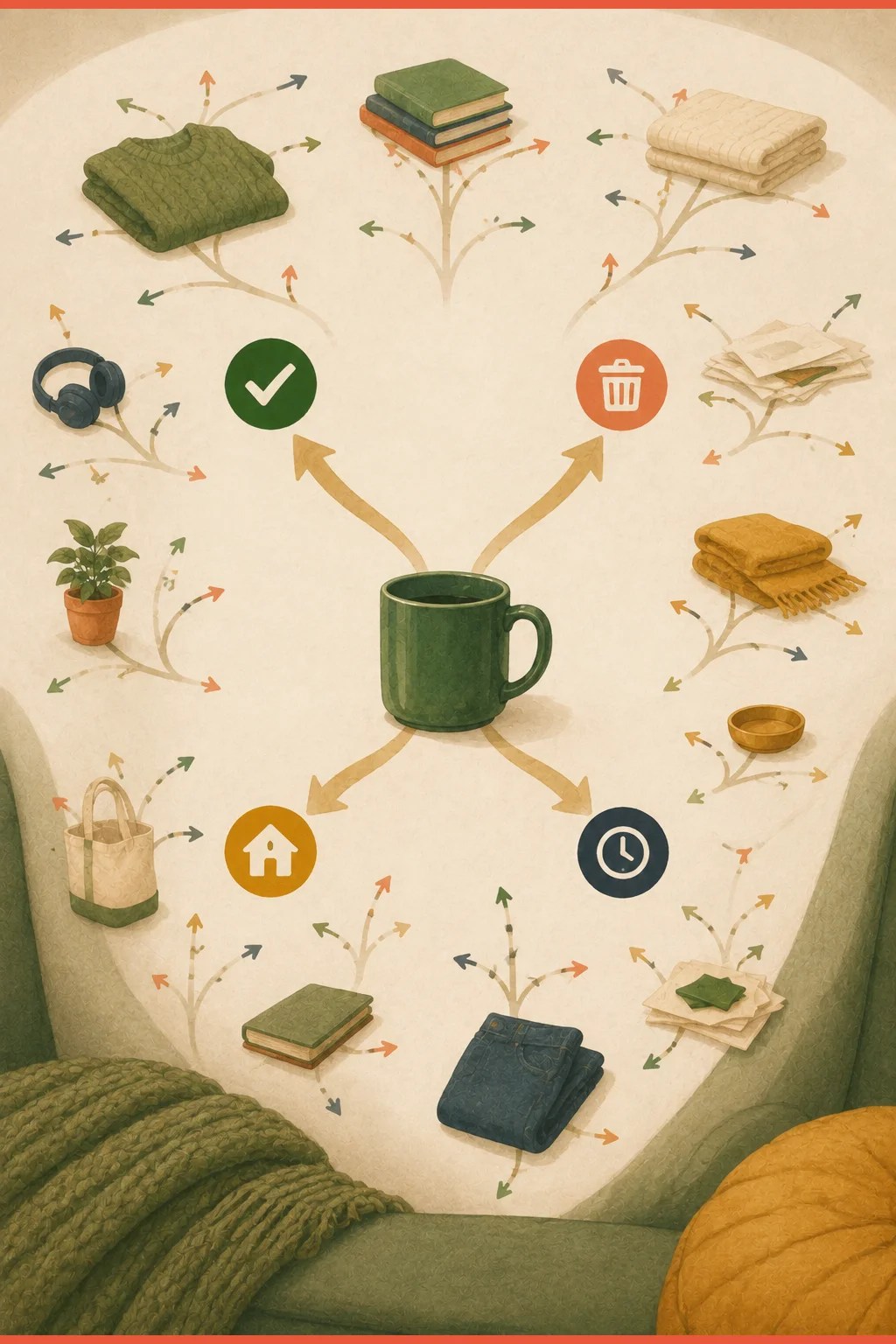
Now the force that explains why the pile grows and why clearing it feels un-startable. Putting one object away sounds like a single action, but it’s really a chain of decisions: What is this? Do I keep it? Where does it live? Do I have to move something else to make room? For one object, trivial. For a chair buried under forty objects, it’s forty chains — hundreds of micro-decisions stacked into what looks, from outside, like a five-minute job.
Decision-making itself runs differently in ADHD. A meta-analytic review found reliable, medium-sized differences in the executive skills that plan, sequence, and organize behavior⁴ — and, more specifically, a meta-analysis and experiment found people with ADHD tend toward more sub-optimal decision-making, not simply riskier choices but a harder time weighing options efficiently.⁵ So the mountain of small choices a doom pile demands is genuinely heavier for an ADHD brain. (Those studies measured decisions and executive skills in the lab, not sorting laundry, so reading them onto a cluttered chair is a reasonable extrapolation, not a directly measured finding.)
This is why “cleaning” so often collapses into standing in the doorway doing nothing — not the physical effort, but decision load hitting a system that fatigues on decisions, the same overlap that drives ADHD task paralysis. And every object you don’t deal with in the moment, because deciding felt like too much, is one more object on the pile. It grows out of the same difficulty that makes it hard to shrink.
When the pile becomes noise
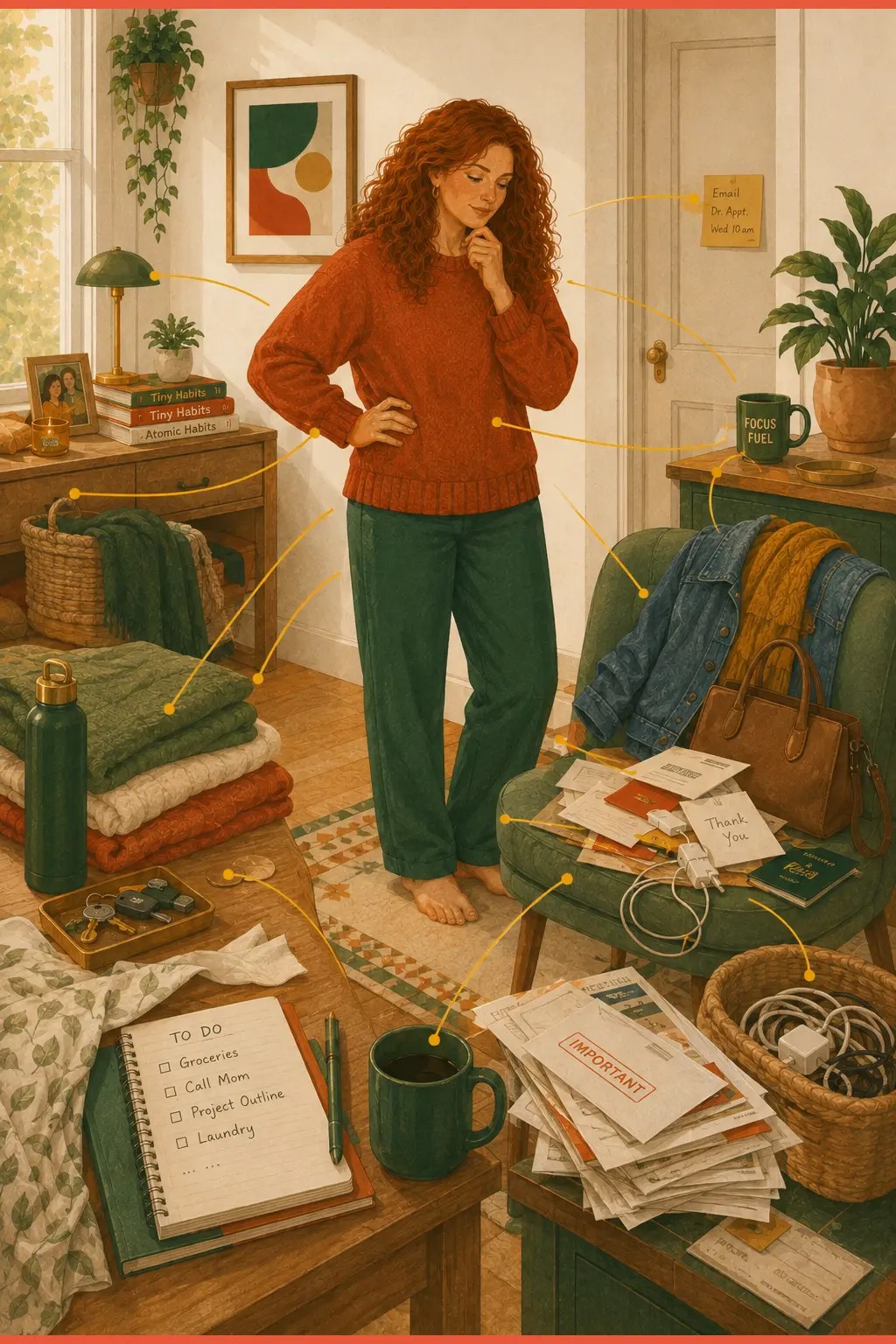
The third force is what the pile does to you once it exists. A cluttered space isn’t neutral background for an ADHD brain — it’s a field of things actively pulling at your attention.
Adults with ADHD are more distractible by salient, task-irrelevant stimuli, a difference documented behaviorally and in brain activity.⁶ A room full of visible objects is exactly that: dozens of small, salient somethings, each a little tug on attention you keep having to resist. Sensory processing often runs differently in adult ADHD, too — one study found atypical sensory sensitivity (heightened or blunted) in 43% of women with ADHD, far above the 22% in men⁷ — so for many women a visually loud room isn’t only distracting, it’s physically taxing to occupy.
There’s an emotional cost on top. In the general population — not ADHD specifically — describing your home as cluttered and unfinished has tracked with a less healthy daily stress-hormone pattern and lower mood,⁸ which can’t prove clutter causes the stress but fits what the pile feels like from the inside. It’s the same territory as broader ADHD overwhelm: input stacking past what your system can process. The cruel loop: noise makes starting harder, and not starting makes the noise worse.
Not sure which workbook fits where you are? See all three →
Why “just clean it up” was never going to work
The advice everyone offers — just tidy as you go, just put things away immediately, just deal with it before it piles up — describes a brain that reliably holds intentions online, finds small decisions cheap, and isn’t taxed by a busy room. That describes the person giving the advice, not the machinery you’re working with. Told to “just put it away,” an ADHD brain hits all three forces at once: putting it away means it might vanish from mind, deciding where it goes is a real cost, and the surrounding clutter is already eating the attention you’d need to follow through. “Just clean up” asks you to power through wiring with willpower — the resource ADHD makes least reliable. So the doom pile isn’t a discipline problem you can shame yourself out of; it’s a design problem needing design solutions: change the conditions so putting things away doesn’t lose them, decisions get cheaper, and the space stops shouting.
What a doom pile doesn’t mean
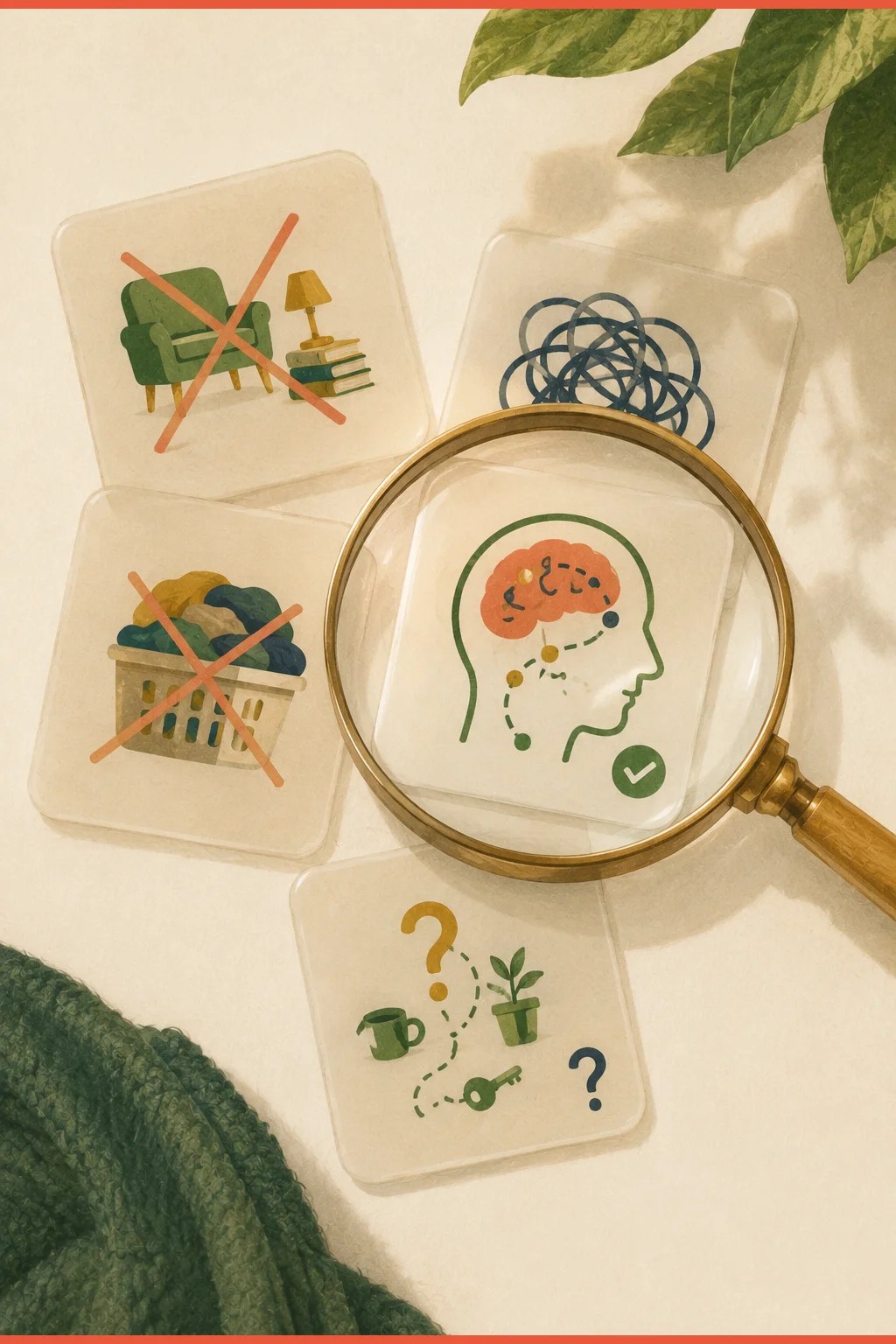
Because “doom pile” is a community term doing a lot of work, a few honest boundaries matter.
It doesn’t mean you’re lazy or a messy person. A doom pile is the predictable output of memory, decision load, and distractibility stacking up — not evidence of a flawed character. Naming the mechanism is the opposite of an excuse; it’s what lets you build around the difficulty instead of blaming yourself.
It doesn’t mean “doom pile” is a diagnosis. It’s a useful label for a real experience, assembled from documented pieces — a lens, not a clinical fact.
It doesn’t mean you literally lack object permanence. You know your things still exist when they’re out of view. “Object permanence” is a borrowed, imprecise label for what’s better explained by working and prospective memory.² ³ The distinction matters because it points at practical fixes — visible storage, external reminders — rather than a made-up deficit.
It isn’t self-diagnosable. Nearly everyone has a junk drawer and a bad clutter week; that alone says nothing. If difficulty managing your space is one thread in a lifelong, pervasive pattern alongside other attention and organization struggles, a validated ADHD screening tool for women is a reasonable thing to bring to a professional — but a screen only flags likelihood and never diagnoses.¹²
When it’s more than ADHD
A doom pile is common, exhausting, and — for most people with ADHD — not a sign of anything more serious than the wiring above. But a couple of patterns are worth knowing, because they respond to different help, and telling them apart is a job for a professional rather than an article.
The most important is hoarding disorder, a distinct diagnosis in the DSM-5, not a severe doom pile.⁹ The line isn’t how much stuff there is — it’s what happens when you try to let it go. A doom pile is largely unsorted: things you haven’t gotten around to deciding on. Hoarding disorder is defined by a persistent difficulty discarding possessions regardless of their real value, driven by a felt need to save them and genuine distress at parting with them, until clutter fills living spaces and stops rooms being used for what they’re for.⁹ If throwing things out feels genuinely wrong rather than merely tedious, or the volume is blocking the use of rooms or exits, that’s a different — and professional — conversation.
The two do overlap. In one clinic sample of adults with ADHD, about one in five met the threshold for clinically significant hoarding, with inattention the strongest predictor.¹⁰ (That figure comes from people who sought help at an ADHD clinic, so it runs higher than it would across everyone with ADHD — it does not mean one in five people with ADHD hoards.) And adults who have both tend to carry a heavier load of mood, anxiety, and attention difficulties than those with ADHD alone.¹¹ The takeaway isn’t alarm — it’s that if the discarding piece rings true, it’s worth naming to a clinician, because it’s treatable and it isn’t the same problem as a chair full of clean laundry.
One more pattern deserves a mention: a sudden collapse in your ability to keep up with a space you used to manage — especially alongside low mood, exhaustion, or a sense that nothing’s worth the effort — can track with depression rather than ADHD alone, a distinction covered in ADHD and depression. None of this is something to diagnose yourself with from a blog post; it’s a reason to bring the specifics to someone qualified if the pile is part of a bigger shift.
What actually helps you clear the pile
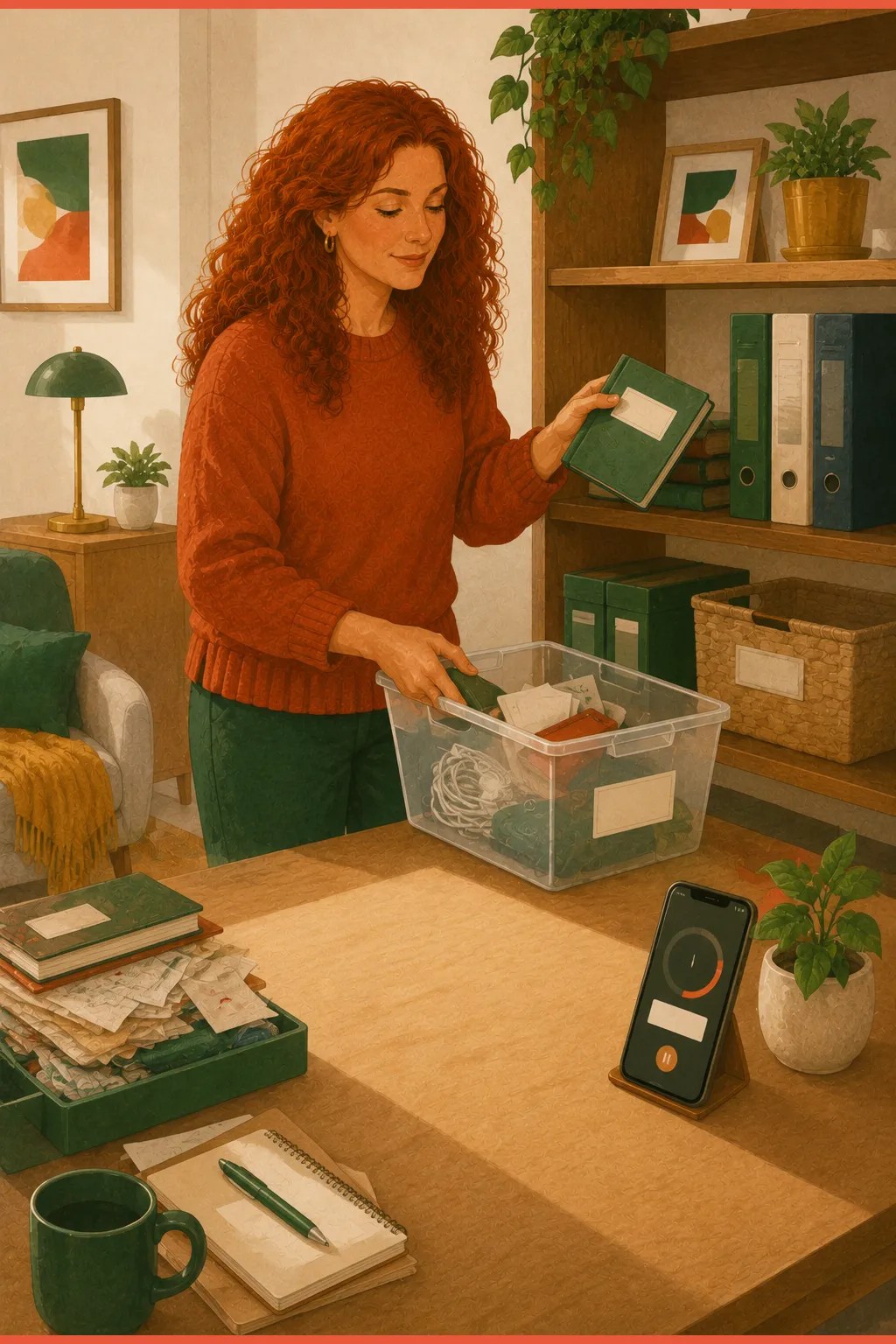
You don’t beat a doom pile by mustering the discipline everyone says you lack — that framing is the thing that’s been failing. You beat it by changing the conditions so the three forces stop working against you. None of this cures ADHD or promises a permanently spotless home — even neurotypical homes have piles — but each move targets one force directly.
Store things visibly on purpose. If “away” means “gone,” design for visibility: open shelves, clear bins, wall hooks, a labeled tray for the things that always land on the counter. The point isn’t to hide your stuff into forgetting; it’s to give the visible items an actual home so the pile has somewhere to resolve to — the filing system your brain was improvising.
Shrink the decisions before you start. The pile stalls you because it’s hundreds of choices, so remove the choosing: sort by category, not by object — “all the laundry first,” then “all the papers” — so you make one kind of decision at a time. Or put away five objects, then stop; small enough to finish is small enough to begin.
Turn down the noise while you work. Because clutter competes for your attention,⁶ clear one small zone completely rather than skimming the whole room — a single shelf, one square of counter — so your eyes get a finished patch to rest on. A cleared corner isn’t only progress; it’s one less thing pulling at you.
Borrow momentum from another person. Many people with ADHD find a task starts far more easily with someone else present — on the phone, on video, or simply in the room. It’s a community strategy rather than a proven treatment, but another person’s presence can supply the activation a task won’t generate alone.
7 ways to tackle ADHD doom piles

- Give the pile’s contents a visible home. Add open shelves, clear bins, hooks, or a labeled catch-all tray so the things that always pile up have somewhere to go that you can still see — working with “out of sight, out of mind” instead of against it.
- Sort by category, not by object. Do all the laundry, then all the papers, then all the dishes, so you make one type of decision at a time instead of a fresh choice for every single item.
- Clear one small zone completely. Finish a single shelf or one square of counter rather than skimming the whole room, so you get a patch of calm your attention can rest on and proof the pile is beatable.
- Run the “five things” reset. Put away five objects, then stop if you want to. Small enough to finish is small enough to start — and you’ll often keep going once you’ve begun.
- Body-double the task. Clean while a friend is on video, on the phone, or in the room. Another person’s presence can supply the momentum an ADHD brain won’t generate solo.
- Set a timer, not a goal. Work the pile for ten minutes by the clock instead of aiming to “finish,” which removes the pressure to make the whole decision-mountain disappear at once.
- Drop the verdict. Name it out loud — “that’s a doom pile, not proof I’m failing” — because the shame layer is what makes you avoid the pile, and avoidance is what lets it grow.
Frequently asked questions
What is an ADHD doom pile?
A doom pile is a growing heap of unsorted stuff — on a chair, a counter, a floor, or stuffed in a bag or drawer — that a person with ADHD struggles to clear even though they know how and want to. It’s a community term, not a clinical diagnosis; no study measures it by that name. What’s real underneath are working-memory differences that make out-of-sight items drop out of mind,² the executive-function and decision load of putting each thing away,⁴ ⁵ and heightened distractibility that makes a cluttered space taxing to occupy.⁶
Why is cleaning so hard for people with ADHD?
Because “cleaning” isn’t one task — it’s a chain of decisions (what is this, do I keep it, where does it go) repeated for every object, and both decision-making and executive function run less efficiently in ADHD.⁴ ⁵ A cluttered room is also full of salient distractions competing for limited attention,⁶ and putting things away can feel like losing them, thanks to working- and prospective-memory differences.² ³ The difficulty isn’t effort or motivation — it’s a decision-and-attention load hitting the exact systems ADHD makes least reliable.
Is a doom pile the same as hoarding?
No. A doom pile is mostly unsorted stuff you haven’t put away yet; hoarding disorder is a separate DSM-5 diagnosis defined by persistent difficulty discarding possessions because of a felt need to keep them and real distress at letting them go, until clutter stops rooms being used.⁹ The distinguishing question isn’t how much stuff there is — it’s what happens when you try to discard it. The two can co-occur, with inattention a particular link,¹⁰ so if throwing things away feels genuinely distressing rather than merely tedious, that’s worth raising with a professional. For most people with ADHD, a doom pile is not hoarding.
Is “object permanence” why I have doom piles?
Partly, but the term is borrowed and imprecise. Adults with ADHD haven’t lost object permanence — you know your things still exist in the drawer. What’s really happening is better described as working and prospective memory: holding an out-of-sight item “online,” or remembering to act on it later, is harder for an ADHD brain,² ³ so things get left in view. The practical upshot is the same — visible storage and external reminders help — but it’s worth being accurate, since “I lack object permanence” isn’t what the research supports.
How do I stop my doom pile from coming back?
You change the conditions rather than relying on willpower. Give the things that always pile up a visible home (open shelves, clear bins, a labeled tray) so putting away doesn’t mean losing; shrink the decisions by sorting one category at a time; clear one small zone fully so your attention gets a rest; and borrow momentum by working alongside another person. None of this cures ADHD or guarantees a spotless home — piles are normal — but each move targets a specific force that rebuilds the pile, which lasts longer than trying harder.
Does having doom piles mean I’m lazy?
No. A doom pile is the predictable result of documented brain differences in memory, decision-making, and attention — not a sign of laziness or a flawed character. In fact, the shame of believing you’re lazy helps keep the pile going: it makes the pile something you avoid rather than approach, and avoidance is what lets it grow. Dropping the verdict is a genuine strategy, not only a kindness.
When is clutter worth getting help for?
Consider talking to a professional if clearing things brings real distress rather than ordinary reluctance, if clutter is blocking the use of rooms or exits or creating safety issues, or if it’s part of a larger lifelong pattern of attention and organization struggles. It’s also worth reaching out if the clutter appeared alongside a drop in mood or energy, since that can point toward depression rather than ADHD alone. A clinician can tell apart ordinary ADHD clutter, hoarding disorder, and low mood — distinctions an article can’t make for you.
The same forces that build doom piles can stall showering and basic hygiene too — ADHD and self-care looks at why the tasks you do only for yourself are the hardest to start.
📚 The ADHD Library by Dr. Morgan Reed

If the chair, the counter, and the closed door keep rebuilding themselves no matter how many times you clear them, You’re Not Broken: The 7-Week Executive Function Workbook for Late-Diagnosed ADHD Adults was written for exactly this kind of stuck. It’s seven weeks of practical, capacity-first systems for the machinery underneath the doom pile — building visible storage so putting things away doesn’t mean losing them, shrinking decisions so a task is startable, and turning down the noise so a room stops draining you. The goal was never to shame you into finally being tidy. It’s to hand your brain the external structure that makes a clear space possible to keep.
★★★★★
Save this. You’ll want to come back to it.
- 📕 You’re Not Broken: The 7-Week Executive Function Workbook for Late-Diagnosed ADHD Adults — the flagship workbook for rebuilding after a late diagnosis
- 📗 ADHD Mastery for Adults: 3-in-1 — a daily coaching system for the executive-function load
- 📙 Executive Function Rescue — a nine-week program for overwhelm and emotional regulation
Part of The ADHD Library by Dr. Morgan Reed — practical, evidence-informed tools for late-diagnosed adults.
Medical disclaimer: This article is for educational purposes only and is not a substitute for professional medical or mental-health advice, diagnosis, or treatment. “Doom pile” is a community term, not a clinical diagnosis, and the mechanisms described here are drawn from research on ADHD, memory, and attention rather than from studies of “doom piles” themselves. Hoarding disorder is a distinct condition that only a qualified clinician can assess. ADHD can only be diagnosed by a qualified professional through a comprehensive evaluation — no article or screening tool can diagnose you. If clutter is tied to a larger struggle with low mood or hopelessness, please reach out to a professional; in the US, you can call or text 988 (the Suicide and Crisis Lifeline) any time, free and confidential.
Written by Dr. Morgan Reed, specialist in ADHD and executive function. Last reviewed: August 2026.
References
- Faraone SV, Banaschewski T, Coghill D, et al. The World Federation of ADHD International Consensus Statement: 208 evidence-based conclusions about the disorder. Neuroscience & Biobehavioral Reviews. 2021;128:789–818. https://pubmed.ncbi.nlm.nih.gov/33549739/
- Alderson RM, Kasper LJ, Hudec KL, Patros CHG. Attention-deficit/hyperactivity disorder (ADHD) and working memory in adults: a meta-analytic review. Neuropsychology. 2013;27(3):287–302. https://pubmed.ncbi.nlm.nih.gov/23688211/
- Fuermaier ABM, Tucha L, Koerts J, et al. Complex prospective memory in adults with attention deficit hyperactivity disorder. PLoS One. 2013;8(3):e58338. https://pmc.ncbi.nlm.nih.gov/articles/PMC3590133/
- Willcutt EG, Doyle AE, Nigg JT, Faraone SV, Pennington BF. Validity of the executive function theory of attention-deficit/hyperactivity disorder: a meta-analytic review. Biological Psychiatry. 2005;57(11):1336–1346. https://pubmed.ncbi.nlm.nih.gov/15950006/
- Dekkers TJ, Agelink van Rentergem JA, Huizenga HM, et al. Decision-making deficits in ADHD are not related to risk seeking but to suboptimal decision-making: meta-analytical and novel experimental evidence. Journal of Attention Disorders. 2021;25(4):486–501. https://pubmed.ncbi.nlm.nih.gov/30520666/
- Schneidt A, Jusyte A, Rauss K, Schönenberg M. Distraction by salient stimuli in adults with attention-deficit/hyperactivity disorder: evidence for the role of task difficulty in bottom-up and top-down processing. Cortex. 2018;101:206–220. https://pubmed.ncbi.nlm.nih.gov/29518704/
- Bijlenga D, Tjon-Ka-Jie JYM, Schuijers F, Kooij JJS. Atypical sensory profiles as core features of adult ADHD, irrespective of autistic symptoms. European Psychiatry. 2017;43:51–57. https://pubmed.ncbi.nlm.nih.gov/28371743/
- Saxbe DE, Repetti R. No place like home: home tours correlate with daily patterns of mood and cortisol. Personality and Social Psychology Bulletin. 2010;36(1):71–81. https://pubmed.ncbi.nlm.nih.gov/19934011/
- Mataix-Cols D. Clinical practice. Hoarding disorder. New England Journal of Medicine. 2014;370(21):2023–2030. https://pubmed.ncbi.nlm.nih.gov/24849085/
- Morein-Zamir S, Kasese M, Chamberlain SR, Trachtenberg E. Elevated levels of hoarding in ADHD: a special link with inattention. Journal of Psychiatric Research. 2022;145:167–174. https://pubmed.ncbi.nlm.nih.gov/34923357/
- Grassi G, Moradei C, Cecchelli C, van Ameringen M. The complex clinical and cognitive phenotype of adult patients with attention deficit hyperactivity disorder and comorbid hoarding disorder. International Journal of Psychiatry in Clinical Practice. 2024;28(2):167–176. https://pubmed.ncbi.nlm.nih.gov/39544030/
- Ustun B, Adler LA, Rudin C, et al. The World Health Organization adult attention-deficit/hyperactivity disorder self-report screening scale for DSM-5. JAMA Psychiatry. 2017;74(5):520–527. https://pubmed.ncbi.nlm.nih.gov/28384801/
As an Amazon Associate, I earn from qualifying purchases — at no extra cost to you. Full disclosure.