

26 min read
Quick answer: If you’re the parent — and you’re also the one with ADHD — you already know parenting asks for the exact things your brain supplies least reliably: remembering the permission slip, holding the morning routine together, staying calm at 6 p.m. when everyone’s melting down including you. This article is about parenting when you have ADHD, not about raising a child who does. Here’s what’s happening: children borrow a parent’s planning, memory, and emotional regulation until their own slowly matures, which turns you into the executive function for the whole household — running the demands ADHD makes hardest, all day, for more than yourself. That’s not a character flaw or a sign you’re failing your kids. It’s a real mismatch between how your brain works and a job built almost entirely from your weakest skills, and naming it is what lets you build around it instead of drowning in guilt.
What does “parenting with ADHD” mean? Parenting with ADHD describes raising children when you, the parent, have attention-deficit/hyperactivity disorder — a neurodevelopmental condition affecting attention, working memory, and self-regulation. It’s a different topic from parenting a child who has ADHD. Because ADHD is highly heritable, many women only recognize their own ADHD after a child is diagnosed and they see themselves in the paperwork. Parenting with ADHD tends to strain the same systems ADHD already taxes: remembering the invisible logistics of family life, holding routines steady day after day, managing transitions, and staying regulated through a child’s big feelings while managing your own. The struggle isn’t a measure of how much you love your children — it’s the predictable friction between an ADHD brain and a role that runs on planning, repetition, and emotional steadiness.
The forgotten form, the 6 p.m. meltdown

It’s the permission slip you found crumpled in a backpack the morning it was due. The library book lost for three weeks. The dentist appointment you were sure was next Tuesday. It’s standing in the kitchen at six in the evening — dinner half-made, a toddler crying, an older kid asking the same question for the fourth time — feeling your own nervous system climb toward the ceiling right alongside theirs. It’s loving your children with your whole chest and still lying awake replaying the moment you snapped, certain a real mother would have handled it better.
None of that means you’re a bad parent. It means you’re running one of the most executive-function-heavy jobs on earth with a brain that finds executive function genuinely hard. The mental load of a household — the tracking, scheduling, remembering, anticipating — is invisible labor for anyone; for a mother with ADHD it lands directly on the systems her brain already struggles to run. This article is about why, and about what actually helps — not by trying harder at the thing that’s hard, but by changing the setup.
What’s actually happening: the double executive load

ADHD is a neurodevelopmental condition whose core features — differences in attention and self-regulation — sit at the center of the disorder in a large international consensus statement.¹ It’s also one of the most heritable conditions in psychiatry: twin studies put its heritability around 74%,² a large part of why so many women first recognize their own ADHD only after a child is assessed and the description sounds uncomfortably familiar. Women are diagnosed later and recognized less, because quieter, inattentive presentations don’t disrupt a classroom the way hyperactivity does.³
Here’s the frame that makes it make sense: a double executive load. Executive functions — planning, working memory, holding your temper, sequencing steps, tracking time — are the mental tools you use to run your own life, and ADHD supplies them unevenly. Parenting then asks you to be those tools for other people too. Children aren’t born with executive function; it develops slowly across the first two decades, and until it does, they run on a borrowed copy of yours. You are their working memory (where are your shoes?), their planning (we leave in ten minutes), their impulse control (we don’t hit), and their emotional regulation — the calm voice that helps a dysregulated child come back down.
So parenting with ADHD isn’t one hard job — it’s running executive demand for a whole household on the single brain that finds executive demand hardest. Three forces spring the trap: you became the family’s executive function (the load multiplies), the job is built from your hardest skills (routine, transitions, time, staying regulated), and guilt and dysregulation feed each other (the gap between who you mean to be and the tired parent you sometimes are turns into shame that drains your capacity). None is the whole picture alone; together they’re why this is so much harder than it looks.
You became the family’s executive function

Before kids, an ADHD brain finds workarounds: you lean on deadlines, crises, and other people’s structure to prop up your own. Parenting removes most of those props and hands you a second full set of executive demands that never clocks out.
Executive function runs differently in ADHD to begin with. A foundational meta-analytic review found reliable, medium-sized differences in the skills that plan, organize, and sequence behavior,⁴ and a meta-analysis focused on adults found moderate differences in working memory — the ability to hold information “online” while you use it.⁵ Picture what a single morning demands of that system: track three people’s shoes and lunches, hold the clock in mind, anticipate the meltdown before it lands, remember the thing that has to go to school — all while nobody helps you stay on task. That’s not a to-do list; it’s a continuous, high-stakes working-memory exercise, run for people who can’t yet run it themselves, on the exact faculty ADHD makes least reliable.
This is why “I forgot” is so often the honest answer that sounds like the worst one: you’re not forgetting because you don’t care, you’re holding more than any working memory does comfortably, and yours is already stretched. The tasks that never make a list because they live in someone’s head are exactly the ones an ADHD brain drops.
The job is built from your hardest skills

There’s a cruel design flaw in the match between ADHD and parenting: the things good parenting runs on are, almost item for item, the things ADHD disrupts.
Parenting rewards consistency — the same bedtime, the same rules, the same response to the same behavior — and ADHD brains, wired for novelty, find sameness depleting; the tenth identical bedtime is harder to run well than the first. It demands endless transitions — stop playing, shoes on, get in the car — exactly where ADHD attention snags. It runs on time: be there at pickup, notice that twenty minutes evaporated. And it runs, above all, on staying regulated while a small person comes apart.
That last one carries a lot of the shame. Emotional regulation isn’t a side issue in ADHD; a meta-analysis of adults found emotion dysregulation substantially more common than in adults without ADHD, with a large effect size,⁶ and a systematic review calls it a core feature of adult ADHD rather than an optional add-on.⁷ So when a child’s screaming pushes you past your own limit and you hear yourself snap, that isn’t proof you’re a uniquely bad parent — it’s two nervous systems dysregulating at once, one of them running on a brain that finds the brakes harder to reach. That doesn’t excuse a hard moment, but it explains it, and explanation is what you build repair on instead of shame.
Guilt and dysregulation feed each other

Now the force that turns a hard job into a painful one. Between the parent you picture being and the ADHD-tired parent you sometimes are, there’s a gap — and mothers with ADHD tend to live in it, narrating it in a running voice that says I should be able to do this, everyone else can.
It’s worth being honest about what the research on parents who have ADHD actually shows, because the honest version is far kinder than the story guilt tells. A meta-analysis found that greater parental ADHD symptoms are linked to somewhat less consistent and more reactive parenting.⁸ That sounds damning until you look closely: the effects are small, the findings are correlational (they can’t show ADHD causes anything), and they’re about behaviors, which change with support — not about how much a parent loves or wants to show up. Mothers with more ADHD symptoms also report more parenting stress,⁹ which makes sense: you’re doing the hardest version of the hardest job while wondering what’s wrong with you for finding it hard.
Here’s the loop. The gap produces guilt; guilt is itself dysregulating — it floods you with the emotional noise an ADHD brain already struggles to quiet — leaving less capacity for the next transition, the next meltdown, the next patient repetition. Less capacity means more moments you’re not proud of, which produces more guilt. Around it goes. Sitting on top, for many mothers, is a heavier worry — did I give this to them? — which gets a clear answer below. The loop is real, but its exit is never “feel more guilty until you improve”; it’s to interrupt the shame, because the shame is part of what keeps you stuck.
Not sure which workbook fits where you are? See all three →
Why “just get more organized” was never going to work
The advice is always a version of the same thing: just get more organized, just be more consistent, just be present, just stay on top of it. It describes a brain that holds intentions online without effort, runs routines on autopilot, and stays regulated through chaos on demand — the person giving the advice, not the machinery you’re parenting with. “Just try harder” asks you to power through your wiring with willpower — the one resource ADHD makes least dependable. So parenting with ADHD isn’t a discipline problem you can shame yourself out of; it’s a design problem, and design problems have design solutions.
What parenting with ADHD doesn’t mean
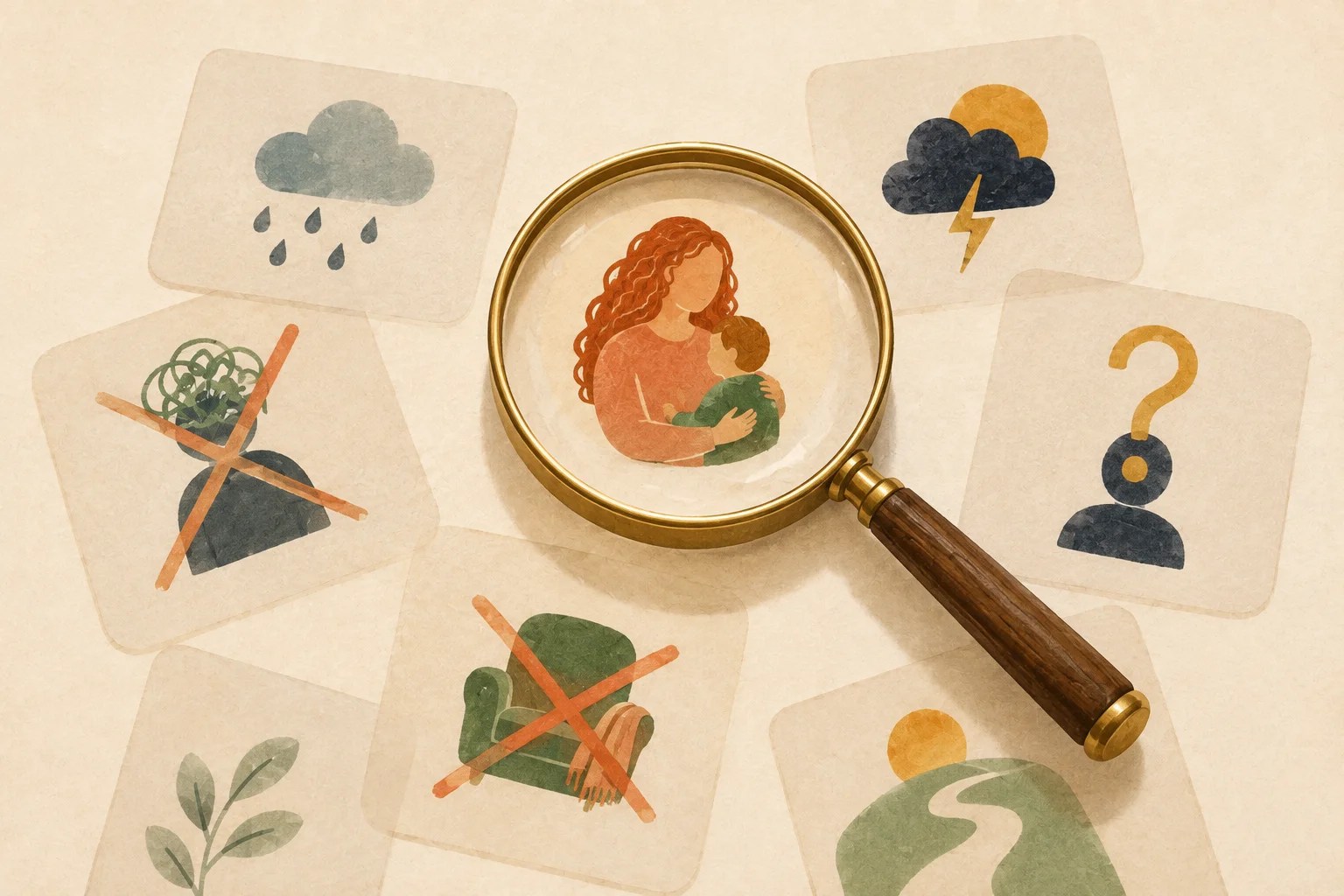
Because this topic is soaked in shame, a few honest boundaries matter more here than almost anywhere.
It doesn’t mean you’re a bad mother. A harder time with logistics and regulation is the predictable output of memory, novelty, and emotion-regulation differences — not a verdict on your character or your love. The research linking a parent’s ADHD to parenting describes small, changeable patterns,⁸ not a sentence. Naming the mechanism isn’t an excuse; it’s what lets you build around the difficulty instead of blaming yourself for it.
It doesn’t mean you’re neglecting your kids. A forgotten form and a lost library book are lapses of an overloaded working memory, not signs of a parent who isn’t paying attention to what matters. Present, loving parents with ADHD forget logistics; the two facts sit together comfortably.
It doesn’t mean you doomed your children. This is the heritability worry, and it deserves a straight answer. ADHD does run strongly in families — in one nationwide study, first-degree relatives of a person with ADHD were far more likely to have it themselves¹⁰ — so your children’s odds are higher than average. But higher odds are not destiny; heritability is a statistic about groups, not a guarantee about your child, and it says nothing about fault. There’s even an advantage hidden here: a child with ADHD whose parent understands it from the inside and caught it early won’t spend years being told they’re lazy. That’s not damage; that’s a head start.
It isn’t self-diagnosable. If you’re reading yourself in all of this, take it seriously — but a blog post can’t diagnose you. A validated ADHD screening tool for women can flag whether a professional assessment is worth pursuing, but a screen only estimates likelihood and never diagnoses.¹¹
When it’s more than ADHD
Parenting with ADHD is common, exhausting, and — for most mothers — not a sign of anything more than the wiring above. But two patterns are worth knowing, because they respond to different help, and telling them apart is a job for a professional.
The first is your own mental health. ADHD frequently travels with depression and anxiety; in a large national survey, adults with ADHD had markedly higher rates of mood and anxiety disorders than adults without it.¹² The postpartum and early-parenting years add their own risk — one systematic review put the combined prevalence of major and minor depression through pregnancy and the first postpartum year at up to roughly one in eight¹³ — and perinatal depression is real, common, and treatable. If your difficulty keeping up arrived suddenly, or comes wrapped in low mood, hopelessness, loss of interest, or a sense that your children would be better off without you, that can point toward depression rather than ADHD alone, and it’s worth reaching out about today. There’s more on telling the two apart in ADHD and depression; in the US you can call or text 988, the Suicide and Crisis Lifeline, any time, free and confidential.
The second is a reminder about your children. If you find yourself wondering whether one of them has ADHD too, that’s a conversation for their pediatrician or a qualified evaluator — not a diagnosis to make from the couch, however well you now know the pattern. Many things can look like ADHD in a child, and only a professional evaluation can tell.
What actually helps

You don’t parent well with ADHD by finally mustering the organization everyone says you lack — that framing is the thing that’s been failing you. You do it by changing the conditions so the three forces stop working against you. None of this cures ADHD or turns you into a different parent, and there’s no version of family life without hard days — but each move takes load off the systems that keep coming up short.
Move the household out of your head. If working memory is the bottleneck, stop storing the household in it: a shared calendar everyone can see, visible morning and bedtime checklists, a launch pad by the door, and a short rotation of automated routines (the same easy dinners, clothes set out the night before, standing reminders) so family life runs on structure in the room instead of your working memory.
Aim for good-enough-and-repair, not perfect. The most protective thing in parenting isn’t never losing your temper — it’s the repair after. “I was short with you, and that wasn’t your fault — I’m sorry” teaches a child more than a parent who never slips could. Trading flawless for good enough, then repair is the same all-or-nothing trap that catches so many ADHD adults, covered more fully in ADHD and perfectionism.
Regulate yourself first, then them. You can’t be the calm a child borrows while you’re past your own limit — that’s not a failing, it’s physics. A sixty-second reset before you respond — one slow breath, a hand on your chest — is a parenting skill, not selfishness. When the whole system is over capacity, that’s broader ADHD overwhelm, and stepping back to reset protects everyone in the room.
Share the load, out loud. With another adult, the executive function doesn’t have to live in one brain — name who tracks what, and ask directly for the pieces you keep dropping. Starting a dull task is also easier with someone present. If the division of labor itself is the friction, that’s a relationship conversation too — see ADHD and relationships.
Get support for your own ADHD — not only your child’s. Your brain is the one the whole household runs on, so resource it: therapy, coaching, an ADHD-informed clinician, or medication, all decided with a professional. One honest note — treating a mother’s ADHD reliably improves her own symptoms, but doesn’t automatically translate into better parenting; behavioral parenting support has the most consistent evidence for parenting itself.¹⁴ It’s worth doing anyway, because you deserve to feel less at war with your own brain. (And if you’re pregnant, trying to conceive, or breastfeeding, any medication decision belongs with your prescriber and OB — never a change to make from an article.)
7 ways to parent well with ADHD
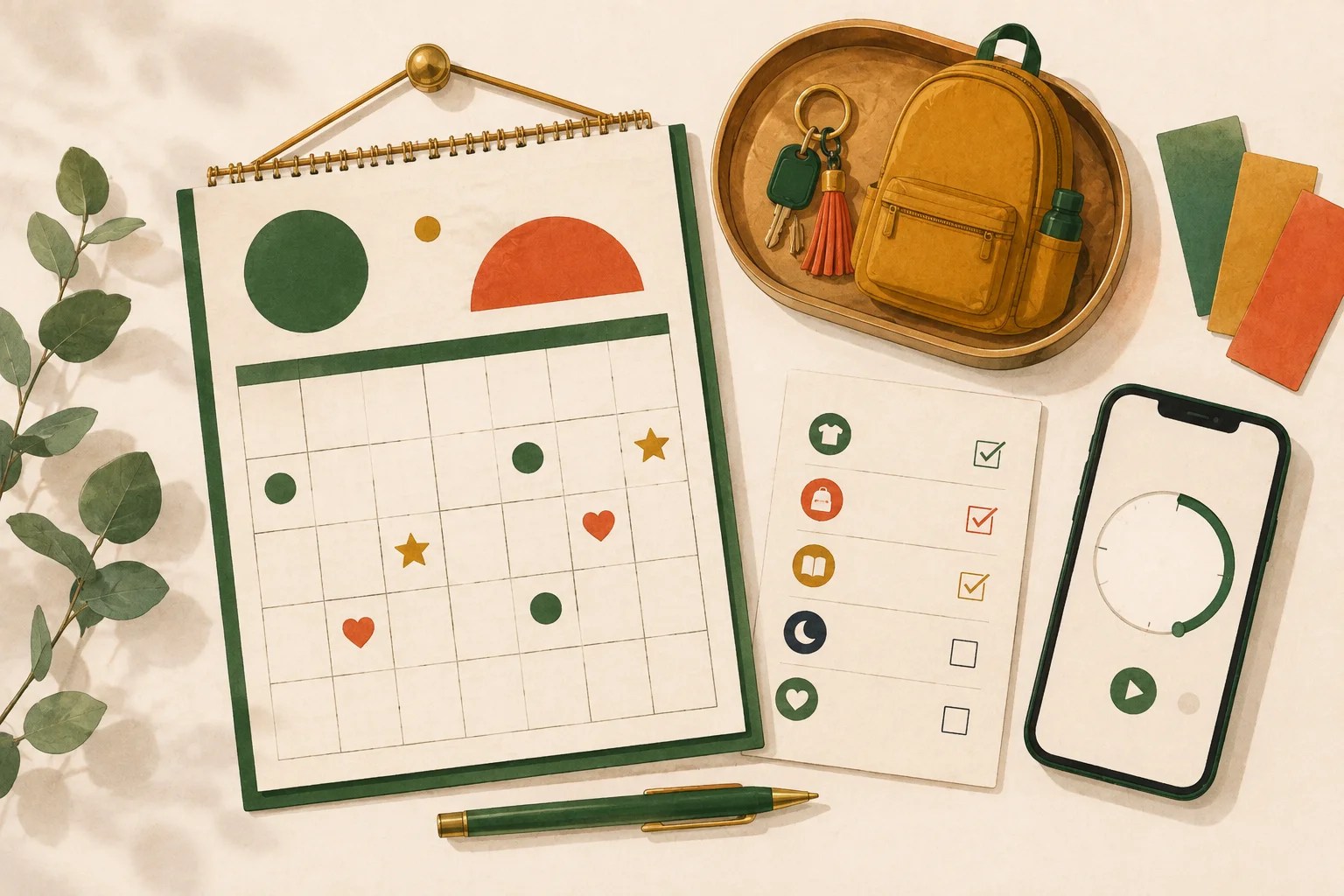
- Put the household on the wall, not in your head. Use a big shared calendar, visible morning and bedtime checklists, and a launch pad by the door so routines run on structure in the room instead of your working memory.
- Automate the daily decisions. A short rotation of easy dinners, clothes set out the night before, and standing reminders for recurring appointments shrink the constant decision load that drains an ADHD brain.
- Trade perfect for good-enough-and-repair. Aim to reconnect after a hard moment — “I was short with you, that wasn’t your fault, I’m sorry” — because the repair teaches more than never slipping would, and it’s reachable on a real day.
- Regulate yourself before you respond. A sixty-second reset — one slow breath, a hand on your chest — lets you be the calm your child borrows instead of matching their meltdown with your own.
- Externalize with a co-parent or ally. Name out loud who tracks what, ask directly for the pieces you keep dropping, and start dull tasks alongside another adult so the executive load isn’t carried by one brain.
- Get support for your own ADHD. Screening, therapy, coaching, or a clinician’s help is worthwhile in its own right — your brain is the one the whole family runs on, and you’re allowed to resource it.
- Drop the “bad mom” verdict. Name the mechanism out loud — “this is my ADHD, not my love for them” — because the shame is what drains the capacity parenting needs, and lowering it frees you to show up.
Frequently asked questions
What does “parenting with ADHD” mean?
It means raising children when you, the parent, have ADHD — as opposed to parenting a child who has it. Because ADHD affects attention, working memory, and self-regulation¹ — the faculties parenting leans on hardest — having it tends to make the logistics, routines, and emotional steadiness of family life more effortful. It’s common, since ADHD is highly heritable² and runs in families — many mothers only discover their own ADHD after a child is diagnosed.
Does having ADHD make me a bad mom?
No. A harder time with the mental load, routines, and staying regulated is the predictable result of documented brain differences, not a measure of your love or character. Research linking a parent’s ADHD symptoms to parenting finds some association with less consistent parenting, but the effects are small and correlational⁸ — changeable behaviors, not a doomed relationship. Believing you’re a bad mother actually makes things harder, because the shame drains the exact capacity parenting requires.
Will my child inherit my ADHD?
Your child’s odds are higher than average — ADHD runs strongly in families, and first-degree relatives of someone with ADHD are considerably more likely to have it too.¹⁰ But higher odds are not certainty, and heritability² is a statistic about groups, not a verdict on your child or a fault to carry. If your child does turn out to have ADHD, having a parent who understands it from the inside and can catch it early is a real advantage. Whether a particular child has ADHD is a question for their pediatrician or a qualified evaluator, not something to diagnose at home.
Why is keeping a routine so hard when I know it helps?
Because routines run on the exact skills ADHD disrupts: consistency (ADHD brains find repetition depleting and are pulled toward novelty), transitions (where attention snags), time awareness, and the working memory to hold the sequence in mind.⁴ ⁵ Knowing a routine helps doesn’t make running it easier, any more than knowing sleep helps lifts insomnia. The fix isn’t willpower — it’s making the routine visible and automatic so it leans less on the parts of your brain that come up short.
Is it ADHD, or am I depressed or burned out?
They can overlap, and telling them apart matters because they need different help. ADHD is lifelong and steady; if your ability to keep up dropped suddenly, or comes with low mood, hopelessness, loss of interest, or exhaustion sleep doesn’t touch, that can point toward depression — common in the parenting years and very treatable.¹² ¹³ A professional can sort out which. If you ever feel your children would be better off without you, treat that as a reason to reach out now; in the US you can call or text 988 any time.
Should I get treated for my own ADHD if I’m a parent?
It’s worth considering — for your sake, not only your children’s. Support can include therapy, coaching, an ADHD-informed clinician, or medication, all decided with a professional. One honest caveat: treating a parent’s ADHD reliably helps their own symptoms but doesn’t automatically improve parenting; behavioral parenting support has the most consistent evidence for that.¹⁴ It’s still worthwhile, because you deserve to feel less at odds with your own brain. If you’re pregnant, trying to conceive, or breastfeeding, any medication decision belongs with your prescriber and OB — never a change to make from something you read.
How do I stop losing my temper with my kids?
Start by understanding it, because the shame version doesn’t work. Emotion dysregulation is a core feature of adult ADHD,⁶ ⁷ so a child’s meltdown pushing you past your limit is two nervous systems dysregulating at once — not proof you’re uniquely bad at this. The practical moves: regulate yourself before you respond (a slow breath, a pause, a step out of the room), lower the daily load so you’re not already at your edge, and repair afterward. No approach makes anyone snap-proof; the goal is fewer hard moments and a reliable way back after the ones that happen.
And if your child’s diagnosis opened the door to your own, the sadness that can follow has a name and a guide — grieving a late ADHD diagnosis.
📚 The ADHD Library by Dr. Morgan Reed

If the forgotten forms, the 6 p.m. overwhelm, and the guilt that follows a hard moment keep cycling no matter how many organizing systems you try, You’re Not Broken: The 7-Week Executive Function Workbook for Late-Diagnosed ADHD Adults was written for exactly this kind of stretched. It’s seven weeks of practical, capacity-first systems for the machinery underneath the mental load — building external structure so the household stops living in your working memory, shrinking the daily decisions that drain you, and steadying your own regulation so you have more of yourself to give. The goal was never to shame you into finally being the “perfect” mom; it’s to hand your brain the external support that makes showing up, on a normal and imperfect day, genuinely possible.
★★★★★
Save this. You’ll want to come back to it.
- 📕 You’re Not Broken: The 7-Week Executive Function Workbook for Late-Diagnosed ADHD Adults — the flagship workbook for rebuilding after a late diagnosis
- 📗 ADHD Mastery for Adults: 3-in-1 — a daily coaching system for the executive-function load
- 📙 Executive Function Rescue — a nine-week program for overwhelm and emotional regulation
Part of The ADHD Library by Dr. Morgan Reed — practical, evidence-informed tools for late-diagnosed adults.
Medical disclaimer: This article is for educational purposes only and is not a substitute for professional medical, mental-health, or parenting advice, diagnosis, or treatment. ADHD can only be diagnosed by a qualified professional through a comprehensive evaluation — no article or screening tool can diagnose you or your child. Decisions about ADHD medication, especially during pregnancy or breastfeeding, should be made only with a qualified clinician. If your struggles are tied to low mood, hopelessness, or thoughts that your family would be better off without you, please reach out to a professional; in the US, you can call or text 988 (the Suicide and Crisis Lifeline) any time, free and confidential.
Written by Dr. Morgan Reed, specialist in ADHD and executive function. Last reviewed: August 2026.
References
- Faraone SV, Banaschewski T, Coghill D, et al. The World Federation of ADHD International Consensus Statement: 208 evidence-based conclusions about the disorder. Neuroscience & Biobehavioral Reviews. 2021;128:789–818. https://pubmed.ncbi.nlm.nih.gov/33549739/
- Faraone SV, Larsson H. Genetics of attention deficit hyperactivity disorder. Molecular Psychiatry. 2019;24(4):562–575. https://pubmed.ncbi.nlm.nih.gov/29892054/
- Quinn PO, Madhoo M. A review of attention-deficit/hyperactivity disorder in women and girls: uncovering this hidden diagnosis. The Primary Care Companion for CNS Disorders. 2014;16(3):PCC.13r01596. https://pubmed.ncbi.nlm.nih.gov/25317366/
- Willcutt EG, Doyle AE, Nigg JT, Faraone SV, Pennington BF. Validity of the executive function theory of attention-deficit/hyperactivity disorder: a meta-analytic review. Biological Psychiatry. 2005;57(11):1336–1346. https://pubmed.ncbi.nlm.nih.gov/15950006/
- Alderson RM, Kasper LJ, Hudec KL, Patros CHG. Attention-deficit/hyperactivity disorder (ADHD) and working memory in adults: a meta-analytic review. Neuropsychology. 2013;27(3):287–302. https://pubmed.ncbi.nlm.nih.gov/23688211/
- Beheshti A, Chavanon ML, Christiansen H. Emotion dysregulation in adults with attention deficit hyperactivity disorder: a meta-analysis. BMC Psychiatry. 2020;20(1):120. https://pmc.ncbi.nlm.nih.gov/articles/PMC7069054/
- Soler-Gutiérrez AM, Pérez-González JC, Mayas J. Evidence of emotion dysregulation as a core symptom of adult ADHD: a systematic review. PLoS One. 2023;18(1):e0280131. https://pubmed.ncbi.nlm.nih.gov/36608036/
- Park JL, Hudec KL, Johnston C. Parental ADHD symptoms and parenting behaviors: a meta-analytic review. Clinical Psychology Review. 2017;56:25–39. https://pubmed.ncbi.nlm.nih.gov/28601690/
- Perez Algorta G, Kragh CA, Arnold LE, et al. Maternal ADHD symptoms, personality, and parenting stress: differences between mothers of children with ADHD and mothers of comparison children. Journal of Attention Disorders. 2018;22(13):1266–1277. https://pubmed.ncbi.nlm.nih.gov/25525155/
- Chen MH, Pan TL, Huang KL, et al. Coaggregation of major psychiatric disorders in first-degree relatives of individuals with attention-deficit/hyperactivity disorder: a nationwide population-based study. Journal of Clinical Psychiatry. 2019;80(3):18m12371. https://pubmed.ncbi.nlm.nih.gov/31090279/
- Ustun B, Adler LA, Rudin C, et al. The World Health Organization adult attention-deficit/hyperactivity disorder self-report screening scale for DSM-5. JAMA Psychiatry. 2017;74(5):520–527. https://pubmed.ncbi.nlm.nih.gov/28384801/
- Kessler RC, Adler L, Barkley R, et al. The prevalence and correlates of adult ADHD in the United States: results from the National Comorbidity Survey Replication. American Journal of Psychiatry. 2006;163(4):716–723. https://pubmed.ncbi.nlm.nih.gov/16585449/
- Gavin NI, Gaynes BN, Lohr KN, Meltzer-Brody S, Gartlehner G, Swinson T. Perinatal depression: a systematic review of prevalence and incidence. Obstetrics & Gynecology. 2005;106(5 Pt 1):1071–1083. https://pubmed.ncbi.nlm.nih.gov/16260528/
- Chronis-Tuscano A, French W, Strickland J, Sasser T, Schoenfelder Gonzalez EN, Whitlock KB, Stein MA. Acute effects of parent stimulant medication versus behavioral parent training on mothers’ ADHD, parenting behavior, and at-risk children. Journal of Clinical Psychiatry. 2020;81(5):19m13173. https://pubmed.ncbi.nlm.nih.gov/32926603/
As an Amazon Associate, I earn from qualifying purchases — at no extra cost to you. Full disclosure.