

23 min read
TL;DR — Quick Answer: Job interviews are hard with ADHD for a specific, mechanical reason: they demand live verbal recall under social evaluation — exactly the surfaces where adult ADHD testing shows the most consistent differences — while you also run the background program of looking composed. Call it the Retrieval Gap: the distance between what you know and what you can pull up on command in that room. You cannot train it away in a week, but you can build around it: externalized prep (a story matrix, scripts, notes), formats you can predict, and a plan for the days after. One honest note up front: no study has ever measured ADHD and interview outcomes directly — and the largest real-world study of interview anxiety to date found its effect on ratings is far smaller than it feels.
The interview version of you is not the work version of you
You can do the job. That part is usually not in question — you have done harder things than this job under worse conditions, unpaid, while managing a brain that bills you for everything twice.
But the room changes you. Somewhere between “tell me about yourself” and “where do you see yourself in five years,” the person who actually knows things is replaced by someone scanning three answers at once, losing the middle of her own sentence, and watching the interviewer’s face for signs of the verdict. You leave, and the perfect answers arrive in the parking lot.
If that is familiar, this article is for you. It covers what is actually happening in that room, the disclosure question everyone asks and nobody answers honestly, the accommodation trade-off almost nobody mentions, and a preparation system built for how your memory actually works — not the one interview advice assumes you have.
This is the interview-stage companion to our guide to ADHD and career fit. What happens after you’re hired — telling your boss and workplace accommodations — has its own guides, because those are different decisions with different rules.
The Retrieval Gap: why interviews tax exactly what ADHD taxes
Definition Box — The Retrieval Gap: the distance between what you know and what you can retrieve out loud, on command, while being evaluated. A job interview is not a test of whether you can do the job. It is a test of live retrieval under observation — a format that happens to lean on the narrow set of cognitive surfaces where adult ADHD shows up most consistently.
Three findings, none of them about interviews, together explain the parking-lot phenomenon.
First: when researchers pooled 24 studies of neuropsychological testing in adults with ADHD, the measures that best separated ADHD from non-ADHD adults were not exotic. They were verbal memory and complex attention — holding spoken material and managing competing streams.¹ Notably, that same meta-analysis found executive functions were not uniformly reduced in adults with ADHD — so this is not “your brain is globally impaired.” It is: the specific things an interview demands are the specific things that test hardest.¹
Second: a meta-analysis of 38 studies found that working memory differences in ADHD persist into adulthood, at moderate size, in both verbal and visuospatial forms.² Working memory is the mental desk where you assemble an answer while tracking the question, the follow-up you anticipate, and your own last sentence. An interview asks you to do that assembly live, with no notes, for an hour.
Third — and this is the one that should retire your shame: in a study of 23 healthy volunteers with no ADHD at all, acute social-evaluative stress impaired verbal recall, attention, and spatial working memory, and the recall deficit kept declining even after a rest period.³ Being evaluated by strangers degrades retrieval in people whose retrieval was never fragile. The interview format is a memory stressor by design. ADHD just means you walk in with less margin.

An honest note before we go further: there is no published study measuring ADHD and job-interview outcomes — not interview ratings, not offer rates, not rejection rates. Everything in this article is inference from adjacent research: memory testing, stress studies, interview-anxiety research in general populations, and disability-hiring experiments. That inference is reasonable, and I will show you the seams. But nobody can honestly tell you “studies show ADHD candidates interview worse,” because no such study exists.
The second job in the room: masking
While the retrieval system runs on overdraft, most late-diagnosed women are also running a second program: monitoring posture, eye contact, enthusiasm level, whether that last answer rambled — the full performance of composure. If you’ve read our guide to ADHD masking, you know this program well. An interview is masking’s championship round.
The research here is younger than the lived experience. A 2024 study comparing 105 adults with ADHD to matched comparison adults found the ADHD group reported more camouflaging than non-diagnosed adults — evidence that masking is not exclusive to autism — though less than autistic adults, and with an important caveat: the questionnaire used was built to measure camouflaging of autistic traits, and there is not yet a validated instrument for ADHD masking specifically — indeed, in that study it was autism traits, not ADHD traits, that predicted how much a person camouflaged.⁴ So no one can tell you what percentage of ADHD women mask in interviews. The number does not exist.
What does exist: a consensus statement from clinicians specializing in female ADHD names compensatory strategies that mask symptoms as a specific reason women’s ADHD goes unrecognized — the better you perform “fine,” the longer you go unseen.⁵ And in one small qualitative study — five undergraduate students, so treat it as testimony, not statistics — participants with ADHD described masking as their response to feeling rejected, and described its cost as withdrawal and losing track of themselves.⁶
Here is what I will not tell you: to unmask in interviews. Later in this article you will see a field experiment showing that disability disclosure measurably reduced employer interest. In a hiring market where that is true, masking is not a character flaw — it is a rational strategy with a real cost. You get to decide, per room, whether the cost is worth paying. That is a budgeting decision, not a moral one.

What interview anxiety actually does (less than it feels like)
Interview anxiety deserves its own paragraph, because the research says something genuinely useful — and more forgiving than your after-midnight replay suggests.
Researchers who built the standard measure of interview anxiety found it is not one feeling but five: worry about communication, about appearance, about the social dynamics, about performance, and about behaving oddly.⁷ In their field sample of real applicants, here is the part worth reading twice: candidates’ own felt anxiety was only weakly related to the ratings interviewers gave them. What tracked strongly with lower ratings was anxiety the interviewer perceived — visible signals, not internal weather.⁷ (One caveat the authors themselves raise: the same interviewer rated both the anxiety and the performance, so that link may partly be one impression echoing itself.)
Then in 2021, the largest field study of interview anxiety to date — 8,343 real applicants in real high-stakes virtual interviews across 373 companies and 93 countries, during the first COVID year — found that anxiety was negatively related to performance ratings, and related more strongly to how unfair the process felt to candidates.⁸ Two caveats that study earns: these were virtual, pandemic-era interviews, and the effect on ratings — though statistically significant in a very large sample — was small.
Read those together and the message is: your anxiety is almost certainly not why you didn’t get the job. It feels enormous from the inside; from the rating sheet, it barely registers — and what registers at all is the visible portion, which is exactly the part preparation can shrink. That is not a demand to perform calm. It is permission to stop auditing every flutter as a fatal error.
One boundary, stated plainly: if anxiety around interviews is severe, persistent, and driving you to avoid applying at all, that pattern deserves assessment in its own right — see our guide to ADHD and anxiety, and talk to a professional rather than treating it with preparation tips.

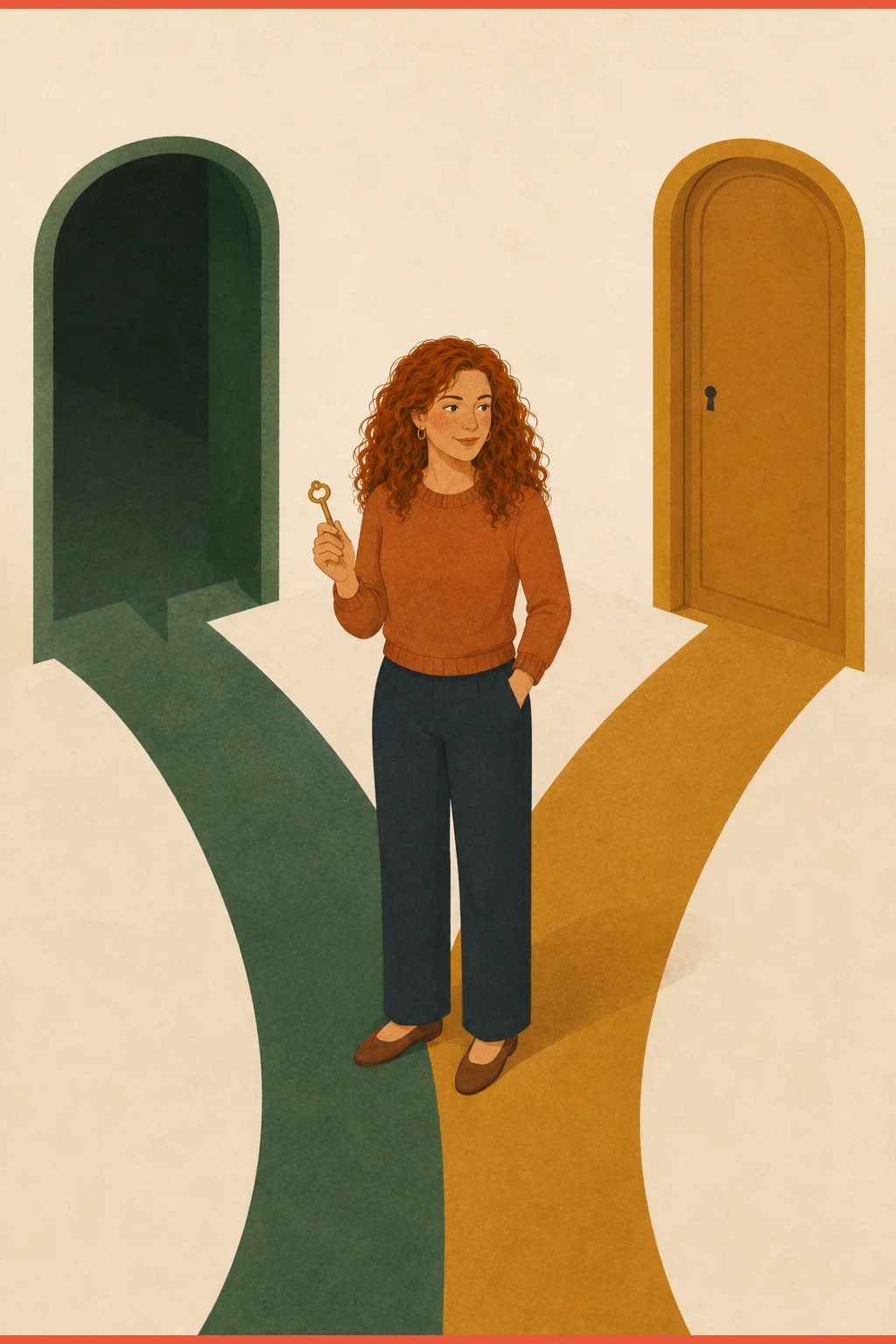
Should you disclose ADHD in a job interview?
The honest answer — the one the Job Accommodation Network itself gives — is that there is no single right or wrong approach to disclosing a disability, and the timing is yours to choose.¹¹ Anyone who tells you “always disclose, employers value transparency” or “never disclose, it’s career suicide” is selling a rule where the evidence supports a decision.
Here is what is actually known.
The law (US, pre-offer). Before a conditional job offer, an employer generally cannot ask whether you have a disability, cannot ask about the nature or severity of a condition, and cannot require a medical exam.¹⁰ They can ask whether you can perform specific job functions, with or without accommodation.¹² After a conditional offer, the rules change substantially — medical questions become permissible if asked of all individuals selected for the same job.¹⁰ This is US federal law; state rules vary, and readers outside the US are under different frameworks entirely.
The evidence. The strongest data we have is a field experiment that sent 6,016 applications to accounting positions. Cover letters that disclosed a disability — spinal cord injury or Asperger’s syndrome, not ADHD — received 26% fewer expressions of employer interest, with the gap concentrated at small firms not covered by the ADA.⁹ That study is about written disclosure at the application stage, for different conditions, in one industry — it cannot tell you what happens when you mention ADHD in your interview. But it is enough to retire the idea that disclosure is automatically safe, and enough to justify the caution you already feel.
The strategic frame. Because pre-offer medical questions are largely off-limits, the pre-offer stage is when you hold the most information asymmetry you will ever have in this process. Disclosure before an offer is a one-way door — you cannot un-tell them. Waiting costs you little legally in most private-sector hiring — protections that depend on the employer knowing begin whenever you do disclose — though you cannot be accommodated for something you have not disclosed, and some routes (such as the US federal Schedule A hiring authority) require documentation up front. And that conversation usually goes better after you’re in the role, when it can be about specific supports rather than abstract impressions.
Not legal advice — a genuine dispute needs an employment attorney or JAN’s free, confidential helpline (800-526-7234). But as a decision frame: disclose when it buys you something concrete (usually an accommodation you need for the process itself), and know the price before you pay it. Which brings us to the trade-off almost no one mentions.
The accommodation trade-off nobody tells you about
You can ask for accommodations for the interview itself — extra time on an assessment, questions in writing, a quieter room, an interview earlier in the day. For some candidates that materially levels the field. Two limits first: the ADA generally covers private employers with 15 or more employees, and ADHD is not automatically a covered disability — coverage is decided case by case on whether it substantially limits a major life activity.¹⁵
But know the mechanic before you use it: under US rules, when you request an accommodation and the need for it is not obvious, the employer may lawfully ask you for reasonable medical documentation — a note from a healthcare provider describing the disability, your limitations, and why the accommodation is needed.¹² Requesting an interview accommodation is one of the few pre-offer moments where medical questions become permitted. It is a disclosure, with paperwork.
That does not make it wrong. It makes it a trade: you exchange some information asymmetry for a process you can actually perform in. For a timed assessment your working memory will sabotage, that trade may be clearly worth it. For a mild preference, maybe not. Decide deliberately, not reflexively.
Worth knowing, too, what a well-trained interviewer can always safely do if you disclose mid-conversation: acknowledge it and ask one narrow question — essentially, “is there anything you need in order to participate in the interview or perform the job tasks?” — and stop there, without probing your diagnosis, severity, or history.¹² Knowing that script tells you immediately when a line is being crossed. (In-role accommodations after you’re hired are a different process with better leverage — the workplace-accommodations guide covers that.)

A preparation system for the Retrieval Gap
Standard interview advice says “prepare answers.” For an ADHD brain that is like saying “remember better” — it names the outcome and skips the mechanism. The system below has one design principle, backed by the training literature: externalize memory, don’t try to upgrade it. (Working-memory training, tested across 23 studies — mostly in children and non-ADHD samples — produces gains on the trained tasks that fade, and no convincing transfer to anything else¹³ — so we build shelves instead.)
- Build a six-story matrix — on paper, before anything else. Mine the job posting for its six most-repeated demands. For each, write one real story from your history in four lines: situation, task, action, result. This is the classic STAR format, chosen here for a mechanical reason: it converts open-ended retrieval (“tell me about a challenge”) into reading from a shelf you stocked in advance. Six stories cover a remarkable share of what any interviewer asks.
- Prepare for the two question archetypes that structured interviews use. US federal hiring guidance reports that interviews with higher degrees of structure show higher validity, higher rater reliability and agreement, and less adverse impact — and it describes two core question types: behavioral (“tell me about a time you…”) and situational (“what would you do if…”).⁹ᵃ Your story matrix answers the first type. For the second, prepare a one-line method statement per job demand (“how I triage competing deadlines is…”). To be clear, no study has tested whether structured interviews are fairer to ADHD candidates specifically — but predictable formats are preparable formats, and preparable is what your memory needs.
- Bring the external memory into the room. A slim notes page — your six story titles, three questions to ask them, your closing line — is acceptable in most interviews and invisible in virtual ones. You are not memorizing content; you are carrying an index. Glancing at a page titled “warehouse migration story” is enough to unlock the whole file.
- Script the three transitions your working memory drops. The opener (“tell me about yourself” — 90 seconds, written, rehearsed aloud), the recovery line (“that’s a good question — give me a moment to pick the right example,” which converts a blank into composure), and the closer (two questions for them + one sentence of interest). These are the moments where live assembly fails hardest; scripts remove assembly entirely.
- Rehearse out loud, on camera, twice. Not to judge yourself — to shrink the visible signals of nerves, because the research says interviewer-perceived anxiety is what tracks with ratings, far more than felt anxiety.⁷ Watch the recording once for content, once for pace. Two passes is enough; by the tenth it stops being rehearsal and starts being rumination.
- Engineer the logistics like the appointment is hostile. Interview earlier in the day if offered. Build a 30-minute arrival buffer (or a 15-minute tech check for virtual). Lay out clothes the night before. Eat protein. None of this is novel; all of it removes loads from the same working memory you need in the room. One boundary: decisions about medication around interviews belong to you and your prescriber — nothing here is medication advice.
- Write the post-interview protocol before the interview. Decide in advance what happens after: a walk, a debrief note (three things that went fine, one thing to adjust), and a rule that you do not interpret silence for at least a week. This step exists because the hardest part of interviewing with ADHD is often not the hour — it is the replay loop and the wait. That gets its own section, because it deserves one.

After the interview: the replay, the wait, the no
Adults with ADHD show measurably higher emotion dysregulation than adults without — a meta-analysis of 13 studies found a large effect, with emotional lability the strongest facet.¹⁴ In practice, that is the 2 a.m. replay of one clumsy answer, the physical flinch at the rejection email, the week of refreshing your inbox like it owes you money.
So plan for the aftermath as part of the interview, not as a character test you keep failing. The debrief note from step 7 matters because it converts a feelings-loop into a document — closed, external, finished. The one-week no-interpretation rule matters because hiring timelines are noise, not verdicts.
And when a no comes, two facts are worth keeping within reach. First: in the largest field study of interview anxiety to date, anxiety moved actual ratings very little⁸ — your nerves almost certainly did not sink it. Second: the disability-hiring field experiment found measurable employer bias at the paper stage, before anyone met anyone.⁹ Rejections are generated by a process full of factors that have nothing to do with your competence — fit guesses, internal candidates, budget freezes, bias. A no is information about one room on one day. It was never a referendum on whether you should have a career.
If the aftermath stops being a rough week and becomes a shutdown — you cannot make yourself apply anymore, the self-talk turns cruel, the crash lingers — that is not a preparation problem. Our guide to the ADHD crash covers recovery, and if things get darker than that, the 988 Suicide & Crisis Lifeline (call or text 988) is there — reaching out is a competence, not a defeat.

Frequently asked questions
Should I tell them I have ADHD in the interview?
There is no evidence-backed universal answer — the Job Accommodation Network’s own guidance is that there is no right or wrong approach and the timing is yours.¹¹ The practical frame: before an offer, employers mostly cannot ask, so you hold the information. Disclose pre-offer when it buys you something concrete (usually a process accommodation), and know that requesting one can lawfully trigger a documentation request.¹² Many people find the conversation works better after hire, tied to specific supports.
Can an interviewer legally ask if I have ADHD?
In the US, generally no — before a conditional job offer, employers cannot ask disability-related questions or require medical exams. They can ask whether you are able to perform specific job functions. After a conditional offer, medical questions become permissible if asked of all individuals selected for the same job.¹⁰ State laws vary; other countries differ.
Can I get accommodations for the interview itself?
Yes — extra assessment time, written questions, a quieter room, and similar process adjustments are legitimate requests. The trade-off: when the need is not obvious, the employer may lawfully ask for medical documentation supporting the request.¹² Weigh what the accommodation buys you against the disclosure it entails.
Why do I blank on questions I know the answers to?
Because interviews demand live verbal retrieval under social evaluation — and evaluative stress measurably impairs recall and working memory even in people without ADHD,³ while adult ADHD testing shows its most consistent differences precisely in verbal memory, complex attention,¹ and working memory.² That is the Retrieval Gap. The fix is not trying harder to remember; it is externalizing memory — story matrices, notes, scripts — so less depends on live assembly.
Is ADHD covered by the ADA when I’m applying for jobs?
Sometimes — coverage is individualized. The ADA has no list of automatically qualifying conditions; what matters is whether your condition substantially limits major life activities, assessed case by case.¹⁵ Do not assume automatic protection, and for a live dispute, contact JAN (800-526-7234, free and confidential) or an employment attorney.
Are structured interviews better for ADHD candidates?
Nobody has studied that specifically — claims that they are “ADHD-friendly” outrun the evidence. What is documented: structured interviews are more valid and reliable in general and use predictable question archetypes.⁹ᵃ Predictable is preparable, which suits an externalized-memory strategy. Treat that as a useful inference, not a finding.
How do I stop replaying the interview for days afterward?
Build the exit before you enter: a written debrief (three fines, one adjustment), a physical decompression, and a no-interpreting-silence rule with a date on it. The replay loop runs on emotion dysregulation that is measurably stronger in ADHD¹⁴ — externalizing the debrief gives the loop a place to end. If the loop regularly becomes a multi-day spiral, that is worth bringing to a professional.
And if the job you land is remote or hybrid, ADHD and working from home shows how to set up the structure the office would have given you.
📚 The ADHD Library by Dr. Morgan Reed

If the Retrieval Gap follows you out of interviews and into deadlines, mornings, and half-finished plans, You’re Not Broken: The 7-Week Executive Function Workbook for Late-Diagnosed ADHD Adults was written for exactly this kind of stuck. It’s seven weeks of practical, capacity-first systems for the machinery this article describes — externalizing memory so less depends on live recall, scripting the transitions that fall apart under pressure, and steadying the aftermath so one hard hour doesn’t cost you a week. The goal was never to make you perform better for other people. It’s to hand your brain the structure that lets what you actually know finally show up in the room.
★★★★★
Save this. You’ll want to come back to it.
- 📕 You’re Not Broken: The 7-Week Executive Function Workbook for Late-Diagnosed ADHD Adults — the flagship workbook for rebuilding your systems after a late diagnosis
- 📗 ADHD Mastery for Adults: 3-in-1 — a daily coaching system for the executive-function load
- 📙 Executive Function Rescue — a nine-week program for overwhelm and emotional regulation
Part of The ADHD Library by Dr. Morgan Reed — practical, evidence-informed tools for late-diagnosed adults.
References
1. Schoechlin C, Engel RR. Neuropsychological performance in adult attention-deficit hyperactivity disorder: meta-analysis of empirical data. Archives of Clinical Neuropsychology. 2005;20(6):727-744. PMID: 15953706
2. Alderson RM, Kasper LJ, Hudec KL, Patros CH. Attention-deficit/hyperactivity disorder (ADHD) and working memory in adults: a meta-analytic review. Neuropsychology. 2013;27(3):287-302. PMID: 23688211
3. Olver JS, Pinney M, Maruff P, Norman TR. Impairments of spatial working memory and attention following acute psychosocial stress. Stress and Health. 2015;31(2):115-123. PMID: 24395182
4. van der Putten WJ, et al. Is camouflaging unique for autism? A comparison of camouflaging between adults with autism and ADHD. Autism Research. 2024;17(4):812-823. PMID: 38323512
5. Young S, et al. Females with ADHD: An expert consensus statement taking a lifespan approach providing guidance for the identification and treatment of attention-deficit/hyperactivity disorder in girls and women. BMC Psychiatry. 2020;20(1):404. PMID: 32787804
6. Rowney-Smith A, Sutton B, Quadt L, Eccles JA. The lived experience of rejection sensitivity in ADHD — a qualitative exploration. PLoS One. 2026;21(1):e0314669. PMID: 41564005 (five-participant qualitative study; correction: PLoS One. 2026;21(3):e0345112)
7. McCarthy J, Goffin R. Measuring job interview anxiety: beyond weak knees and sweaty palms. Personnel Psychology. 2004;57(3):607-637.
8. McCarthy JM, Truxillo DM, Bauer TN, et al. Distressed and distracted by COVID-19 during high-stakes virtual interviews: the role of job interview anxiety on performance and reactions. Journal of Applied Psychology. 2021;106(8):1103-1117. PMID: 34423997
9. Ameri M, Schur L, Adya M, Bentley FS, McKay P, Kruse D. The disability employment puzzle: a field experiment on employer hiring behavior. ILR Review. 2018;71(2):329-364.
9a. U.S. Office of Personnel Management. Structured Interviews (Assessment & Selection: Other Assessment Methods). https://www.opm.gov/policy-data-oversight/assessment-and-selection/other-assessment-methods/structured-interviews/
10. U.S. Equal Employment Opportunity Commission. Pre-Employment Inquiries and Disability. https://www.eeoc.gov/pre-employment-inquiries-and-disability
11. Job Accommodation Network. Disability Disclosure. https://askjan.org/topics/Disability-Disclosure.cfm
12. Job Accommodation Network. Job Application/Interview Stage Dos and Don’ts. https://askjan.org/articles/Job-Application-Interview-Stage-Dos-and-Donts.cfm
13. Melby-Lervåg M, Hulme C. Is working memory training effective? A meta-analytic review. Developmental Psychology. 2013;49(2):270-291. PMID: 22612437
14. Beheshti A, Chavanon ML, Christiansen H. Emotion dysregulation in adults with attention deficit hyperactivity disorder: a meta-analysis. BMC Psychiatry. 2020;20(1):120. PMID: 32164655
15. Job Accommodation Network. Attention Deficit/Hyperactivity Disorder (ADHD). https://askjan.org/disabilities/Attention-Deficit-Hyperactivity-Disorder-AD-HD.cfm
This article is for general information only and is not medical, legal, or career advice. Employment law described here is US federal law; state laws vary and other countries have different frameworks — for a specific situation, contact the Job Accommodation Network (free and confidential, 800-526-7234) or an employment attorney. ADHD assessment and treatment decisions, including any medication questions, belong with your healthcare provider. If you are struggling emotionally, the 988 Suicide & Crisis Lifeline (call or text 988) is available 24/7.
Written by Dr. Morgan Reed, specialist in ADHD and executive function. Last reviewed: August 2026.
As an Amazon Associate, I earn from qualifying purchases — at no extra cost to you. Full disclosure.