

24 min read
TL;DR — Quick Answer: Remote work can feel harder than office work for a mechanical reason, not a discipline one: an office quietly supplies a lot of the structure your executive function was leaning on — other people in the room, a physical line between “work” and “home,” a commute that starts and stops the day, and the ambient accountability of being seen. Take all that away at once and the systems that held together at a desk can come apart at a kitchen table. Call it the Invisible Scaffolding: the support you didn’t know you were standing on until it was gone. The honest truth is that almost no research directly compares ADHD outcomes at home versus in an office, so nobody can tell you remote work is simply better or worse for your brain. What we can do is name each support the office was giving you for free — and rebuild it on purpose.
The office was doing more than you thought
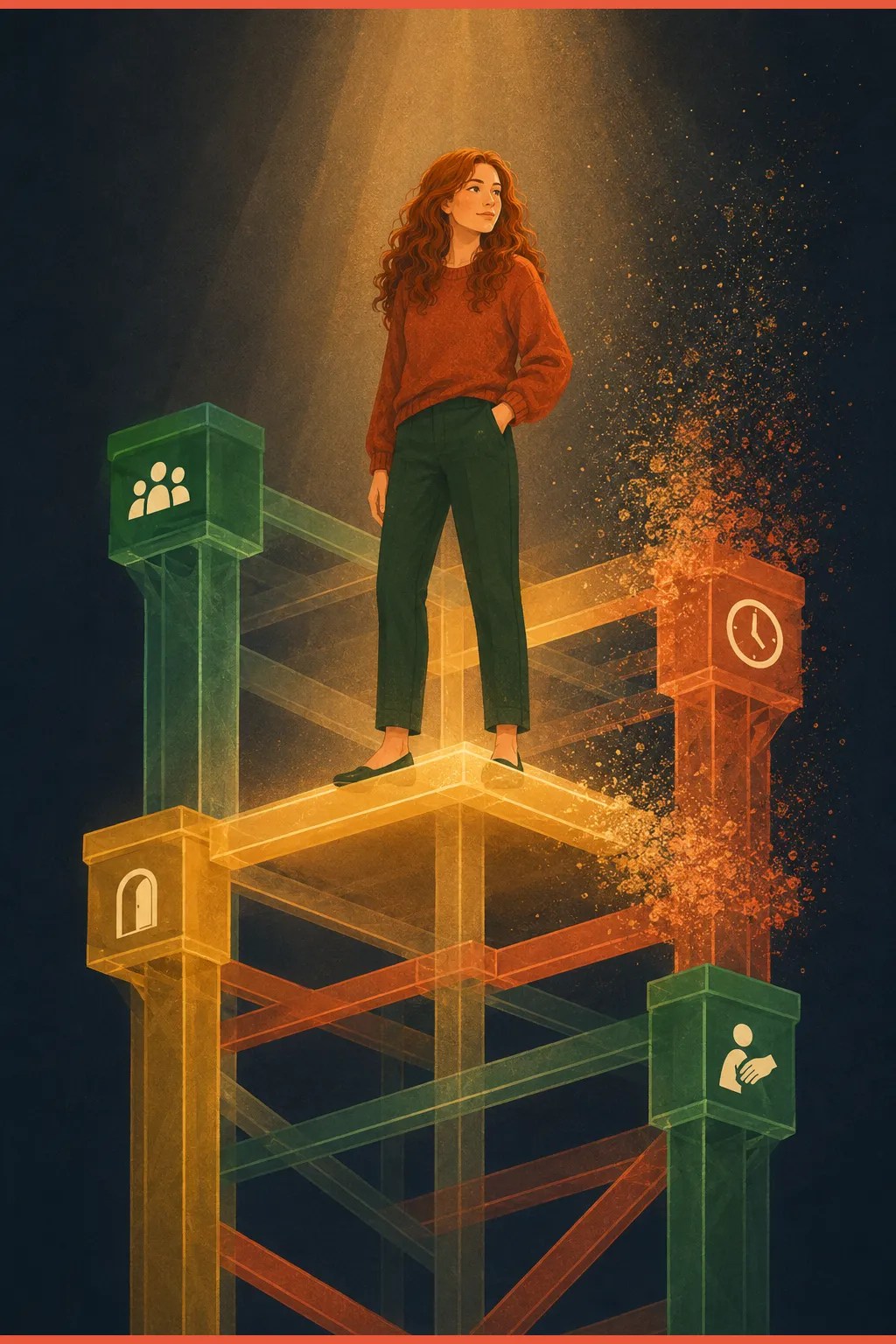
Here is the reframe that changes everything: the version of you that functioned in an office was not more disciplined than the version at home. She was being held up by a building.
The building woke you with a commute. It sat you in a room where other people were also working, so starting felt less optional. It drew a hard line between the place where you worked and the place where you rested, so your brain knew which mode it was in. It gave the day a shape — meetings you didn’t schedule, a lunch rush, the visible exodus at five that told your nervous system the day was over. None of that ran on your willpower. It ran on the environment, in the background, for free.
Then you started working from home, and every one of those supports vanished on the same Monday. If the transition felt like your competence quietly leaked out of you, it didn’t. The scaffolding came down. This article is about seeing each piece that was removed — and putting it back, deliberately, in a form you control.
This is the work-from-home companion to our guide to ADHD and career fit. It is not about whether to work remotely, and it is not the guide to requesting remote work as a formal accommodation — that process has its own rules and its own article. This is about the design problem underneath: how to build a day that holds when the office isn’t holding it for you.
The Invisible Scaffolding: what an office supplies for free
Definition Box — The Invisible Scaffolding: the external structure an office quietly provides for your executive function — other people’s presence, the spatial split between work and home, the commute’s start-and-stop boundaries, and the ambient accountability and rhythm of a shared space. Remote work removes this scaffolding all at once, so systems that held together at the office can come apart at home. The remedy is not more willpower; it is rebuilding each removed support deliberately, in a version you design.
To see why the loss hits ADHD specifically, it helps to name what executive function actually is. In the model most clinicians work from, the whole developmental job of executive function is to move regulation from outside you to inside you — from acting on the visible, present, and external to acting on the mental, future, and internal.¹ ADHD is described in the same tradition less as not knowing what to do and more as a gap at the point of performance — the moment and place where you have to do the known thing.² An office is a machine for closing that gap: it keeps the cues external, present, and visible, which is exactly the register an ADHD brain performs best in. Home, by default, asks you to hold all of it internally.
Three ordinary features of an office turn out to be doing quiet cognitive labor:
Other people. Their presence is a low-grade activation signal — the reason it is easier to start a task at a shared table than an empty one. Remove them and the starting energy has to come entirely from inside, where working-memory differences in adults with ADHD — documented across studies at moderate magnitude, in both verbal and visual forms — make internal self-cueing genuinely harder to sustain.³
A shape for time. Offices externalize time. Meetings, a lunch rush, the sound of people packing up — these are ambient clocks. That matters because timing and time-estimation run unevenly in ADHD across the research, so an environment that tells you what time it is without your having to track it is doing you a favor you never noticed.⁴ At home, time goes smooth and featureless, and three hours disappear.
A place that means one thing. Behavior is cued by stable context; habits are, in large part, responses that fire because the surroundings that triggered them are present.⁵ The office was a single, consistent cue that meant “work.” And when the usual context changes, the habits attached to it are the first thing to break — which is precisely what the research on disrupted routines predicts, and precisely what a whole life moving into one room delivers.⁶
One honesty note before we build: the Invisible Scaffolding is a framework, not a proven law. No study has shown that “removing office structure causes ADHD systems to collapse.” It is assembled from research on how habits are cued, how executive function externalizes, and how people recover from work — applied to the specific situation of a brain that leans hard on external structure losing it all at once. It fits the lived experience well. Treat it as a useful map, not a measured fact.
The trade nobody names: what you lost, what you gained
Most takes on ADHD and remote work pick a side — it’s a dream, or it’s a disaster. The honest position is that it is a trade, and pretending otherwise is where people get hurt.
Start with what almost nobody says out loud: there is very little research directly on ADHD and remote work, and what exists is small, mixed, and mostly self-report. So if anyone tells you working from home is definitively better for the ADHD brain — or definitively worse — they are reaching past the evidence. Nobody has run the study that would earn that sentence.
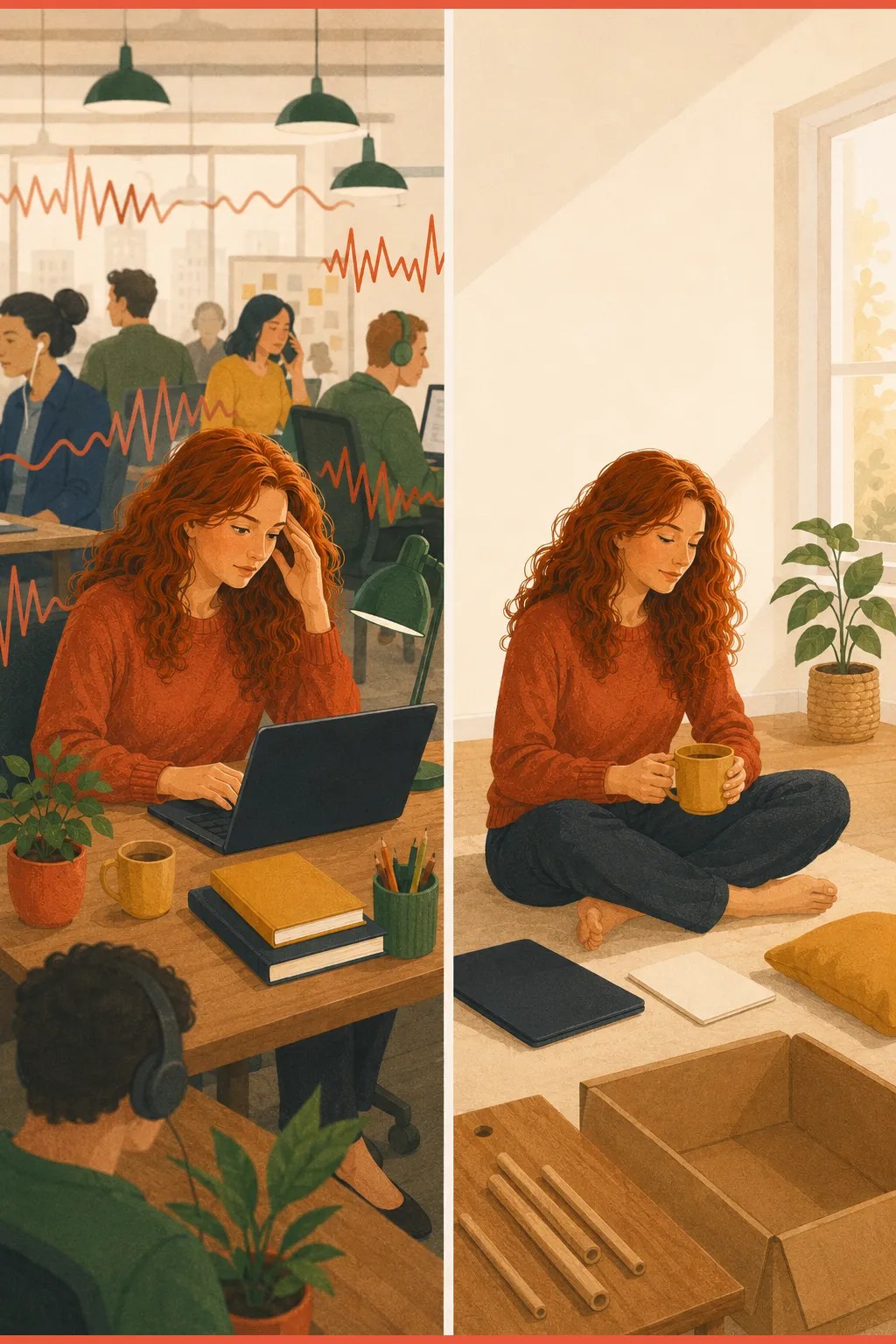
What we can say is what each arrangement gives and takes. The office gave you structure and took your control over the environment. Open-plan offices, in particular, impose a real cost: irrelevant background speech measurably degrades the kind of memory-dependent, concentration-heavy work that many jobs are made of.⁷ If you spent years unable to think through the sound of someone else’s phone call, that was not fragility. That was a documented effect landing on a brain that may have less filter to spare.
Remote work runs the trade in reverse. It takes away the structure — and hands you the one thing the office never could: authority over your own sensory world. You can make it quiet, or add the specific noise you actually focus in. You can move when you need to move. You can dim the lights that drilled into your skull. For some people with ADHD — and this varies enormously from person to person — that control is not a luxury; it is the difference between a workable day and an unworkable one.
So the goal is not to decide whether remote work is “good for ADHD.” The goal is to keep the gain you were handed — control of your environment — while rebuilding the structure you lost. That is the whole project.
Body doubling: the borrowed brain, and what it can’t do
If you have spent any time in ADHD spaces, you have heard of body doubling — working alongside another person whose only job is to be present while you do your task. At home, where the activating presence of coworkers is gone, it is the single most-recommended fix. It deserves an honest section, because the honest version is more useful than the hype.
First, what it is: a strategy widely used and taught in the ADHD community — by coaches, by organizations like ADDitude — for making a task easier to start and stay in by borrowing someone else’s presence.⁹ People run it in person, over a video call left open, or through structured virtual coworking sessions with a stranger.
Now the part most articles skip: body doubling has not been tested in controlled ADHD trials. There is no study showing it works, how well, or for whom. That does not mean it’s fake — plenty of people find it genuinely helps — it means we should call it what it is: a popular practice with a plausible mechanism, not an evidence-based treatment.
The closest science we do have is social facilitation — a century of research on how the mere presence of another person changes performance. Its finding is specific and double-edged: another person’s presence tends to sharpen simple, well-learned tasks and can actually impair complex, novel ones.¹⁰ And even where it helps, the effect is modest — a meta-analysis of 241 studies found presence explains only a small slice of how well people perform.¹¹
Read those together and you get real guidance, not just encouragement. Use a body double for the work that is known but hard to start — the inbox, the expense report, the folding, the form. That is exactly where a bit of presence-driven momentum helps. Do not count on it for your most cognitively demanding, unfamiliar thinking — the deep first draft, the problem you’ve never solved — where another person’s presence may quietly cost you. Borrowed presence is a starter motor, not a thinking aid.

A design system for the missing scaffold
Everything above points to one move: stop trying to feel more disciplined and start rebuilding each support the office removed — in a form you control. Here is the system, one rebuilt beam at a time.
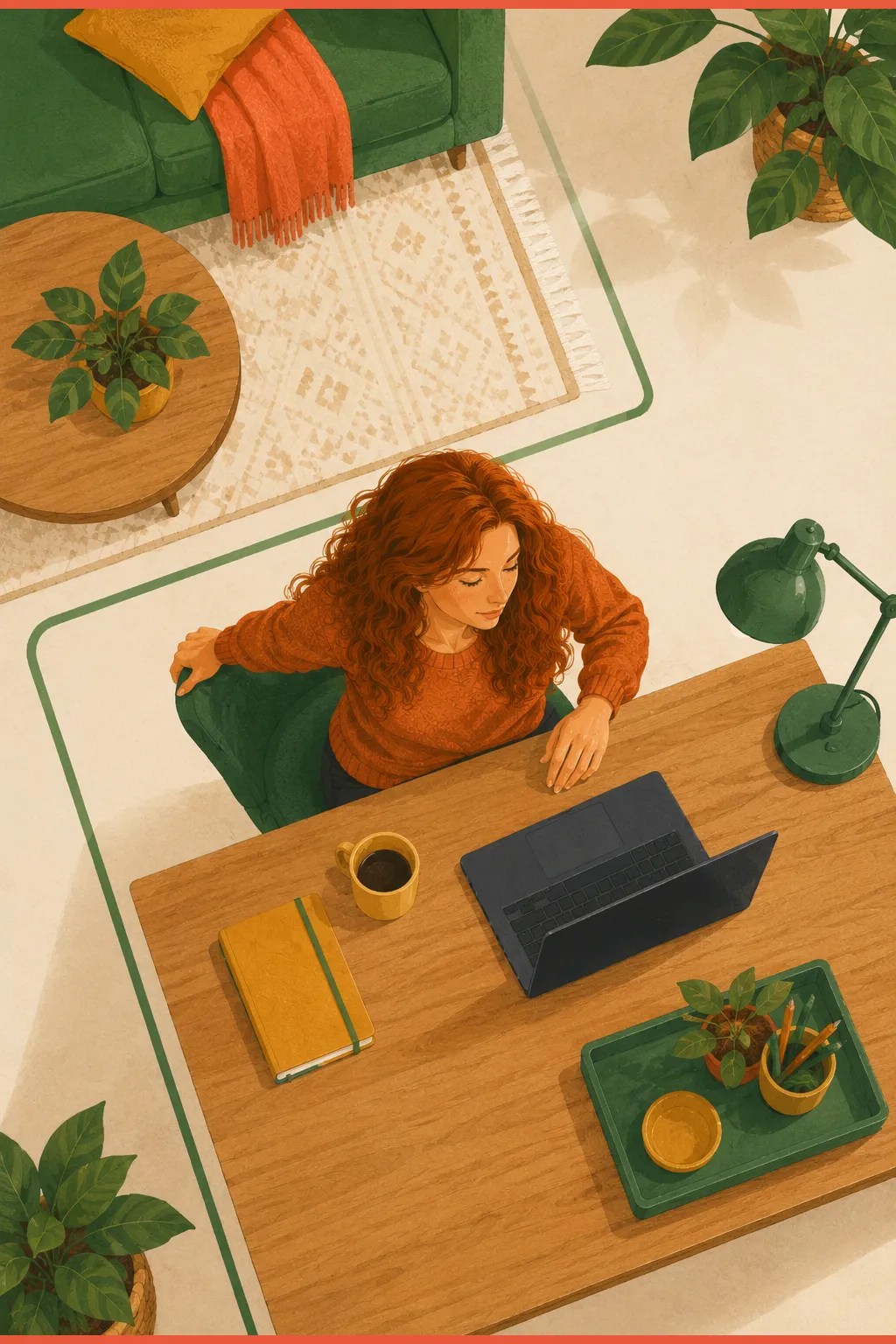
- Give work its own place. Behavior is cued by physical context, so a space that only ever means “work” starts doing some of the starting for you.⁵ It does not need to be a room. A specific corner, a particular chair, a desk you only sit at to work — even a tray that comes out and signals “on” and goes away to signal “off.” The point is a stable cue your brain can attach the habit to, rebuilding the spatial line the office drew between working and living.
- Rebuild the commute as a transition ritual. The commute was never wasted time; it was a boundary-crossing ritual that moved you between roles.¹² Build a deliberate one: a short walk around the block before you “arrive,” a specific playlist, a change of clothes, a coffee made a particular way. The same in reverse at day’s end. Crossing a small threshold on purpose tells your nervous system which mode it is entering — the cue the front door of an office used to give you.
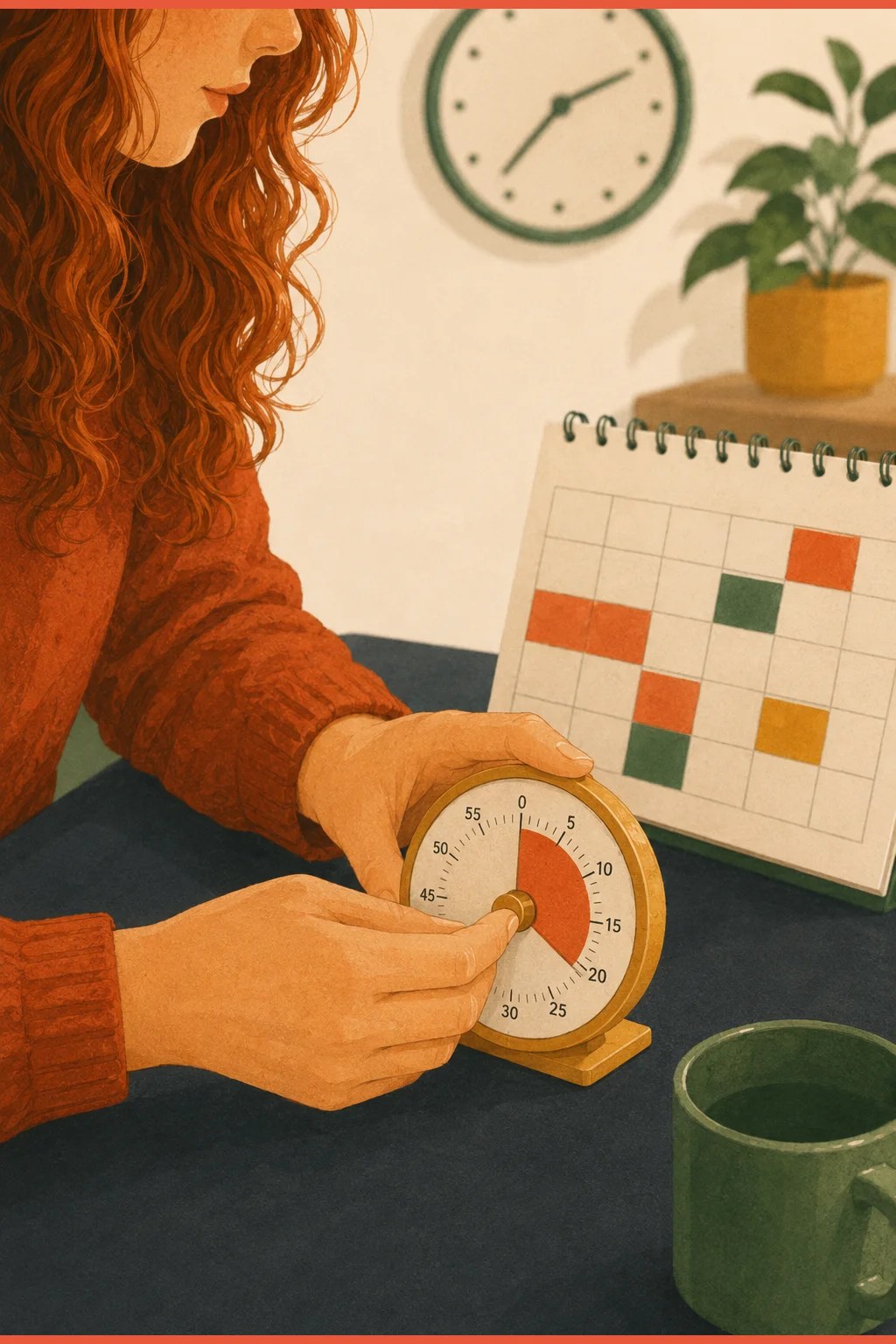
- Make time visible again. The office was full of ambient clocks; your apartment has none, and ADHD time perception is uneven enough that “I’ll just check the time in my head” is not reliable.⁴ So externalize it: an analog timer you can see counting down, a clock in your eyeline, a calendar blocked into visible chunks. (Our guide to ADHD time blindness goes deeper on making time physical.) You are not trying to sense time better; you are putting it on the wall so you don’t have to.
- Body-double the tasks that stall — for the right tasks. Per the section above: schedule a coworking call or a virtual session for the known-but-hard-to-start work, and keep your hardest novel thinking for solo focus.⁹ ¹⁰ It is a beam worth rebuilding; install it where it actually holds weight.
- Use the control the office never gave you. This is the gain side of the trade, so spend it deliberately. Engineer the sensory environment that lets your brain concentrate — the quiet, or the noise, or the movement, or the light — instead of the one an open-plan office forced on you.⁷ Remote work handed you this dial. Turn it on purpose.
- Protect the stop. With no coworkers packing up and no commute home, work bleeds into the evening until you are always a little bit at work and never fully resting. Mentally detaching from work during off-hours is one of the clearest predictors of actually recovering,¹³ and remote setups are where that detachment quietly dies. So set a hard end — a shutdown ritual, a closed laptop put out of sight, the reverse of your morning threshold — and defend it. If you tend toward marathon focus sessions that swallow the whole evening, our guide to ADHD hyperfocus covers building the off-ramp.
- Design against the isolation before it builds. The most consistent downside people report about remote work is not productivity — it is loneliness.⁸ It compounds slowly and quietly, so put human contact on the calendar the way you’d schedule a meeting: a standing call, a coworking session, one day a week somewhere with people, a walk with a friend. Treat connection as infrastructure, not as something you’ll get to when the work is done. It is the beam most likely to be skipped and most costly to lose — which is why it gets its own section next.

The isolation you actually have to plan for
Of everything the office supplied, other people are the support most likely to fall off your list — because it feels optional right up until it isn’t.
The health research here is worth holding carefully, without catastrophizing. Across whole populations, both objective isolation and the subjective feeling of loneliness independently predict worse long-term health outcomes — an effect real enough that researchers rank weak social connection alongside major lifestyle risks.¹⁴ That is a population-level finding, not a prediction about any one person’s month working from home. The right way to read it is not as a threat but as a reason to treat connection as something you engineer rather than something you hope happens.
There is also an ADHD-specific edge to it. Emotional experiences run more intensely in adults with ADHD — emotion dysregulation shows up in the research at a large effect size, with emotional lability the strongest piece.¹⁵ In practice, that can mean isolation doesn’t just sit quietly in the background; it can amplify, and a slow lonely stretch can tip into something heavier faster than you expect.
Which is the line worth naming plainly: feeling lonely because you work alone is a design problem you can solve with structure. A persistent flatness — losing interest in things you used to care about, a low mood that doesn’t lift when you do see people, sleep and appetite going sideways — is not a home-office problem, and no amount of workspace design will fix it. That pattern can be depression, which frequently travels with ADHD, and it deserves a real evaluation. Our guide to ADHD and depression covers how to tell them apart, and a healthcare provider is the right next step. If it ever gets darker than that, the 988 Suicide & Crisis Lifeline (call or text 988) is available 24/7 — reaching out is a competence, not a defeat.

When remote work stops working
Sometimes the honest answer is that a particular remote setup is costing more than it gives — and noticing that is information, not failure.
If the always-on has curdled into genuine exhaustion — you can’t recover on weekends, the work follows you into every room, rest stops working — that is the territory of burnout and overwhelm, and it needs more than a better timer. Our guide to ADHD overwhelm covers what to do when the load itself is the problem. And if the isolation has crossed from lonely into the persistent low mood described above, the move is a professional evaluation, not another productivity system.
None of that means you failed at working from home. It means the setup, as built, removed more structure than it rebuilt — and setups are adjustable. Sometimes the fix is a standing coworking day; sometimes it’s requesting a hybrid schedule; sometimes it’s asking for remote work formally as an accommodation with the supports that make it viable. The scaffolding is yours to redesign. The goal was never to prove you can white-knuckle a bare room. It was to build a day that holds you up the way the building used to.

Frequently asked questions
Why is working from home so hard for people with ADHD?
Because an office supplies structure your executive function was quietly leaning on — other people’s activating presence, a physical line between work and rest, a commute that bookends the day, and ambient cues for time and accountability. ADHD leans hard on that kind of external structure, since executive function and time perception run less reliably from the inside.¹ ⁴ Remove all of it at once and self-generated structure has to do work the environment used to do for free. It is a design gap, not a character gap.
Does body doubling actually work for ADHD?
Many people find it genuinely helpful, but it has not been tested in controlled ADHD trials, so it can’t honestly be called an evidence-based treatment.⁹ The nearest science — social facilitation — suggests another person’s presence tends to help simple, well-learned tasks and can even hinder complex, novel ones.¹⁰ ¹¹ Practical translation: use it to start and grind through known work, and protect your hardest new thinking for solo focus.
Is remote work better or worse for ADHD?
Neither, as far as the evidence goes — there is very little research directly comparing ADHD outcomes at home versus in an office, and what exists is small and mixed. It is best understood as a trade: you lose the office’s built-in structure but gain control over your sensory environment, which for some people with ADHD is a decisive advantage.⁷ The outcome depends less on the arrangement than on how deliberately you rebuild the missing structure.
How do I focus working from home with ADHD?
Rebuild the supports the office removed instead of trying to feel more disciplined: a space that only means “work,” a deliberate start-and-stop ritual in place of the commute, time made visible with timers and blocked calendars, body doubling for tasks that stall, and a hard stop at day’s end.⁵ ¹² ¹³ Then spend the one advantage remote work gives you — control your sound, light, and movement so the environment works for your brain rather than against it.⁷
What is a “fake commute” and does it help?
It’s a short, deliberate transition ritual — a walk around the block, a playlist, a change of clothes — that stands in for the boundary-crossing the real commute used to provide.¹² The commute was never just travel; it moved you between the “home” role and the “work” role. Recreating a small threshold on purpose gives your brain the same signal about which mode it is entering, and doing the reverse at day’s end helps you actually stop.
How do I stop working late when there’s no commute home?
Build an ending the way you’d build a start: a fixed stop time, a shutdown ritual, and the laptop physically put away out of sight. Mentally detaching from work during off-hours is one of the strongest predictors of real recovery, and remote setups are exactly where that detachment erodes.¹³ If long focus sessions routinely swallow your evenings, that’s worth addressing directly rather than willing yourself to stop.
I feel really isolated working from home — is that common with ADHD?
Loneliness is the most commonly reported downside of remote work for everyone, not just people with ADHD, and it tends to build slowly enough to sneak up on you.⁸ Scheduling human contact as deliberately as you schedule work is the structural fix. But if the loneliness has hardened into a low mood that doesn’t lift, a loss of interest in things you used to enjoy, or changes in sleep and appetite, that can be depression rather than a workspace problem — it’s worth a professional evaluation, and our depression guide can help you tell the difference.
Working from home strips out the natural transitions an office provided — ADHD and task switching is the mechanism layer under that loss, with bridges to build instead.
Body doubling deserves its own deep-dive — our full guide to ADHD body doubling covers the honest state of the evidence and eight ways to run a session that actually works.
📚 The ADHD Library by Dr. Morgan Reed

If the missing scaffolding shows up everywhere — not just at your desk, but in mornings, deadlines, and half-finished plans — You’re Not Broken: The 7-Week Executive Function Workbook for Late-Diagnosed ADHD Adults was written for exactly that. It’s seven weeks of practical, capacity-first systems for building external structure your brain can actually lean on: making time visible, engineering an environment that starts tasks for you, and protecting the boundaries that keep the work from swallowing the day. The goal was never to make you grind harder in a bare room. It’s to hand your brain the structure a building used to, so the version of you that works from home gets to be as capable as she already is.
★★★★★
Save this. You’ll want to come back to it.
- 📘 The Masking Tax: The 7-Week ADHD Burnout Recovery Workbook for Late-Diagnosed Adults — new: recovery for the burnout years of masking leave behind.
- 📕 You’re Not Broken: The 7-Week Executive Function Workbook for Late-Diagnosed ADHD Adults — the flagship workbook for rebuilding after a late diagnosis
- 📗 ADHD Mastery for Adults: 3-in-1 — a daily coaching system for the executive-function load
- 📙 Executive Function Rescue — a nine-week program for overwhelm and emotional regulation
Part of The ADHD Library by Dr. Morgan Reed — practical, evidence-informed tools for late-diagnosed adults.
References
1. Barkley RA. The executive functions and self-regulation: an evolutionary neuropsychological perspective. Neuropsychology Review. 2001;11(1):1-29. PMID: 11392560
2. Barkley RA. Attention-Deficit Hyperactivity Disorder: A Handbook for Diagnosis and Treatment. 4th ed. New York: Guilford Press; 2015. (Source of the “point of performance” concept: ADHD as a performance disorder to be supported where and when behavior occurs.)
3. Alderson RM, Kasper LJ, Hudec KL, Patros CH. Attention-deficit/hyperactivity disorder (ADHD) and working memory in adults: a meta-analytic review. Neuropsychology. 2013;27(3):287-302. PMID: 23688211
4. Noreika V, Falter CM, Rubia K. Timing deficits in attention-deficit/hyperactivity disorder (ADHD): evidence from neurocognitive and neuroimaging studies. Neuropsychologia. 2013;51(2):235-266. PMID: 23022430
5. Wood W, Rünger D. Psychology of habit. Annual Review of Psychology. 2016;67:289-314. PMID: 26361052
6. Wood W, Tam L, Guerrero Witt M. Changing circumstances, disrupting habits. Journal of Personality and Social Psychology. 2005;88(6):918-933. PMID: 15982113
7. Jahncke H. Open-plan office noise: the susceptibility and suitability of different cognitive tasks for work in the presence of irrelevant speech. Noise & Health. 2012;14(61):315-320. PMID: 23257585 (general-population experimental study, not ADHD-specific)
8. Lyzwinski LN. Organizational and occupational health issues with working remotely during the pandemic: a scoping review of remote work and health. Journal of Occupational Health. 2024;66(1):uiae005. PMID: 38289710 (general workforce, not ADHD-specific)
9. ADDitude Editors. Get More Done with a Body Double. ADDitude Magazine. https://www.additudemag.com/getting-stuff-done-easier-with-a-friend-body-double/ (community/coaching practice — not an efficacy study)
10. Zajonc RB. Social facilitation. Science. 1965;149(3681):269-274. PMID: 14300526
11. Bond CF Jr, Titus LJ. Social facilitation: a meta-analysis of 241 studies. Psychological Bulletin. 1983;94(2):265-292. PMID: 6356198
12. Ashforth BE, Kreiner GE, Fugate M. All in a day’s work: boundaries and micro role transitions. Academy of Management Review. 2000;25(3):472-491. DOI: 10.5465/amr.2000.3363315
13. Sonnentag S, Bayer UV. Switching off mentally: predictors and consequences of psychological detachment from work during off-job time. Journal of Occupational Health Psychology. 2005;10(4):393-414. PMID: 16248688
14. Holt-Lunstad J, Smith TB, Baker M, Harris T, Stephenson D. Loneliness and social isolation as risk factors for mortality: a meta-analytic review. Perspectives on Psychological Science. 2015;10(2):227-237. PMID: 25910392
15. Beheshti A, Chavanon ML, Christiansen H. Emotion dysregulation in adults with attention deficit hyperactivity disorder: a meta-analysis. BMC Psychiatry. 2020;20(1):120. PMID: 32164655
This article is for general information only and is not medical or career advice. ADHD assessment and treatment decisions, including any medication questions, belong with your healthcare provider. Employment arrangements and any request for remote work as a formal accommodation depend on your specific situation and jurisdiction — the Job Accommodation Network (free and confidential, 800-526-7234) is a useful starting point. If you are struggling emotionally, the 988 Suicide & Crisis Lifeline (call or text 988) is available 24/7.
Written by Dr. Morgan Reed, specialist in ADHD and executive function. Last reviewed: August 2026.
As an Amazon Associate, I earn from qualifying purchases — at no extra cost to you. Full disclosure.
Leave a Reply