

21 min read
Quick answer: Switching tasks costs every brain time and accuracy — cognitive scientists call it the switch cost, and even fully prepared adults in lab studies never get it to zero.¹ With ADHD, the cost runs higher at the exact weak points: disengaging from what has your attention, re-aiming attention at a new kind of information, and reloading the context of the new task into working memory. Honest note: in lab studies, set-shifting differences in ADHD are real but among the smallest executive effects measured⁴ — the everyday struggle is bigger than the lab numbers, and that gap itself is a documented puzzle.¹³ The fix isn’t forcing faster switches: it’s building bridges — preparation, bookmark notes, buffers, and rituals that pay the cost on purpose. Here’s what’s actually happening.
The moment between two tasks
It’s 4pm. You’ve finally finished the email that ate your afternoon. The next thing is right there — a report, dinner, a phone call. You know what it is. You even want to do it.
And you’re standing in the kitchen doing neither.
You’re not resting. Rest would feel better than this. You’re in the gap between two tasks — not done leaving the first one, unable to start the second, scrolling or snacking or staring while some internal gearbox grinds. From the outside it looks like laziness. From the inside it feels like pushing against a door that has no handle.
That gap has a name, and a mechanism, and — this may be the most useful thing you read today — a measurable cost that every human brain pays. Yours just pays more, at predictable points, for reasons that have nothing to do with character.
Every brain pays the switch cost
Here’s the part almost nobody tells you: task switching is expensive for everyone. In decades of lab experiments, people responding to simple tasks are substantially slower and, usually, more error-prone immediately after a switch — and the cost is “reduced, but not eliminated” by the chance to prepare.¹ Cognitive scientists call this the switch cost, and it isn’t a disorder; it’s the price of being a brain that runs one task-set at a time.
Definition Box — Switch cost: the reliable dip in speed and accuracy that follows any change of task. It comes from two sources: the old task’s mental settings carrying over and interfering, and the time it takes to reconfigure — to load the new task’s rules, relevant information, and goals.¹ Cognitive flexibility — shifting smoothly between tasks or perspectives — is considered one of the three core executive functions, built on top of the other two: inhibition and working memory.²

Why does this matter? Because if you’ve spent years reading your kitchen-gap as a personal failing, the baseline resets the story: the gap is human. The ADHD question isn’t “why can’t I do a thing everyone else does effortlessly” — nobody does it effortlessly. The question is why the universal cost runs higher for you, and where exactly the surcharge lands.
The Switch Cost, itemized: three fees, not one
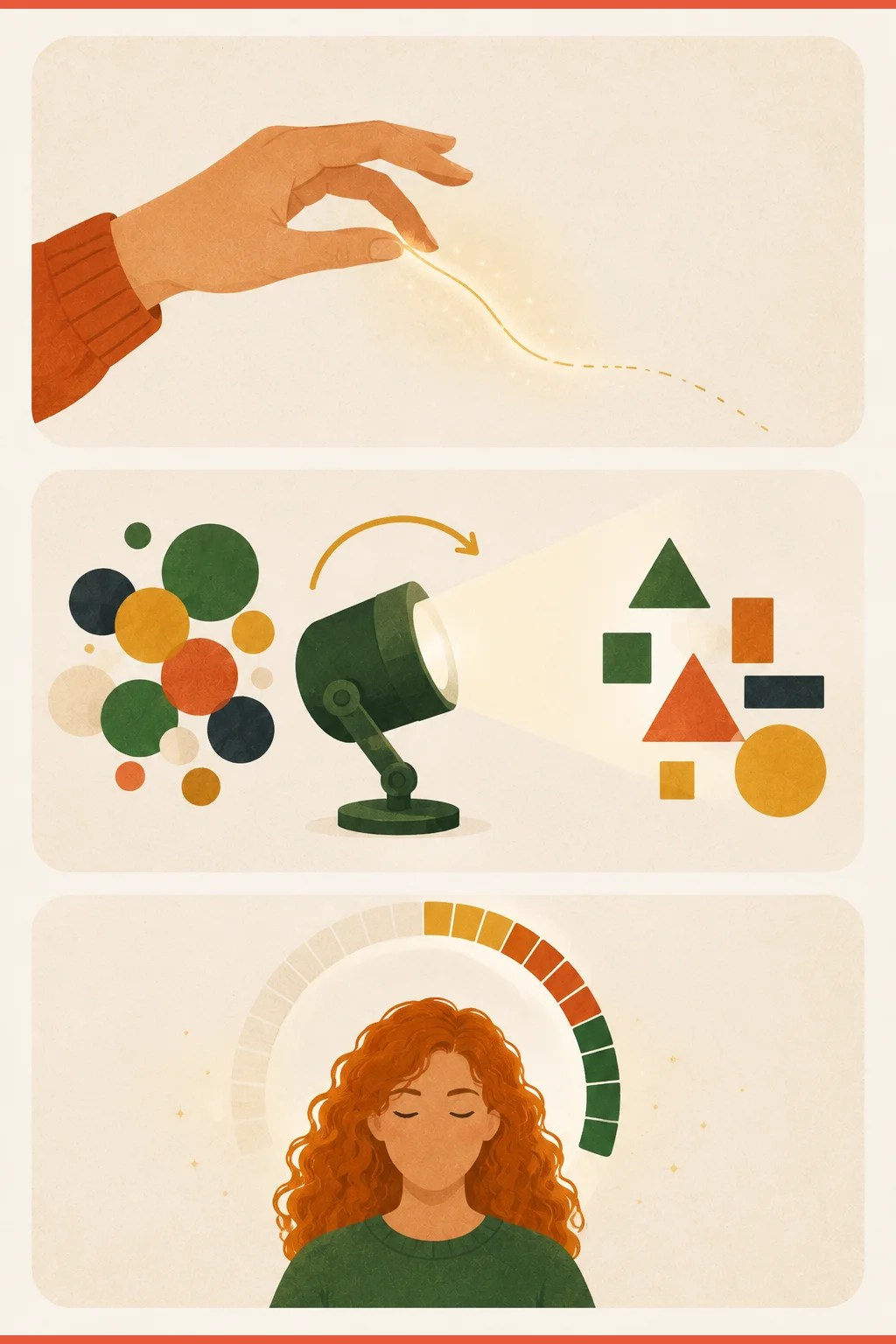
Treat every task switch as a toll with three separate fees. ADHD doesn’t raise them equally — knowing which fee is spiking on a given day tells you which tool to reach for.
Fee one: detaching. Before you can start the next thing, you have to leave the current thing — and an ADHD brain can hold on hard. Sometimes that’s hyperfocus: researchers are honest that hyperfocus doesn’t yet have an agreed scientific definition,¹² but the experience of being locked into an absorbing task while the world (and the next obligation) dissolves is one of the most consistently reported experiences in adult ADHD communities — reported, because like interruption-rage below, it’s better documented in lived experience than in trials. If you can’t put a task down any more easily than you can pick one up, our guide to ADHD hyperfocus covers that lock specifically.
Fee two: re-aiming. A revealing adult study — one study, not yet replicated, so hold it lightly — found something surprising: adults with ADHD showed normal switch costs when the new task used the same kind of attention — their slowdown appeared specifically when the switch also required re-aiming attention at a different kind of information.⁸ The switching machinery itself is intact. It’s the redirection of attention — zooming from detail-work to big-picture, from words to numbers, from screen to person — that carries the ADHD surcharge.
Fee three: reloading. Arriving at the new task, you have to load its context into working memory: where you left off, what the goal was, what the next step is. Working memory differences in adult ADHD are among the better-documented findings — moderate, not catastrophic, but real⁹ — which means the reload runs slower and drops more packets. This is why “just start where you left off” is harder than it sounds: finding where you left off is itself a memory task.
There’s a fourth moment that deserves its own line: sometimes the gap isn’t a switching problem at all — it’s a starting problem. If you detach fine but freeze at ignition, that’s task paralysis, and ADHD paralysis is the better map for it.

What the research honestly shows about ADHD and switching
Now the part that makes this article different from most of what you’ll read on the topic — because the honest version is more useful than the dramatic one.
Yes, the difference is measurable. A meta-analysis of studies in adults found a medium-sized set-shifting difference (d = 0.65),⁶ and adult studies keep finding the effect concentrated where cognitive demand is highest.⁷ ⁸ But here’s the twist: when researchers pooled 34 meta-analyses covering 253 effect sizes across every neurocognitive domain, set shifting came out as the smallest ADHD effect of them all — smaller than working memory, smaller than inhibition, smaller than reaction-time variability.⁴ A meta-analysis of 24 adult studies even concluded that executive functions overall were “not generally reduced” in adults with ADHD.⁵ And the landmark meta-analysis of the executive-function theory itself concluded that EF weaknesses are “neither necessary nor sufficient to cause all cases of ADHD.”³
So why does 4pm in your kitchen feel nothing like a pooled effect of 0.35? (To be clear, the same review’s bottom line was that ADHD involves real, measurable differences across many domains — the point is that switching, specifically, is not where the biggest ones live.)⁴ This is a documented paradox, not a contradiction: in autism research, the same gap exists — everyday flexibility struggles that lab switch tasks largely fail to capture — and researchers have named the mismatch explicitly.¹³ Lab switches are clean: one cue, two simple tasks, no emotion, no fatigue, no meaning. Your kitchen switch is dirty: an unfinished task still humming in your head, a next task with no deadline pulling you forward, low blood sugar, an afternoon of accumulated masking, and feelings about all of it. The lab measures the gearbox. Life loads the truck.
The takeaway cuts both ways, and both matter. Your struggle is real and partly measurable — you’re not imagining it. And your brain is not incapable of switching — the machinery works, it just runs expensive under load. That second half is hope, not dismissal: expensive processes can be budgeted for.

Why interruptions cost so much more than they look
A special, expensive case of the switch cost: the switch you didn’t choose.
You’re finally in the groove — the reload paid, the context loaded, the work moving — and someone says “quick question.” The rage that flashes through you can feel embarrassingly outsized. Here’s the mechanics under it: laboratory work with general adults shows that interruptions averaging just 4.4 seconds tripled the rate of a specific kind of error — losing your place in a sequence — and even 2.8-second interruptions doubled it.¹⁰ Getting back to full speed after an interruption follows a measurable ramp, on the order of fifteen seconds of recovering the displaced mental context in a lab task¹¹ — and real work is heavier than a lab task. (You may have heard “it takes 23 minutes to refocus” — that figure comes from workplace observation of when people returned to a suspended task, not how long refocusing takes. The lab numbers above are the defensible ones.)
For you, the toll is steeper: the context you lose was more expensive to load, and working memory — measurably weaker on average in adult ADHD⁹ — is the system that has to hold that context. And the emotional spike is real, too — emotion regulation runs harder on average in adult ADHD¹⁵ — though it’s worth honesty here: the specific experience of interruption-rage is something clinicians and the ADHD community describe constantly, but it hasn’t been directly studied. What you’re feeling when the “quick question” lands isn’t pettiness. It’s watching something you paid dearly for get knocked out of your hands.

Not just ADHD: when transitions mean something else
The reverse-inference guard, because it matters: struggling with transitions does not mean you have ADHD. The switch cost is universal,¹ and several other things raise it.
Sleep debt, stress, loneliness, and lack of exercise each measurably impair executive functions — including flexibility — in anyone.² A depressive episode slows switching along with everything else; if the gears grind and the world has gone flat and heavy, our guide to ADHD and depression walks through telling those apart, and it matters that you do.
And one differential deserves special care: autistic people also find transitions hard — but often for a different reason. In autism, the distress frequently attaches to the change itself — the departure from routine and sameness — rather than to the effort of the cognitive switch, and researchers treat the two conditions as related but distinct.¹³ ¹⁴ The two also co-occur often. If what derails you is less “the gearbox is slow” and more “the plan changed and everything in me revolted,” that’s a pattern genuinely worth describing to a clinician who knows both conditions — accurate names lead to better support.
None of this is self-diagnosis material in either direction. It’s a map of the neighborhood, so the conversation you have with a professional starts three steps ahead.

Building bridges: 7 ways to pay the toll on purpose
You can’t delete the switch cost. You can stop paying it in surprise installments at 4pm, and start paying it deliberately, in advance, in smaller coins. That’s what every strategy here does.
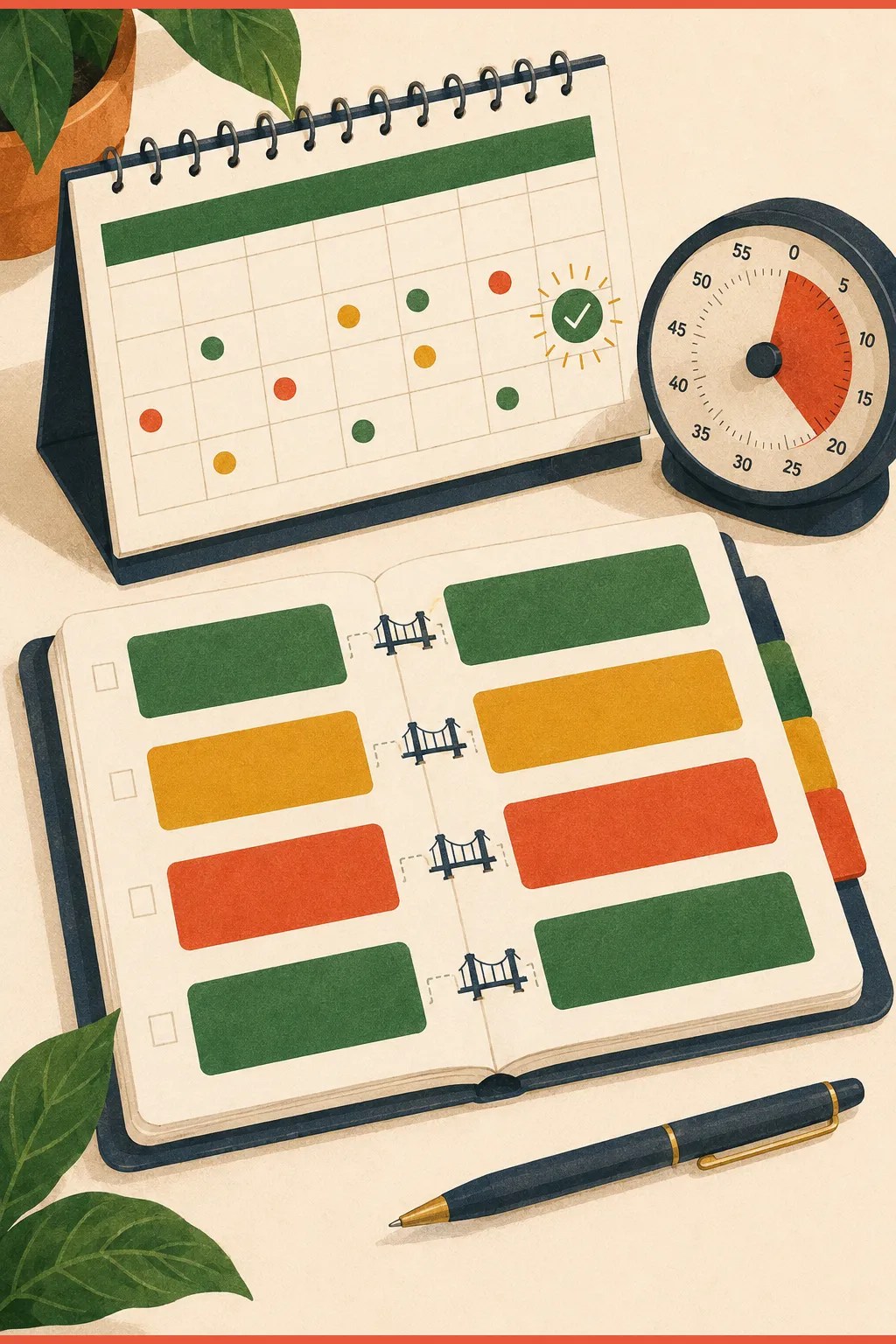
- Give your brain advance warning. In a cued-switching study of adults with ADHD, performance differences depended on how much preparation time people got before the switch.⁷ (The lab version is a cue moments ahead; the life version scales the same principle up.) Use that: a timer ten minutes before the transition, a calendar alert that names the next task, a partner saying “leaving in fifteen.” The warning starts the detach early, while the pressure is still low.
- Write a landing note before you leave. The reload fee is mostly “where was I?” — so answer it while you still know. One sentence on a sticky note or at the top of the document: “Next: paste the numbers into table 2.” Thirty seconds now buys back the most expensive minutes of the next session. (Park facing downhill.)
- Make an if-then plan for the transition itself. Not “I’ll start the report after lunch” but “When I put my plate in the sink, then I open the report and type one sentence.” Implementation intentions — if-then plans tied to a concrete cue — have a strong evidence base for goal follow-through in clinical and analogue samples (not ADHD-specific, but the mechanism travels).¹⁶ The plan removes the decision from the gap, and the gap is where decisions go to die.
- Put a physical bridge in the gap. The hardest switch is mind-to-mind with the body idle. Give the transition a body: stand up, refill the water, step outside for one minute, change rooms. A short physical ritual gives the old task somewhere to end and the new one somewhere to begin — it’s the same principle as the fake commute that makes remote work livable — and it’s low-risk, zero-cost practice, even though nobody has run a trial on transition rituals specifically.
- Batch to buy fewer tolls. Every switch costs; the cheapest switch is the one you don’t make. Cluster the small same-shaped tasks — messages in one block, calls in another — instead of sprinkling them through the day as ambushes. Fewer, bigger blocks means fewer tolls paid.
- Build buffers between blocks — on the calendar, in writing. Back-to-back scheduling assumes a zero-second switch cost, which is false for everyone and expensive for you. Ten to fifteen minutes of named buffer (“landing/loading”) between meetings or task blocks isn’t slack — it’s the toll, paid on schedule. If your calendar has no gaps, your day has hidden debts — and if you consistently budget zero minutes because time itself is slippery, ADHD time blindness is the underlying layer worth understanding.
- Protect yourself from chosen interruptions. You can’t stop the coworker, but you can stop volunteering for ambushes: notifications off during loaded work, phone in another room, status set to heads-down. Every interruption you prevent is a tripling of your odds of losing your place¹⁰ and a fifteen-second-plus ramp¹¹ you never pay. If the phone itself is the main ambusher, that’s its own article — and structured support like CBT for adult ADHD, which trains exactly these external-structure skills, has meaningful evidence behind it, with the honest caveat that effects look smaller against active control treatments.¹⁷

The gap is not a verdict
One more time, because it’s the sentence to keep: the gap between tasks is human. The switch cost is paid by every brain that has ever moved from one thing to another. Yours charges more — at detach, at re-aim, at reload — and it charges most when the day has already taxed you. That’s a budgeting problem, not a character problem.
So build the bridges. Warn your brain, write the landing note, put your body in the gap, pay the toll on purpose. Some days the crossing will still be slow — low sleep, high stress, a morning of interruptions — and that’s not backsliding; that’s load. The measure of a good system isn’t that 4pm never happens. It’s that when it does, you know what it is, you know it passes, and you know the door has a handle now, because you installed it yourself.
Frequently asked questions
Why is task switching so hard with ADHD?
Because switching is genuinely costly for every brain — slower responses and more errors right after any switch, even with preparation¹ — and ADHD raises the cost at three points: disengaging from the current task, re-aiming attention at a new kind of information,⁸ and reloading the new task’s context into working memory.⁹ Adult studies find a medium-sized set-shifting difference on average⁶ — though set shifting is the smallest of the measured ADHD neurocognitive effects⁴ — concentrated where cognitive demand is highest. It’s a higher toll, not a missing ability.
Is trouble with transitions a symptom of ADHD?
It’s a common experience in ADHD, but it isn’t diagnostic — transition difficulty is universal at baseline¹ and rises with sleep debt, stress, depression, and other conditions.² Formal ADHD diagnosis rests on a broader lifelong pattern of inattention and/or hyperactivity-impulsivity, assessed by a clinician. If transitions are one thread in a larger fabric — time blindness, task paralysis, hyperfocus, forgetfulness — that pattern is worth a professional conversation. One thread alone isn’t a verdict.
How is this different from autistic difficulty with change?
Broadly: in ADHD the struggle is usually the effort of the transition — detaching, re-aiming, reloading — while in autism, distress often attaches to the change itself, the departure from routine and sameness — insistence on sameness is a core diagnostic feature of autism in the DSM-5. The two conditions co-occur often and are considered related but distinct.¹⁴ If unexpected plan changes produce revolt rather than sluggishness — especially alongside sensory sensitivities or a deep need for predictability — that’s worth raising with a clinician familiar with both.
Why do I get so angry when I’m interrupted?
Because the interruption destroys something you paid heavily for. Even seconds-long interruptions measurably multiply place-keeping errors,¹⁰ and rebuilding your mental context takes a measurable ramp¹¹ — costs that plausibly run higher when working memory is already taxed⁹ — that specific interaction hasn’t been tested directly. Add that emotion regulation runs harder on average in adult ADHD,¹⁵ and the flash of rage makes mechanical sense. (The interruption-rage experience specifically hasn’t been directly studied — but the ingredients are all documented.) It doesn’t make you difficult; it makes you someone whose work-in-progress is expensive.
Does it really take 23 minutes to refocus after an interruption?
That famous figure traces to a 2005 workplace-observation study by Gloria Mark and colleagues, presented at the CHI conference: it averaged how long workers took to return to a suspended task while other work filled the gap — a different quantity from cognitive recovery time, and never a peer-reviewed measure of refocusing. The controlled findings: interruptions of a few seconds double-to-triple sequence errors,¹⁰ and returning to speed follows a ramp of roughly fifteen seconds in a simple lab task¹¹ — longer, plausibly much longer, for complex work. The precise number matters less than the principle: interruptions are never free, so preventing them is real productivity, not preciousness.
How can I get faster at switching tasks?
Mostly by switching less and bridging better, not by pushing harder. Give yourself advance warning of transitions,⁷ write a one-line landing note before leaving a task, use if-then plans to automate the first step of the next one,¹⁶ batch similar tasks to reduce total switches, and schedule real buffers between blocks. Speed follows structure: the toll gets smaller when it’s paid deliberately instead of extracted mid-collapse.
Does hyperfocus make task switching worse?
They’re two faces of the same coin — attention that’s hard to steer: hard to aim at the boring thing, hard to pull off the absorbing thing. Hyperfocus lacks an agreed research definition,¹² but the reported experience — deep absorption, lost time, the world dropping away — makes the detach fee of a switch enormous. If your worst transitions are exits from absorption, work the exit specifically: alarms with meaning, a person who physically appears, a pre-written stopping ritual. Our ADHD hyperfocus guide covers those off-ramps in detail.

★★★★★
Save this. You’ll want to come back to it.
- 📘 The Masking Tax: The 7-Week ADHD Burnout Recovery Workbook for Late-Diagnosed Adults — new: recovery for the burnout years of masking leave behind.
- 📕 You’re Not Broken: The 7-Week Executive Function Workbook for Late-Diagnosed ADHD Adults — the flagship workbook for rebuilding after a late diagnosis
- 📗 ADHD Mastery for Adults: 3-in-1 — a daily coaching system for the executive-function load
- 📙 Executive Function Rescue — a nine-week program for overwhelm and emotional regulation
This article is for educational purposes only and is not a substitute for professional medical or mental-health advice, diagnosis, or treatment. Difficulty with task switching and transitions has many possible causes — including sleep debt, stress, depression, anxiety, and autism — and is not by itself evidence of ADHD or any condition. Decisions about ADHD treatment belong with your clinician. For assessment or support, please talk to a qualified professional. If low mood ever comes with hopelessness or thoughts of self-harm, in the US you can call or text 988 (the Suicide and Crisis Lifeline) for free, confidential support, 24/7.
Written by Dr. Morgan Reed, specialist in ADHD and executive function. Last reviewed: August 2026.
References
1. Monsell S. Task switching. Trends in Cognitive Sciences. 2003;7(3):134-140. PMID: 12639695
2. Diamond A. Executive functions. Annual Review of Psychology. 2013;64:135-168. PMID: 23020641
3. Willcutt EG, Doyle AE, Nigg JT, Faraone SV, Pennington BF. Validity of the executive function theory of attention-deficit/hyperactivity disorder: a meta-analytic review. Biological Psychiatry. 2005;57(11):1336-1346. PMID: 15950006
4. Pievsky MA, McGrath RE. The neurocognitive profile of attention-deficit/hyperactivity disorder: a review of meta-analyses. Archives of Clinical Neuropsychology. 2018;33(2):143-157. PMID: 29106438
5. Schoechlin C, Engel RR. Neuropsychological performance in adult attention-deficit hyperactivity disorder: meta-analysis of empirical data. Archives of Clinical Neuropsychology. 2005;20(6):727-744. PMID: 15953706
6. Boonstra AM, Oosterlaan J, Sergeant JA, Buitelaar JK. Executive functioning in adult ADHD: a meta-analytic review. Psychological Medicine. 2005;35(8):1097-1108. PMID: 16116936
7. King JA, Colla M, Brass M, Heuser I, von Cramon D. Inefficient cognitive control in adult ADHD: evidence from trial-by-trial Stroop test and cued task switching performance. Behavioral and Brain Functions. 2007;3:42. PMID: 17708762
8. Luna-Rodriguez A, Wendt M, Kerner auch Koerner J, Gawrilow C, Jacobsen T. Selective impairment of attentional set shifting in adults with ADHD. Behavioral and Brain Functions. 2018;14(1):18. PMID: 30414619
9. Alderson RM, Kasper LJ, Hudec KL, Patros CH. Attention-deficit/hyperactivity disorder (ADHD) and working memory in adults: a meta-analytic review. Neuropsychology. 2013;27(3):287-302. PMID: 23688211
10. Altmann EM, Trafton JG, Hambrick DZ. Momentary interruptions can derail the train of thought. Journal of Experimental Psychology: General. 2014;143(1):215-226. PMID: 23294345
11. Altmann EM, Trafton JG. Timecourse of recovery from task interruption: data and a model. Psychonomic Bulletin & Review. 2007;14(6):1079-1084. PMID: 18229478
12. Ashinoff BK, Abu-Akel A. Hyperfocus: the forgotten frontier of attention. Psychological Research. 2021;85(1):1-19. PMID: 31541305
13. Geurts HM, Corbett B, Solomon M. The paradox of cognitive flexibility in autism. Trends in Cognitive Sciences. 2009;13(2):74-82. PMID: 19138551
14. Antshel KM, Russo N. Autism spectrum disorders and ADHD: overlapping phenomenology, diagnostic issues, and treatment considerations. Current Psychiatry Reports. 2019;21(5):34. PMID: 30903299
15. Beheshti A, Chavanon ML, Christiansen H. Emotion dysregulation in adults with attention deficit hyperactivity disorder: a meta-analysis. BMC Psychiatry. 2020;20(1):120. PMID: 32164655
16. Toli A, Webb TL, Hardy GE. Does forming implementation intentions help people with mental health problems to achieve goals? A meta-analysis of experimental studies with clinical and analogue samples. British Journal of Clinical Psychology. 2016;55(1):69-90. PMID: 25965276
17. Knouse LE, Teller J, Brooks MA. Meta-analysis of cognitive-behavioral treatments for adult ADHD. Journal of Consulting and Clinical Psychology. 2017;85(7):737-750. PMID: 28504540
As an Amazon Associate, I earn from qualifying purchases — at no extra cost to you. Full disclosure.
Leave a Reply