

23 min read
Quick answer: “Phone addiction” isn’t an official diagnosis — researchers call it problematic smartphone use — but the pull is real, and it tracks closely with ADHD: across 15 studies and more than 35,000 people, problematic social media use and ADHD symptoms are moderately correlated.¹ The reason isn’t weakness. A phone is a frictionless, infinitely novel, variable-reward machine — a near-perfect match for a brain whose reward-anticipation circuitry responds differently on average⁶ and whose brakes arrive a beat late. The fix isn’t willpower or shame: it’s changing the equation — friction, structure, and honest attention to what the scrolling is doing for you. Here’s what’s actually happening, and what honestly helps.
You picked up your phone to check the time
Forty-five minutes later, you still don’t know what time it is.
You know this moment. You picked the phone up for one small, legitimate reason — the time, the weather, one message — and something else happened. A notification. A video. A comment thread. And then the strange time-hole opened, and when you surfaced, the tea was cold and the evening was gone and you never did find out what time it was.
If you have ADHD, this isn’t an occasional glitch. It might be the shape of most evenings. And somewhere under the lost minutes sits a heavier feeling: why can’t I control this? Everyone uses a phone. Why does mine use me?

Here’s the honest answer, up front: because the phone is very good at what it does, and because the brain you’re holding it with is wired in a way the phone happens to fit. That’s not an excuse — it’s a mechanism. And mechanisms, unlike character flaws, can be worked with.
What “phone addiction” actually is (and isn’t)
Definition Box — Problematic smartphone use: the research term for phone use that feels out of control, crowds out sleep, work, or relationships, and continues despite real costs. It is not an official diagnosis: neither the DSM-5 nor the ICD-11 recognizes “phone addiction” or “social media addiction.” The only screen-related condition in the ICD-11 is gaming disorder, defined by impaired control, escalating priority over other activities, and continued gaming despite harm, usually over at least twelve months.¹⁰ Researchers have argued the addiction label goes further than the evidence for phones — “problematic use” is the more accurate frame.⁹
That distinction isn’t pedantry — it changes what you do about it. Addiction language invites shame and abstinence fantasies (“I just need to quit”). Problematic-use language invites a more useful question: what, exactly, is the problem — and what would make it smaller?
One number that matters here: heavy use alone isn’t the problem. In a three-wave study of adolescents, it was problematic social media use — the out-of-control, interfering kind — that predicted increases in ADHD symptoms over time, while sheer intensity of use predicted nothing.⁴ Hours on the screen-time report are the wrong metric. The right metric is what the use costs you, and whether you’re choosing it.

The Perfect Trap: a machine that fits your wiring
Think about what a smartphone actually is, from your brain’s point of view. We’ll call it the Perfect Trap — not because you’re trapped forever, but because it’s hard to design a better one.
It has infinite novelty: no feed ever ends, no refresh ever comes back empty. It has variable rewards: sometimes the next post is boring, sometimes it’s the funniest thing you’ve seen all week — and in the classic animal recordings that underpin reward neuroscience, it’s precisely unpredictable rewards that produce the most sustained dopamine signalling, with uncertainty itself driving the response.⁸ It has zero starting cost: no setup, no decision, no effort — the phone is already in your hand. And it has no stopping cue: a book ends, a show ends, a level ends. A feed doesn’t — which is why the scroll so often turns into a full hyperfocus session you never chose.
Now put that machine in the hand of an ADHD brain. A neuroimaging meta-analysis finds that, on average, ADHD involves differences in how reward-anticipation circuitry responds — specifically, blunted ventral-striatal response while anticipating rewards.⁶ (Note what that is not: it is not “your brain has no dopamine.” Imaging studies show group-level differences in dopamine-related markers,⁷ but the popular “dopamine deficiency” story is an oversimplification the research doesn’t support.) Add the ADHD difficulties with inhibition and time perception — the late brake, the porous sense of minutes passing that we’ve mapped in ADHD time blindness — and every one of the trap’s four hooks finds something to hold on to.
The scroll, in other words, isn’t happening because you’re weak. It’s happening because a billion-dollar machine and a particular kind of brain fit together with almost mechanical precision. You were never fighting fair.

The evidence: this really is harder with ADHD
This isn’t a vibe; it’s one of the more consistent findings in the field. A 2025 meta-analysis pooling 15 studies and 35,223 people found a moderate correlation between ADHD symptoms and problematic social media use — r = 0.36, which in psychology terms is a solid, replicated association.¹ In adults specifically, a study of 400 people aged 18 to 70 found ADHD symptoms were among the best predictors of problematic internet use, alongside age and time online.² And in one of the largest samples ever collected — more than 23,000 adults — ADHD symptoms tracked with addictive social media use, with one detail worth noticing: women skewed toward problematic social media use specifically, while men skewed toward gaming.³
Two honest caveats belong next to those numbers. First, most of this research is correlational — it shows the link, not the direction. Second, “moderate correlation” means many people with ADHD don’t have problem use, and many people with problem use don’t have ADHD. If the scroll owns your evenings, that’s a real pattern worth addressing — but it is not, by itself, a diagnosis of anything.
No, your phone didn’t give you ADHD
The fear under a 7-hour screen-time report is often bigger than the report: did I do this to myself? Is the phone making me worse?
Here’s what the research actually shows. ADHD is a neurodevelopmental condition — the traits are required to have been present since childhood, which is why a phone you bought as an adult cannot have caused it. The most-cited study on the other direction, a JAMA cohort that followed 2,587 teenagers for two years, found that each additional digital media activity a teen used many times a day was associated with about 10% higher odds of later ADHD symptoms (OR 1.10) — and its own authors stressed the effect was modest and causality undetermined.⁵ The adolescent study above found the arrow ran from problematic use to symptoms, not from ADHD to problematic use — but in one cohort, and only for the problematic kind.⁴
The honest summary: the direction is unresolved, the effects are small, and nothing in this literature says you scrolled your way into ADHD. What the phone can do is amplify what’s already there — eat the sleep that was protecting your focus, fill the gaps where boredom used to force you into starting things, and hand your shame a number to point at. Which brings us to the loop.
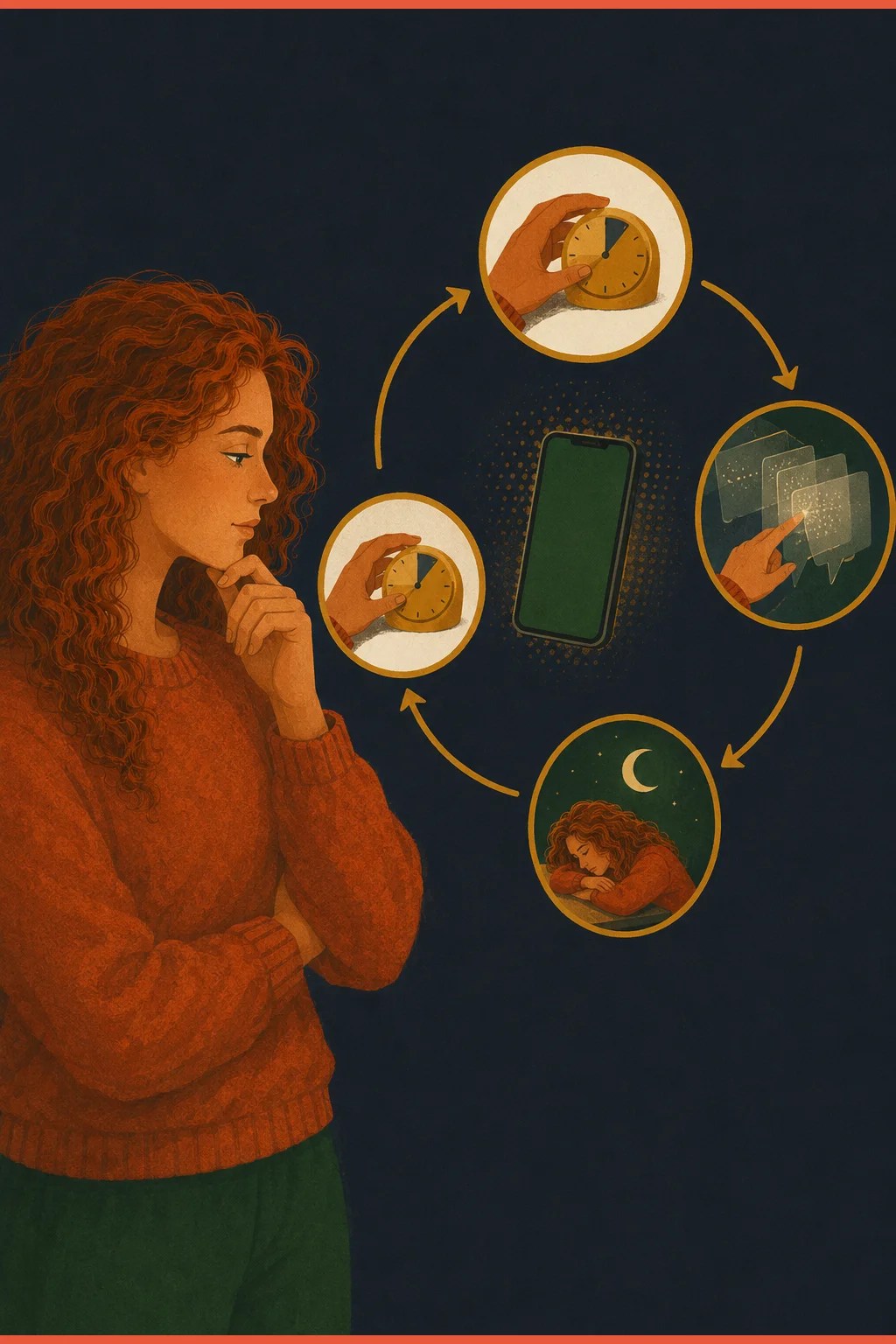
The limit-override-disgust loop
You know the cycle. The screen-time report says seven hours and something in your chest drops. You set an app limit that night, feeling resolute. Two days later, at 11:40pm, your thumb taps “Ignore limit” without consulting you. The next report is worse. Now you feel disgusted and defeated — and the feed is excellent company for feeling defeated.
Notice what the limit actually was: a moral test you administered to yourself nightly, with a one-tap trapdoor built in. A tap is not friction. For a brain with a late brake, a dialog box at midnight is not a barrier; it’s a formality.
There’s a second lesson hiding in the research here. In a randomized trial where students cut their screen time to under two hours a day for three weeks, mood, stress, sleep and well-being all improved — and within six weeks of the study ending, screen time had climbed nearly back to baseline.¹³ Willpower sprints work exactly as long as the sprint. What survives is structure — changes to the environment that keep working when your resolve is spent. That’s not a discouraging finding. It’s permission to stop running sprints you were never going to win, and to redesign the track instead.
When the scroll is doing a job
Before the strategies, one question that matters more than any of them: what is the scrolling for?
Sometimes it’s the trap working as designed — stimulation for a brain that’s under-stimulated by the task in front of it; the scroll is where you idle while task paralysis holds the real task out of reach. But sometimes scrolling is what avoidance looks like in 2026. Doomscrolling at 1am can be anxiety looking for certainty one more headline at a time. A weekend lost to the feed can be depression wearing a convenient costume — low energy, low interest, and a machine that asks nothing of you. Endless scrolling can also be simple sleep deprivation, which by itself produces inattention that looks a lot like ADHD.
This is worth taking seriously, because the fix is different in each case. If the scroll spikes with worry, our guide to ADHD and anxiety is the better map. If it comes with flatness, lost interest in things you love, or a mood that doesn’t lift when the phone is finally down, please read our piece on ADHD and depression — and if things ever tilt toward hopelessness or thoughts of not wanting to be here, reach out now: in the US you can call or text 988, the Suicide and Crisis Lifeline, free and confidential, any time. The scroll is never the whole story when you’re in that much pain, and you don’t have to sort it out alone.

Night scrolling: where the loop bites hardest
If the phone costs you one thing you can’t afford, it’s sleep. In a study of 844 adults, texting and calling after lights-out was associated with longer time to fall asleep, worse sleep efficiency, more disturbance and more daytime dysfunction — with the fatigue link clearest in adults under about forty. (Cross-sectional, and from an era before short-video feeds.)¹⁴ Controlled lab work adds the mechanism: evening use of light-emitting screens suppresses melatonin, delays the body clock, and dulls next-morning alertness — shown in a small but tightly controlled crossover study (four hours of a bright screen in a dim lab — everyday use shifts things less, but in the same direction).¹⁵
For ADHD, this is a compounding loop, because ADHD and sleep already have a complicated relationship — and a sleep-deprived brain has less inhibition and more need for stimulation, which is to say: it scrolls more. If your nights look like revenge bedtime scrolling stacked on a wired-but-tired brain, our guide to ADHD and sleep covers that whole tangle properly.

What actually helps: change the equation, not your character
Everything that follows comes from one principle: you cannot out-willpower a variable-reward machine, but you can make the machine harder to start and easier to stop. Friction is the strategy. Honesty about what the evidence shows is the seasoning.
And the evidence is encouragingly specific. In a month-long randomized trial, adults who blocked mobile internet on their phones for two weeks — calls and texts still worked — improved their mental health, their well-being, and their objectively measured sustained attention. (Worth knowing: the often-quoted “91% improved” figure is a simple before-and-after count across everyone in the trial, not the share of people the block itself helped — and about four in ten participants never installed the blocker at all.)¹² A much smaller one-week experiment — 37 students, none selected for ADHD — that simply reduced phone distractions found it eased hyperactivity-restlessness but not inattention: a useful, honest partial result.¹¹ Friction helps. It is not a cure for ADHD, and anyone selling you a dopamine detox as one is selling.

7 ways to loosen the loop
- Put the phone in another room — for one specific block, not forever. Physical distance is friction your resolve can’t dismiss with a tap: standing up and walking is a real cost in a way a dialog box never will be — and removing the phone’s pull entirely is the closest thing this literature has to a causal win.¹² Pick one protected block (dinner, the first work hour, the last hour before bed) rather than a vague “less phone.”
- Decide what you’re opening it for — out loud, before you unlock. “I’m checking the time.” “I’m answering Kim.” Naming the mission gives your brain a stopping cue the feed refuses to provide. When the mission’s done and your thumb drifts, you’ll at least notice the drift — and noticing is the veto window.
- Make the good things frictionless too. The equation has two sides. The book on the nightstand opened to your page, the puzzle already out on the table, the playlist one tap away — every alternative you pre-stage lowers the phone’s relative advantage at the exact moment your brain is hunting stimulation.
- Blunt the trap’s hooks. Turn off every notification that isn’t a human trying to reach you. Grayscale the screen. Log out of the apps that eat you so each visit costs a password. Move the worst offenders off the home screen — or off the phone, onto the laptop only. Each one is small; together they slow the slot machine.
- Use blockers as walls, not tests. An app limit you can dismiss with one tap is a moral test at midnight. A blocker that needs a code you keep in a drawer downstairs, or one that locks mobile internet for a set window, is a wall. Walls work when resolve doesn’t — that’s the shape of the blocking evidence,¹² and the sprint-then-rebound pattern is exactly what happens when you rely on resolve alone.¹³
- Borrow a body. Scrolling thrives in unaccountable time. Doing the boring task next to another human — in person or on a focus call — supplies the stimulation your brain was about to go hunting for, and a witness for the moment your hand reaches for the phone. It’s the same body-doubling that many people find helps with everything else ADHD makes heavy.
- Schedule the scroll on purpose. Total abstinence sets up the override-disgust loop. A deliberate, time-boxed scroll — after the task, on the couch, timer on — keeps the pleasure and deletes the ambush. You’re allowed to like your phone. The goal is for the liking to be mutual.
The dopamine equation, reframed
Here’s the reframe that makes the strategies stick: your screen time is not a referendum on your character. It’s an equation — a brain that runs hot for novelty and cold on friction, meeting a machine engineered to supply infinite novelty at zero friction. Change either side of the equation and the answer changes. Shame changes nothing; shame is, if anything, more fuel for the machine, because the feed is where we go to stop feeling things.
So the next time the screen-time report tries to tell you who you are, remember what it’s actually measuring: the fit between a trap and a brain, in an environment nobody designed for brains like yours. You can redesign your corner of it. Friction by friction, mission by mission, one protected hour at a time.
And if the scroll keeps swallowing whole evenings even after the redesign — or it’s guarding a sadness or a worry that’s still there when the phone finally goes dark — that’s not a scrolling problem. That’s a signal worth bringing to a professional who can help you look underneath it.

Frequently asked questions
Is phone addiction a real diagnosis?
No. Neither the DSM-5 nor the ICD-11 includes “phone addiction” or “social media addiction” as a diagnosis — the only screen-related condition formally recognized is gaming disorder, in the ICD-11.¹⁰ Researchers generally use “problematic smartphone use” for phone habits that feel out of control and carry real costs, and several have argued the addiction label overstates the current evidence.⁹ That doesn’t make the struggle less real — it means the useful question isn’t “am I an addict?” but “what is this costing me, and what would shrink it?”
Why is my phone so much more addictive with ADHD?
Because the phone’s design and ADHD’s wiring interlock. The phone offers infinite novelty, unpredictable rewards, zero start-up cost, and no stopping cue. ADHD brains show, on average, differences in reward-anticipation circuitry,⁶ plus later-arriving inhibition and a porous sense of time. Across more than 35,000 people, problematic social media use and ADHD symptoms are moderately correlated¹ — and in adults, ADHD symptoms are among the strongest predictors of problematic use.² It’s a fit problem, not a willpower problem.
Did my phone cause my ADHD?
No. ADHD is a neurodevelopmental condition whose traits begin in childhood — a device can’t install it. One of the most-cited studies on the question followed 2,587 teens for two years and found that each extra digital media activity used many times a day predicted roughly 10% higher odds of later ADHD symptoms, with its own authors calling the effect modest and causality unresolved.⁵ What phones can plausibly do is amplify existing traits — mostly by eating sleep and filling every gap where starting something used to happen.
Why do screen-time limits never work for me?
Because a limit you can dismiss with one tap isn’t friction — it’s a nightly moral test with a trapdoor. For a brain with late-arriving brakes, the “Ignore limit” button at 11:40pm is a formality. What works better is structure that doesn’t consult your willpower: the phone physically elsewhere, mobile internet blocked for set windows, apps logged out or moved off the device.¹² And when a limits-sprint does work, expect the rebound — in one trial, screen time was nearly back to baseline six weeks after the study ended¹³ — which is an argument for permanent small frictions over heroic temporary ones.
Is doomscrolling a form of self-medication?
Sometimes, loosely — but hold the term gently, because it smuggles in the “dopamine deficiency” story. What imaging research actually shows is narrower: group-level differences in reward-anticipation response⁶ and in dopamine-related markers,⁷ which is not the same thing as a simple deficiency. What’s fair to say: when the task in front of you produces too little stimulation to start, the feed supplies stimulation instantly, so the scroll often functions as the path of least resistance for an under-stimulated brain. But doomscrolling specifically — feeding on bad news at 1am — is just as often anxiety hunting for certainty, or depression’s low-effort company. If it’s soothing something, it’s worth asking what, because the answer changes the fix.
How do I stop doomscrolling at night?
Attack the night specifically, because that’s where the loop compounds: after-lights-out phone use tracks with worse sleep in adults,¹⁴ evening screen light delays the body clock,¹⁵ and the resulting sleep debt makes tomorrow’s brain more scrollable. The mechanics: charge the phone outside the bedroom (a $10 alarm clock replaces its one legitimate job — and if you need to be reachable overnight for kids, caregiving, or on-call work, keep it across the room on Do Not Disturb with favorites allowed instead), set mobile internet or the worst apps to block during your wind-down window, and pre-stage a genuinely pleasant alternative — a book, a podcast on a speaker, anything that doesn’t refresh. If the 1am scroll is really worry wearing a costume, that’s the part to treat.
When is scrolling a sign of something more than ADHD?
When it’s the visible edge of avoidance or flatness: whole weekends lost to the feed with no pleasure in them, scrolling instead of eating or sleeping or seeing people, a mood that stays heavy when the phone is down, or feeds full of content that matches a darkening inner state. Depression and anxiety both recruit the scroll, and both are more common alongside ADHD — our guides to ADHD and depression and ADHD and anxiety cover the overlap properly. If any of that is familiar — or if things ever reach hopelessness or thoughts of self-harm — please don’t file it under “screen time.” Talk to a professional, and in a crisis in the US, call or text 988. It’s free, confidential, and there 24/7.

★★★★★
Save this. You’ll want to come back to it.
- 📘 The Masking Tax: The 7-Week ADHD Burnout Recovery Workbook for Late-Diagnosed Adults — new: recovery for the burnout years of masking leave behind.
- 📕 You’re Not Broken: The 7-Week Executive Function Workbook for Late-Diagnosed ADHD Adults — the flagship workbook for rebuilding after a late diagnosis
- 📗 ADHD Mastery for Adults: 3-in-1 — a daily coaching system for the executive-function load
- 📙 Executive Function Rescue — a nine-week program for overwhelm and emotional regulation
This article is for educational purposes only and is not medical advice, diagnosis, or treatment. “Phone addiction” is a research and community term, not a clinical diagnosis, and difficulty controlling phone use has many possible causes. If problematic use, low mood, or anxiety is disrupting your life, please talk to a qualified clinician. In the US, you can call or text 988 (the Suicide and Crisis Lifeline) for free, confidential support, 24/7.
Written by Dr. Morgan Reed, specialist in ADHD and executive function. Last reviewed: August 2026.
References
1. Ding J, Liu Z, Chao M. The association between problematic social media use and attention deficit/hyperactivity disorder symptomatology: a systematic review and meta-analysis. Journal of Psychiatric Research. 2025;189:544-553. PMID: 40768894
2. Panagiotidi M, Overton P. The relationship between internet addiction, attention deficit hyperactivity symptoms and online activities in adults. Comprehensive Psychiatry. 2018;87:7-11. PMID: 30176388
3. Schou Andreassen C, Billieux J, Griffiths MD, et al. The relationship between addictive use of social media and video games and symptoms of psychiatric disorders: a large-scale cross-sectional study. Psychology of Addictive Behaviors. 2016;30(2):252-262. PMID: 26999354
4. Boer M, Stevens G, Finkenauer C, van den Eijnden R. Attention-deficit/hyperactivity disorder-symptoms, social media use intensity, and social media use problems in adolescents: investigating directionality. Child Development. 2020;91(4):e853-e865. PMID: 31654398
5. Ra CK, Cho J, Stone MD, et al. Association of digital media use with subsequent symptoms of attention-deficit/hyperactivity disorder among adolescents. JAMA. 2018;320(3):255-263. PMID: 30027248
6. Plichta MM, Scheres A. Ventral-striatal responsiveness during reward anticipation in ADHD and its relation to trait impulsivity in the healthy population: a meta-analytic review of the fMRI literature. Neuroscience & Biobehavioral Reviews. 2014;38:125-134. PMID: 23928090
7. Volkow ND, Wang GJ, Kollins SH, et al. Evaluating dopamine reward pathway in ADHD: clinical implications. JAMA. 2009;302(10):1084-1091 (erratum 2009;302(13):1420). PMID: 19738093
8. Fiorillo CD, Tobler PN, Schultz W. Discrete coding of reward probability and uncertainty by dopamine neurons. Science. 2003;299(5614):1898-1902. PMID: 12649484
9. Panova T, Carbonell X. Is smartphone addiction really an addiction? Journal of Behavioral Addictions. 2018;7(2):252-259. PMID: 29895183
10. World Health Organization. Addictive behaviours: gaming disorder (Q&A). 2020. https://www.who.int/news-room/questions-and-answers/item/addictive-behaviours-gaming-disorder
11. Wasmuth JM, Reinhard I, Hill H, et al. A smarter way to use your smartphone: an intervention to limit smartphone-related distractions reduces hyperactivity but not inattention symptoms. European Addiction Research. 2022;28(4):255-266. PMID: 35124666
12. Castelo N, Kushlev K, Ward AF, Esterman M, Reiner PB. Blocking mobile internet on smartphones improves sustained attention, mental health, and subjective well-being. PNAS Nexus. 2025;4(2):pgaf017. PMID: 39967678
13. Pieh C, Humer E, Hoenigl A, et al. Smartphone screen time reduction improves mental health: a randomized controlled trial. BMC Medicine. 2025;23(1):107. PMID: 39985031
14. Exelmans L, Van den Bulck J. Bedtime mobile phone use and sleep in adults. Social Science & Medicine. 2016;148:93-101. PMID: 26688552
15. Chang AM, Aeschbach D, Duffy JF, Czeisler CA. Evening use of light-emitting eReaders negatively affects sleep, circadian timing, and next-morning alertness. PNAS. 2015;112(4):1232-1237. PMID: 25535358
As an Amazon Associate, I earn from qualifying purchases — at no extra cost to you. Full disclosure.
Leave a Reply