

23 min read
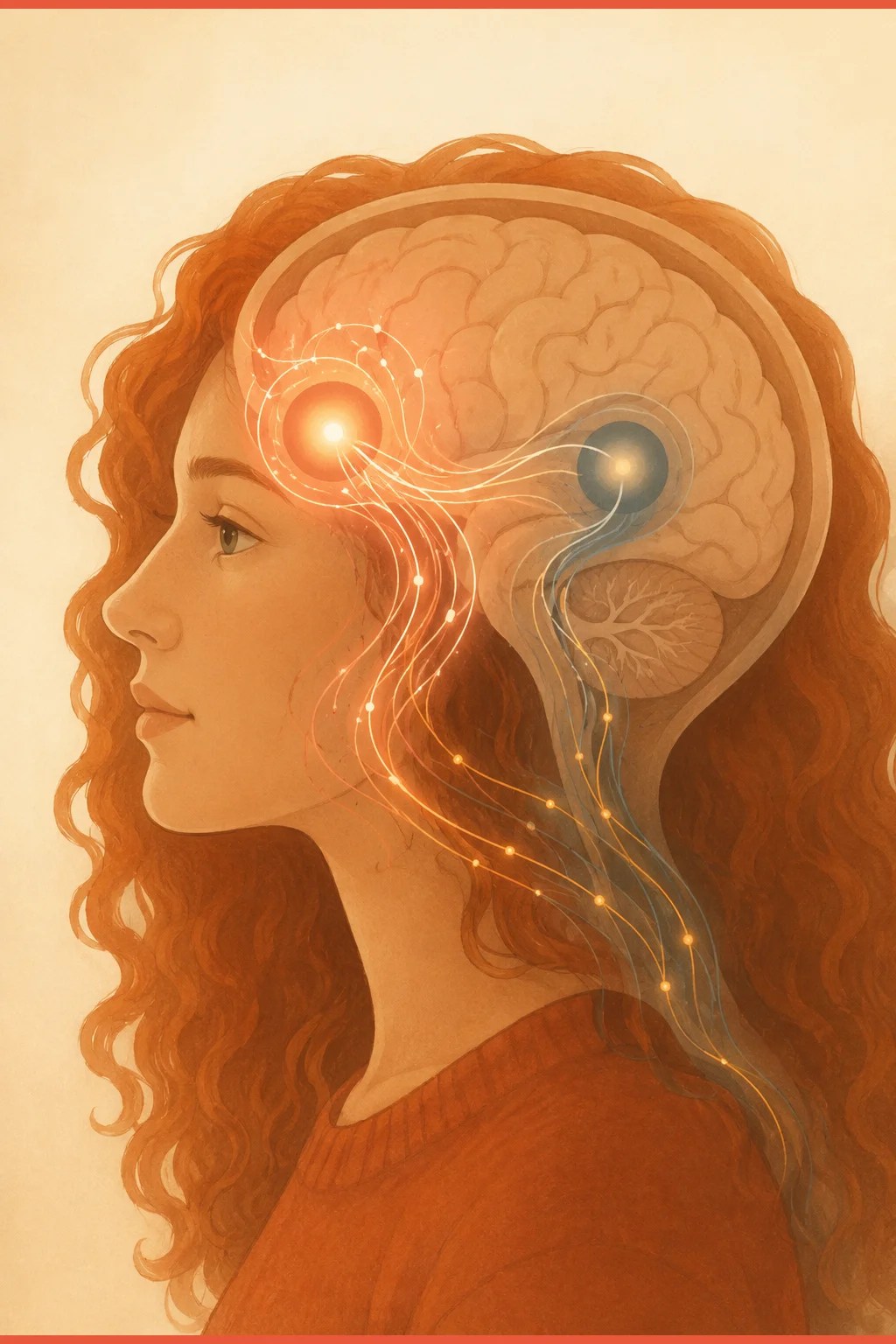
TL;DR — Quick Answer: In ADHD, impulsivity isn’t a willpower problem — it’s a timing problem. Call it the Missing Pause: the split second between an impulse and acting on it, the veto most brains fire automatically, arrives late or weak — so you’re already halfway into the decision before the brake catches. In controlled lab tests, adults with ADHD show a medium-sized deficit in exactly this “stop” ability.² Two honest notes up front. First, unlike emotional dysregulation, impulsivity is a core, defining part of ADHD’s diagnostic criteria — half of the hyperactivity-impulsivity domain — so this part of the picture is well established. Second, impulsive behavior by itself never proves ADHD: it also shows up in bipolar disorder, borderline personality disorder, and substance use, which is why the sorting belongs to a clinician and not a checklist. The goal here is management, not a cure — and it’s very possible.
The four-seconds-ago decision
You said yes before you’d thought it through. You quit the job in the meeting, out loud, in a voice that surprised you. You interrupted her again — not because you weren’t listening, but because the sentence was leaving your mouth before you’d decided to open it. You bought the thing, booked the trip, sent the text, cut the bangs.
And then, a beat later, the review board convenes. Why did I do that? I knew better. What is wrong with me?
Here is the reframe this whole article is built on: nothing is wrong with your character. The problem isn’t that you don’t know better — you almost always know better, usually about four seconds too late. The knowing and the doing aren’t arriving in the right order. That’s not a moral failing you can shame your way out of. It’s a difference in the brain’s timing, and timing is something you can build around once you stop treating it as a personality defect.
This deserves a real explanation instead of another round of think before you act — advice that assumes the thinking and the acting happen in the order the phrase implies. For a lot of adults with ADHD, they don’t.
One scope note before we start. This article is about impulsive decisions and actions — the snap yes, the interruption, the quit-on-the-spot. If your struggle is specifically with money and impulse spending, that has its own guide on how the ADHD brain handles reward and “later”, and we’ll point you there rather than repeat it. And if your impulses tend to ride big waves of feeling — you act rashly because the emotion is enormous — that’s the overlap with emotional dysregulation, which has its own guide too.
The Missing Pause
Definition Box — The Missing Pause: the gap between an impulse and acting on it — the brief internal veto that lets most people catch a prepotent response before it runs. In ADHD, this stop signal is measurably slower and weaker, so the action is often already underway before the brake engages. Impulsivity is a core feature of ADHD — part of the hyperactivity-impulsivity domain, one of ADHD’s two symptom domains alongside inattention — but impulsive behavior on its own is never proof of ADHD, because a short pause has many possible causes.

What the research actually shows
Start with the part that’s solid, because it’s more solid than the emotional-side story people sometimes assume.
Impulsivity is not a fringe feature of ADHD or a modern add-on. It is a core, defining part of the diagnostic criteria — the hyperactivity-impulsivity domain, one of ADHD’s two symptom domains alongside inattention — and the 2021 World Federation of ADHD International Consensus Statement — 208 evidence-based conclusions signed by 80 researchers across 27 countries — treats it as a valid, often lifelong part of the disorder that carries real, measurable consequences in everyday life.¹ That “lifelong” matters: the hyperactivity you may have visibly outgrown often converts, in adulthood, into an internal restlessness and a habit of acting first — the impulsivity outlasts the fidgeting.
The mechanism has a name in the lab: response inhibition — the ability to cancel an action you’ve already started to make. A 2024 systematic review and meta-analysis pooled 27 studies comparing 883 adults with ADHD against 916 adults without, using the stop-signal task (a test that measures, in milliseconds, how long it takes you to abort a response once the “stop” cue appears). Adults with ADHD were reliably slower to hit the brake — a medium-sized deficit.² An older, broader meta-analysis found the same inhibition gap and noted it is one of the more specific findings in ADHD, not something you see across every condition.³ This is the Missing Pause, measured: not a story about willpower, but a timing lag you can see on a stopwatch.
There’s a companion mechanism, and it’s the one that explains the quit-the-job flavor of impulsivity rather than the interrupting flavor. People with ADHD, on average, discount the future more steeply — a smaller reward now tends to outweigh a larger reward later.⁴ That single sentence is as far as we’ll go here, because the money and reward side has its own guide; the point for now is only that “act now” often genuinely feels more rational in the moment than “wait,” which is different from not caring about consequences.
One more nuance worth having, because it prevents a lot of self-misdiagnosis: impulsivity is not one thing. A foundational model breaks it into distinct traits — acting rashly under strong emotion (often called urgency), acting without forethought, difficulty sticking with something, and sensation-seeking.⁵ You might have one of these turned up and the others turned down. The “acting rashly under strong emotion” flavor is exactly where impulsivity shakes hands with emotional dysregulation — if that’s your pattern, that guide is the better companion to this one.
Now the honest brake on all of it: impulsive behavior is common, and it is not specific to ADHD. Everyone acts without thinking sometimes; impulsivity is also a prominent feature of bipolar disorder, borderline personality disorder, and substance use. So the research supports a careful claim — impulsivity is a real, core, measurable part of the ADHD picture — and refuses an overclaim: feeling impulsive, or recognizing yourself in these paragraphs, is not the same as having ADHD.


Why the pause is hard to reach
The lab test tells you that the brake is slow; it doesn’t fully explain why, and here the science is younger and more correlational, so hold it loosely. Imaging and neuropsychological work points toward differences in the brain’s inhibitory and reward circuits — the systems that would, in another brain, fire an automatic “not yet” — rather than any deficit of caring or intelligence.¹ ² The stop-signal task is a clean measurement, but it’s still a proxy: it captures the millisecond veto over a button-press, not the messy real-world decision to hand in your notice. Treat the number as evidence the pause is real, not as a readout of your life choices.
What this does explain is why try harder to think first is such useless advice. The thinking-first is precisely the function that runs slow. You can’t will a faster brake any more than you can will better eyesight — but you can, as we’ll get to, move the pause outside your head, where it doesn’t have to fire in four seconds.
Why this lands harder for late-diagnosed women
If you’re a woman who wasn’t diagnosed until adulthood, impulsivity may have hidden in plain sight for decades — because the loud, hyperactive-impulsive presentation is the one clinicians were trained to spot in boys. An expert consensus statement on females with ADHD describes exactly this: girls and women are under-identified and under-treated, often present with a more internalized, masked profile, and get missed or misdiagnosed for years.¹¹ Your impulsivity may have shown up as talking too much, over-committing, blurting the wrong thing socially, or making a string of “why did I do that” relationship and career decisions — none of which look like the stereotype, all of which are the same underlying timing.
There’s a harder-edged reason to take this seriously rather than laugh it off as being “a bit chaotic.” A major research review following girls with ADHD into adulthood documented elevated rates of self-harm and suicidality, particularly in those with the combined presentation.¹² Impulsivity is part of why that risk is real — a dark moment plus a short pause is a dangerous combination. So one plain sentence, and then we move on: if your impulses have ever turned toward hurting yourself, that is beyond what any article can hold, and it belongs with a professional now — in the US you can call or text 988 (the Suicide & Crisis Lifeline) any time, free and confidential.
And if you spent years performing composure over all of this, the occasional impulsive break tends to look “out of nowhere” to people who never saw the effort underneath. That’s the cruel math of a masked presentation: the restraint is invisible, so only the slip gets witnessed.

Before you call it ADHD: what else produces this exact picture
This section comes before the strategies on purpose. Impulsivity is one of the least specific signals in mental health, and several conditions produce a picture close enough to matter — some of which need a completely different kind of help.
Bipolar disorder. During a manic or hypomanic episode, impulsivity and risky decisions can spike dramatically — spending sprees, abrupt quitting, uncharacteristic sexual or financial choices. The distinguishing feature is the time signature, not the intensity. ADHD impulsivity is chronic and trait-like — it’s how your Tuesday runs, and has for as long as you can remember. Bipolar impulsivity arrives inside discrete mood episodes that last days or longer — a stretch of elevated or irritable mood with reduced need for sleep, racing thoughts, and grandiosity, in a person who isn’t like that the rest of the time.⁹ If your impulsivity comes in waves that last days and lift, rather than as a constant hum, that pattern needs evaluation before anyone concludes “it’s just ADHD” — the ADHD-versus-bipolar distinction has its own guide.
Borderline personality disorder. Impulsivity is itself one of the defining criteria of BPD, so the overlap with ADHD is genuine and the two co-occur often. A review comparing them found the impulsivity in ADHD tends to be more motor and situation-general, while BPD impulsivity is more tied to relationship stress and emotional triggers — and that people with both carry the heaviest impulsivity load of all.¹⁰ The same review recommends screening for trauma in both presentations. This is exactly the sorting an article cannot do and a clinician can.
Substance use. The link runs both ways and deserves plain language. Childhood ADHD raises the later risk of substance use,⁷ and — from the other direction — roughly one in four people in treatment for a substance use disorder also meets criteria for ADHD.⁸ If bringing the impulses down, or chasing the next one, has come to involve alcohol or other substances — even occasionally, even “not that bad” — that’s information for a professional, not a verdict on you, and treating one without the other rarely works.
The unglamorous causes. Sleep debt, high stress, and some medication effects all shorten anyone’s fuse and thin out the pause. They’re worth ruling in or out before reaching for a diagnosis.
A clinician can hold all of these possibilities at once. An article cannot, and neither can the person standing inside the impulse.

The stakes, named without panic
It’s worth being honest that impulsivity has a real-world tab, precisely because naming it is what turns “I’m just chaotic” into “this is worth treating.” The consensus evidence links ADHD to elevated everyday risks — including accidents and injuries¹ — and the driving research is specific: drivers with ADHD have more crashes and traffic citations, though the same research shows stimulant medication improves several driving measures.⁶ These are associations, not your destiny, and they are not here to frighten you. They’re here to make the case that the Missing Pause is a fair target for real help — not a quirk to keep apologizing for.
What actually helps (management, not cure)
The honest headline: you cannot install a faster internal brake by wanting one. What works is moving the pause out of your head and into your environment, plus treating the underlying ADHD so the whole system runs on a better baseline. On medication, the network meta-analysis of 133 trials found stimulants reduce core ADHD symptoms — including the impulsive ones — in adults, at least over the short term studied;¹³ that’s about symptoms on rating scales, not a proven fix for the lab stopwatch, and every medication decision belongs with you and your prescriber. On the non-drug side, cognitive behavioural therapy for adult ADHD shows a moderate-to-large benefit over waitlist,¹⁴ though one careful meta-analysis found the advantage shrinks toward nothing when CBT is compared against an active control rather than no treatment¹⁵ — real, helpful, and worth honest expectations. Everything below is scaffolding around that foundation.
- Name the pattern to the people who matter. “I make big calls too fast — if you ever hear me quit or commit on the spot, hold me to sleeping on it” turns a recurring source of damage into a known quirk with a handrail. It recruits allies instead of an audience, and it beats the alternative, where the people around you invent their own story about why you do what you do.
- Learn the body’s pre-action tell. The Missing Pause has a physical signature a half-second before it fails — the lean-in, the held breath, the hot screw-it surge right before the yes. You can’t lengthen the pause mid-surge, but you can learn to recognize the click of the amplifier switching on, which is the only moment a strategy can catch.
- Build the pause on the outside. Since the internal veto is unreliable, install an external one: a 24-hour rule for any decision over a set dollar amount, a “sleep on it before you resign” pact, a trusted person who is your mandatory phone call before you do The Thing. You’re not trying to feel less impulsive — you’re routing the decision through a delay the impulse can’t override.
- Put friction between the impulse and the money. This one gets a single line because it has its own guide: remove the one-tap purchase, unsave the card, and let that article do the rest.
- If the impulses ride big emotions, treat the emotion. When the rash act is powered by a spike of feeling — the furious resignation, the reckless text after a fight — the leverage is upstream, on the feeling. That’s the emotional dysregulation overlap, and its strategies (catch the spike in the body, build a gap before you respond) are the right tools for this flavor.
- Give the pause fewer battles to fight. Every impulsive channel you close in advance is one the slow brake never has to defend. Delete the app you rage-open, take the credit card out of the wallet, shop from a list, turn on the confirmation step. Reducing the number of one-tap opportunities does quietly what willpower can’t do reliably.
- Treat the ADHD itself, with a professional. Because impulsivity runs on the same machinery as attention and inhibition,¹ ³ treating the underlying condition — a medication conversation with a prescriber,¹³ CBT with a therapist¹⁴ — is upstream of every tactic on this list. The tactics work better on a treated baseline; they are not a substitute for one.


Frequently asked questions
Is impulsivity a symptom of ADHD?
Yes — and this is a real difference from some other parts of the ADHD picture. Impulsivity is a core, defining part of ADHD’s diagnostic criteria — the hyperactivity-impulsivity domain, one of ADHD’s two symptom domains alongside inattention — and it typically persists into adulthood even after visible hyperactivity fades.¹ At the same time, impulsive behavior on its own is never enough to conclude someone has ADHD: it’s common in the general population and prominent in several other conditions. Both things are true at once.
Why do I make big decisions, like quitting a job, on impulse?
Two mechanisms stack up. The brain’s stop signal — the veto over an action already in motion — is measurably slower in adults with ADHD,² and future rewards tend to get discounted more steeply, so “act now” can genuinely feel more sensible in the moment than “wait.”⁴ The speed is mechanism, not carelessness — which is also why the fix is an external delay rather than a resolution to think harder.
How is ADHD impulsivity different from bipolar disorder?
The time signature. ADHD impulsivity is chronic and constant — it’s your baseline. Bipolar impulsivity arrives in sustained mood episodes lasting days or longer, usually with reduced need for sleep, racing thoughts, or grandiosity.⁹ If your impulsivity comes in waves that last days and then lift, get evaluated rather than self-sorting — there’s a full guide to the difference.
Could it be borderline personality disorder instead?
Possibly, and possibly both. Impulsivity is a defining criterion of BPD as well as a core feature of ADHD, the two overlap and co-occur, and people with both carry the heaviest impulsivity load.¹⁰ The distinctions are subtle and the sorting — including screening for trauma — is exactly what a clinician does and an article can’t.
Does medication help with impulsivity?
Trial evidence shows stimulants reduce core ADHD symptoms, including impulsive ones, in adults over the short term studied¹³ — that’s improvement on symptom ratings, not a documented fix for the lab measure of response inhibition. Whether medication belongs in your picture is a conversation for you and your prescriber; nothing here is medication advice.
Is impulsivity worse in women with ADHD?
Women with ADHD are more often missed and misdiagnosed, and their impulsivity tends to hide in socially “acceptable” forms — over-talking, over-committing, string-of-regretted-decisions.¹¹ What’s clearest, and most important, is the elevated risk of self-harm documented in girls followed into adulthood,¹² which raises the stakes of taking impulsivity seriously rather than dismissing it as chaos.
How do I stop acting on impulse in the moment?
Mostly by arranging the moment in advance, because the in-the-moment brake is the part that’s unreliable. Pre-commit to a delay you can’t easily override (a 24-hour rule, a mandatory phone call), learn your body’s pre-action tell, and close off the one-tap channels before you’re standing in front of them. Strategies that respect the slow pause beat strategies that demand instant self-control.
📚 The ADHD Library by Dr. Morgan Reed

If the four-seconds-too-late decisions, the apology tours, and the exhausting effort of trying to think faster are your daily weather, You’re Not Broken: The 7-Week Executive Function Workbook for Late-Diagnosed ADHD Adults was written for exactly this. It’s seven weeks of practical, capacity-first systems for the machinery this article describes — learning your pre-action tell, building the pause on the outside where it can actually work, and closing the one-tap channels before they close on you. The goal was never to make you a more disciplined person. It’s to hand your brain enough structure that the pause stops depending on willpower you were never going to have on demand.
★★★★★
Save this. You’ll want to come back to it.
- 📘 The Masking Tax: The 7-Week ADHD Burnout Recovery Workbook for Late-Diagnosed Adults — new: recovery for the burnout years of masking leave behind.
- 📕 You’re Not Broken: The 7-Week Executive Function Workbook for Late-Diagnosed ADHD Adults — the flagship workbook for rebuilding after a late diagnosis
- 📗 ADHD Mastery for Adults: 3-in-1 — a daily coaching system for the executive-function load
- 📙 Executive Function Rescue — a nine-week program for overwhelm and emotional regulation
Part of The ADHD Library by Dr. Morgan Reed — practical, evidence-informed tools for late-diagnosed adults.
References
1. Faraone SV, Banaschewski T, Coghill D, et al. The World Federation of ADHD International Consensus Statement: 208 evidence-based conclusions about the disorder. Neuroscience & Biobehavioral Reviews. 2021;128:789-818. PMID: 33549739
2. Senkowski D, Ziegler T, Singh M, et al. Assessing inhibitory control deficits in adult ADHD: a systematic review and meta-analysis of the stop-signal task. Neuropsychology Review. 2024;34(2):548-567. PMID: 37300725
3. Lipszyc J, Schachar R. Inhibitory control and psychopathology: a meta-analysis of studies using the stop signal task. Journal of the International Neuropsychological Society. 2010;16(6):1064-1076. PMID: 20719043
4. Jackson JNS, MacKillop J. Attention-deficit/hyperactivity disorder and monetary delay discounting: a meta-analysis of case-control studies. Biological Psychiatry: Cognitive Neuroscience and Neuroimaging. 2016;1(4):316-325. doi:10.1016/j.bpsc.2016.01.007
5. Whiteside SP, Lynam DR. The Five Factor Model and impulsivity: using a structural model of personality to understand impulsivity. Personality and Individual Differences. 2001;30(4):669-689. doi:10.1016/S0191-8869(00)00064-7
6. Barkley RA, Cox D. A review of driving risks and impairments associated with attention-deficit/hyperactivity disorder and the effects of stimulant medication on driving performance. Journal of Safety Research. 2007;38(1):113-128. PMID: 17303170
7. Lee SS, Humphreys KL, Flory K, Liu R, Glass K. Prospective association of childhood attention-deficit/hyperactivity disorder (ADHD) and substance use and abuse/dependence: a meta-analytic review. Clinical Psychology Review. 2011;31(3):328-341. PMID: 21382538
8. van Emmerik-van Oortmerssen K, van de Glind G, van den Brink W, et al. Prevalence of attention-deficit hyperactivity disorder in substance use disorder patients: a meta-analysis and meta-regression analysis. Drug and Alcohol Dependence. 2012;122(1-2):11-19. PMID: 22209385
9. National Institute of Mental Health. Bipolar Disorder. https://www.nimh.nih.gov/health/topics/bipolar-disorder
10. Ditrich I, Philipsen A, Matthies S. Borderline personality disorder (BPD) and attention deficit hyperactivity disorder (ADHD) revisited — a review-update on common grounds and subtle distinctions. Borderline Personality Disorder and Emotion Dysregulation. 2021;8(1):22. PMID: 34229766
11. Young S, Adamo N, Ásgeirsdóttir BB, et al. Females with ADHD: an expert consensus statement taking a lifespan approach providing guidance for the identification and treatment of attention-deficit/hyperactivity disorder in girls and women. BMC Psychiatry. 2020;20(1):404. PMID: 32787804
12. Hinshaw SP, Nguyen PT, O’Grady SM, Rosenthal EA. Annual research review: attention-deficit/hyperactivity disorder in girls and women: underrepresentation, longitudinal processes, and key directions. Journal of Child Psychology and Psychiatry. 2022;63(4):484-496. PMID: 34231220
13. Cortese S, Adamo N, Del Giovane C, et al. Comparative efficacy and tolerability of medications for attention-deficit/hyperactivity disorder in children, adolescents, and adults: a systematic review and network meta-analysis. Lancet Psychiatry. 2018;5(9):727-738. PMID: 30097390
14. Young Z, Moghaddam N, Tickle A. The efficacy of cognitive behavioral therapy for adults with ADHD: a systematic review and meta-analysis of randomized controlled trials. Journal of Attention Disorders. 2020;24(6):875-888. PMID: 27554190
15. Knouse LE, Teller J, Brooks MA. Meta-analysis of cognitive-behavioral treatments for adult ADHD. Journal of Consulting and Clinical Psychology. 2017;85(7):737-750. PMID: 28504540
This article is for educational purposes only and is not a substitute for professional medical or mental-health advice, diagnosis, or treatment. Impulsivity has many possible causes — including bipolar disorder, borderline personality disorder, substance use, trauma, high stress, and sleep deprivation — that only a qualified clinician can sort out, and impulsive behavior alone does not mean a person has ADHD. Decisions about ADHD medication belong with your prescriber. If your impulses ever turn toward hurting yourself, or you feel unsafe, please reach out now: in the US, call or text 988 (the Suicide & Crisis Lifeline), any time, free and confidential.
Written by Dr. Morgan Reed, specialist in ADHD and executive function. Last reviewed: August 2026.
As an Amazon Associate, I earn from qualifying purchases — at no extra cost to you. Full disclosure.
Leave a Reply