

27 min read
TL;DR — Quick Answer: The shower is right there. You know exactly how to take one. And still, on the worst days, the distance between your bed and the bathroom might as well be a canyon — and by the time you’ve not-crossed it for the third day, a quiet verdict has settled in: something is wrong with me, I’m gross, I’m a failed adult. That verdict is wrong. Self-care tasks like showering, brushing your teeth, changing clothes, and eating a real meal are, for an ADHD brain, secretly the hardest category of task there is — not the easiest. They arrive with none of the things that make an ADHD brain able to start: no deadline, no one watching, no reward, and often a stack of small sensory-heavy steps on top. Call it the Reward Desert: the stretch of tasks that give your brain nothing to run on, which is exactly why the “basic” stuff is where you stall. There is no research measuring “ADHD and showering” directly — but the machinery underneath (how ADHD brains start tasks, chase reward, and process sensory input) is well documented. Once you see the design, you stop needing willpower you were never going to have, and start changing the conditions instead.
The shower you keep not taking
Everyone’s version has a different shape. For some it’s the shower — three, four days, the dread building each morning until washing your hair feels like an expedition. For others it’s teeth left unbrushed until your mouth feels wrong, the same clothes worn a fifth day because changing means a decision, meals skipped because feeding yourself was a chain of steps no one was there to start. Whatever the task, it carries a weight far heavier than itself — because it stopped being a chore a while ago and became evidence.
Every time you walk past the bathroom, some part of you registers I really need to shower, walks past anyway, and lays down a thin layer of shame on top of yesterday’s layer. Over time the task stops being a to-do and hardens into a verdict: proof that you’re lazy, that you don’t care about yourself, that every other adult manages this invisible baseline and you, somehow, cannot.
That verdict is not just cruel — it’s wrong, and it’s backwards. This article is about why. Not the “romanticize your self-care routine with a new shower caddy” version (you have tried the caddy), but the actual brain differences that make self-care specifically hard, and why the advice to just take a shower was never built for the way an ADHD brain works. Seeing the mechanism is what lets you stop treating a stall as a moral failing and start treating it as a design problem — the kind that has design solutions.
Why self-care is the hardest task type for an ADHD brain
Definition Box — The Reward Desert: the category of tasks that arrive with none of the signals an ADHD brain uses to get started — no deadline, no one watching, no reward, and no novelty — leaving nothing to run on. Self-care and hygiene are the purest examples: showering on an ordinary Tuesday has no due date, no audience, and no dopamine payoff, so a brain wired to act on urgency, interest, and reward finds it strangely, disproportionately hard to begin. “Reward Desert” is a lens for organizing what the research shows about ADHD, reward, and task initiation — a useful map, not a clinical diagnosis, and no study has measured a thing by that name.
To see why the loss hits ADHD specifically, it helps to name what these tasks are missing. ADHD sits, in the model most clinicians work from, at the level of attention and self-regulation — the differences a large international consensus statement places at the core of the condition.¹ And one of the most reliable descriptions of ADHD is that it’s less a problem of knowing what to do than of doing the known thing at the moment it needs doing — what Russell Barkley calls a disorder at the “point of performance.”³ You already know how to shower. The gap is at the point of performance: the specific moment, alone in your room, when the doing has to happen and nothing in the environment is pushing it.
Most tasks you manage are being quietly pushed by something outside you. Work has deadlines and a boss; a dinner with a friend has a time and someone who’ll notice if you don’t show; cleaning before guests has an audience. Those external forces do a huge amount of the starting for you — it feels like choosing to act, but the environment is doing the heavy lifting. Self-care is the one category with none of it. No one sees whether you showered, nothing is due, and the reward is diffuse and delayed. It’s the task stripped of every external signal — which turns out to be the exact condition an ADHD brain finds hardest.
Three forces make that desert so hard to cross: no signal to start (why self-care never feels urgent), the task is a stack, not a step (why “just shower” is heavier than it sounds), and the wall of awful (why each skipped day makes the next one harder). None of them is a character flaw. Together, they’re the trap — and each one points at a way through.

Force 1: No signal to start
Start with why self-care never generates its own urgency. An ADHD brain runs, to an unusual degree, on immediacy and reward — and self-care offers neither.
The reward piece is well studied. Across case-control studies, people with ADHD tend to discount delayed rewards more steeply — a smaller reward now consistently beats a larger reward later — one of the most robust findings in the field.⁴ Brain-imaging work fits the same picture: meta-analysis of fMRI studies finds the ADHD brain shows a blunted response in the reward-anticipation circuitry when a payoff is coming, at a medium effect size.⁵ In children and adolescents, the same tilt toward smaller-sooner rewards shows up as a reliable, medium-sized difference in choice-impulsivity.⁶ (Those studies measured choices about money in a lab, not whether anyone showered, so reading them onto self-care is a reasonable synthesis — not a directly measured finding.)
Put that next to a shower and the mismatch is obvious. Showering pays off in a currency the ADHD brain barely registers: a small, delayed, invisible reward with no deadline forcing the moment. A brain that under-responds to reward it can’t feel yet is being asked to act now for a benefit that’s faint and far away. It’s not that you don’t want to be clean and comfortable — it’s that “later, a bit, maybe” is the weakest possible motivator for a system that needs now, a lot, obviously, which is why the task sits undone while urgent or interesting things get handled fine. This is the same starting-gate problem behind ADHD task paralysis: the knowing is intact; the starting is where the wiring gives out.

Force 2: The shower is a stack, not a step
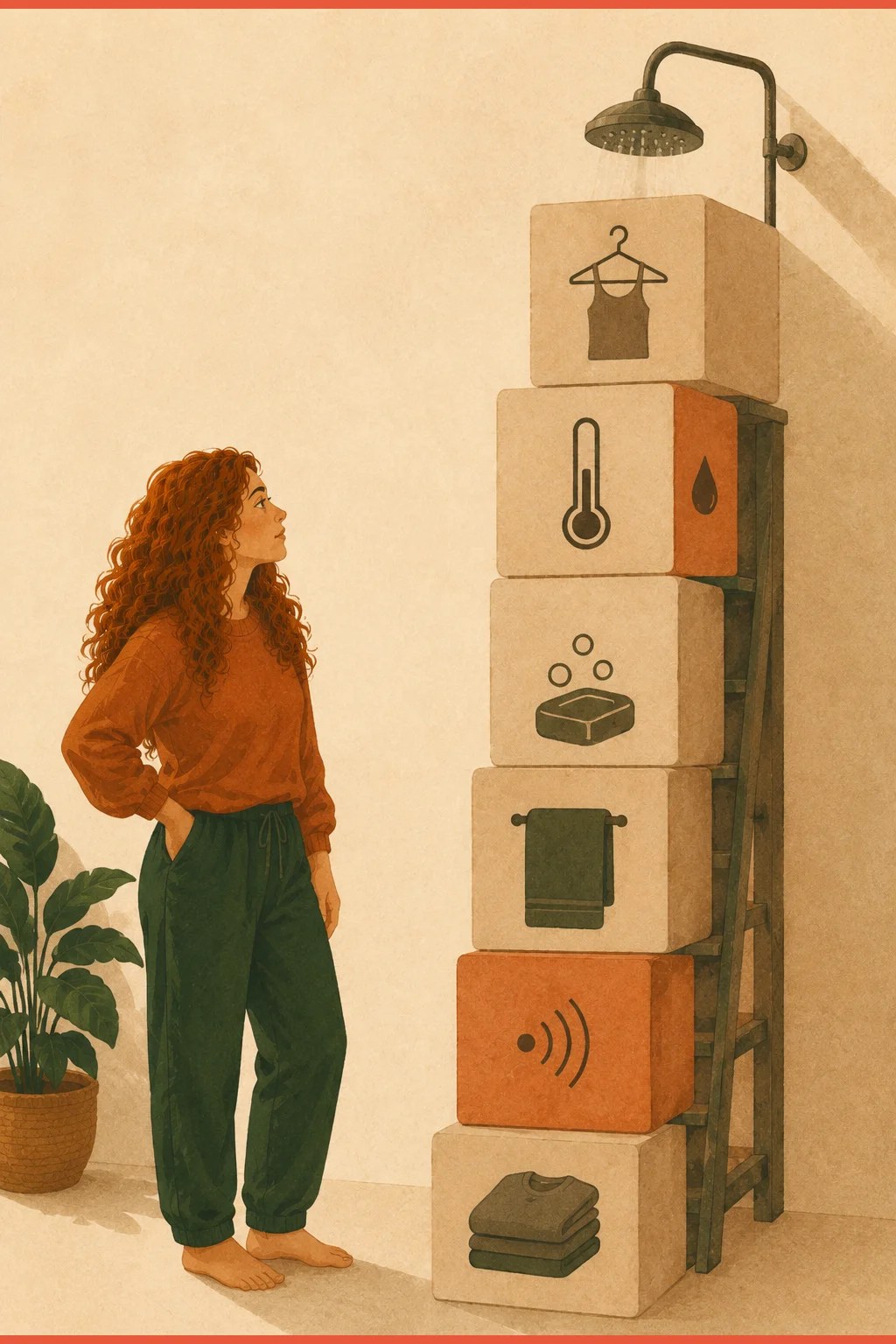
Now the force that explains why self-care is heavier than it looks from outside. “Take a shower” sounds like one action. It is not. It’s a chain: notice you need to, decide to, stop what you’re doing, undress, deal with the water temperature, actually wash, get out, dry off, find clean clothes, put them on, deal with wet hair. For a brain that finds initiation and sequencing cheap, that chain is invisible. For an ADHD brain, executive-function differences in planning, sequencing, and organizing behavior are real and medium-sized in the research² — so the chain is not invisible at all. It’s a dozen small demands, each a place to stall.
And several links in that chain carry a sensory charge that the standard picture ignores. Sensory processing often runs differently in adult ADHD: one study found atypical sensory sensitivity — heightened or blunted — in 43% of women with ADHD, nearly double the 22% seen in men.⁷ (That’s a self-report finding from a single clinic sample, measuring general sensitivity rather than showering specifically — so hold it as “sensory friction is common,” not a law.) For many people that makes the concrete steps genuinely aversive, not merely boring: the cold moment before the water warms, the loud drum of the shower, the heavy discomfort of wet hair, the specific wrongness of certain fabrics against skin. When a task is both a long chain and studded with small sensory costs, “why can’t you just do it” stops being a fair question. You’re not avoiding one easy thing. You’re facing a stack of small hard things with nothing pushing you up it.
Force 3: The wall of awful
The third force is what all of this builds into over time. Miss the shower once and it’s a shower. Miss it for four days while shame stacks up, and standing outside the bathroom you’re no longer facing water and soap — you’re facing everything the task now means.
The ADHD community has a name for this, coined by ADHD coach Brendan Mahan: the “wall of awful.” It’s the invisible barrier of accumulated shame, dread, and past failure that builds in front of an avoided task, growing taller every time you don’t do the thing, until the wall — not the task — is what you can’t get over. It’s a coaching concept, not a research finding, but it names something real, and there’s science underneath why it hits ADHD so hard.
Emotions tend to run more intensely in adults with ADHD. A meta-analysis found emotion dysregulation at a large effect size, with emotional lability the strongest piece.⁸ So the shame that gathers around an undone self-care task doesn’t sit quietly in the background — it can flood, and a flooded brain avoids the source of the flooding, which makes the wall taller, which produces more shame. It’s a loop that feeds itself. There’s a documented backdrop to the shame, too: across the long-term research, untreated ADHD is linked to lower self-esteem⁹ — meaning many late-diagnosed women arrive at the bathroom door already carrying years of I can’t manage the basics before today’s shower is even added to the pile.
Naming the wall is not an excuse; it’s the opposite. The shame layer is the part you can actually take down, and taking it down is what makes the task underneath approachable again.

Why “just take a shower” was never going to work
The advice everyone offers — just take a shower, just brush your teeth, just do the bare minimum — describes a brain that generates its own urgency, finds a multi-step task trivial, isn’t taxed by sensory input, and doesn’t carry a wall of shame. That describes the person giving the advice, not the machinery you’re working with. Told to “just do it,” an ADHD brain hits every force at once: nothing external is pushing the moment, the task is secretly a stack, several steps are sensory-aversive, and a wall of accumulated dread stands in front of the whole thing. “Just shower” asks you to power through all of that on willpower — the single resource ADHD makes least reliable.
So the stall isn’t a discipline problem you can shame yourself out of. Shame is, if anything, part of the machinery keeping it stuck. It’s a design problem that needs design solutions: shrink the stack, add a signal the environment isn’t giving you, lower the sensory cost, and take down the wall. Change the conditions, and the task you couldn’t force becomes a task you can actually start.
What a self-care stall doesn’t mean
Because self-care is so heavily moralized — we treat it as the floor of being a functional adult — a few honest boundaries matter more here than almost anywhere.
It doesn’t mean you’re lazy or dirty. A self-care stall is the predictable output of reward wiring, executive load, sensory friction, and accumulated shame stacking up — not evidence of a flawed character or a person who doesn’t care. ADHD genuinely impairs day-to-day functioning across domains in the research;¹² the difficulty is real, and naming its mechanism is the opposite of an excuse. It’s what lets you build around the difficulty instead of blaming yourself for it.
It doesn’t mean you don’t care about yourself. This is the cruelest misreading, and the most common. The struggle is at the point of performance — the doing — not at the level of caring. Wanting to be clean and comfortable and being unable to start are completely compatible in an ADHD brain; that gap is the whole condition, not a measure of how much you value yourself.
It isn’t self-diagnosable. Nearly everyone has depleted weeks where the basics slide; that alone says nothing. If difficulty with self-care is one thread in a lifelong, pervasive pattern alongside other attention and initiation struggles, a validated ADHD screening tool for women is a reasonable thing to bring to a professional — but a screen only flags likelihood; it never diagnoses. And the flip side matters just as much: a self-care collapse can point somewhere other than ADHD entirely, which is the next section.

When it’s more than ADHD
For most people with ADHD, a self-care struggle is exhausting and lifelong-familiar — the wiring above, running as designed. But one pattern is important enough to name plainly, because it responds to different help and telling it apart is a job for a professional, not an article.
The distinction is sudden versus lifelong. ADHD-driven self-care difficulty tends to be a long-running texture of your life — hard on bad days, present in some form for as long as you can remember. A relatively sudden collapse in your ability to keep up with self-care you used to manage — especially alongside a low mood that won’t lift, a loss of interest in things you used to enjoy, heavy fatigue, or a sense that nothing is worth the effort — can be a signal of depression rather than ADHD alone. Not because “poor hygiene” is a checkbox symptom on any list, but because when the core features of a depressive episode set in — diminished interest and pleasure, loss of energy, a slowing-down of body and mind — self-care is very often one of the first things to go.¹⁰ ¹¹ Depression is also one of the most common conditions to travel alongside ADHD, which can make the two genuinely hard to untangle from the inside.¹⁰
This isn’t something to diagnose yourself with from a blog post. It’s a reason to bring the specifics to someone qualified if the collapse feels sudden, or is wrapped up in a heavier shift in mood and energy — a distinction we cover in ADHD and depression. Reaching out for that is not a failure of self-care; it is self-care, of the most important kind. If things ever feel darker than low — if you’re having thoughts of not wanting to be here — please treat that as the priority it is: in the US you can call or text 988 (the Suicide and Crisis Lifeline) any time, free and confidential, 24/7.

What actually helps
You don’t win back self-care by finally mustering the discipline everyone says you lack — that framing is the thing that’s been failing you. You change the conditions so the three forces stop working against you. None of this cures ADHD or promises a spotless streak — everyone has off days — but each move targets one force, and the goal is “good enough, most days,” not perfection.
Lower the bar on purpose. A “bad” version you actually do beats a perfect one you never start — dry shampoo, body wipes, a rinse instead of a full shower. These aren’t cheating; they’re the version that happens, and something is infinitely more than nothing.
Shrink the stack, then add a signal. Remove links before you start — clothes out, water preset, everything in one place — so no step needs a decision. Then borrow the external push self-care lacks: anchor the task to a fixed daily event, or body-double with a friend on the phone.
Cut the sensory cost. If specific steps are aversive, engineer them out — warm the room first, softer towels, brushing your teeth in the shower to fold two dreaded tasks into one. You’re not being fussy; you’re removing real friction.
Take down the wall, out loud. Name it — “that’s the wall of awful, not proof I’m failing” — and meet yourself with the kindness you’d give a friend. Shame is what makes the task something to avoid, so lowering it is a real strategy, not a nicety. This is the same overload territory as broader ADHD overwhelm, where the same self-compassion move helps.
If the difficulty extends past your own body to the space around you — the dishes, the laundry, the growing pile on the chair — the same design logic applies there too, which we cover in ADHD doom piles.

7 ways to make self-care possible with ADHD

- Lower the bar and keep it lowered. A five-second rinse, dry shampoo, or a wipe-down counts. The “bad” version you actually do beats the perfect routine you keep postponing — do the smallest version and let it be enough.
- Shrink the task into fewer steps. Lay clothes out ahead of time, preset the water temperature, and keep everything in one spot, so starting doesn’t require a string of separate decisions.
- Anchor self-care to something you already do. Attach the shower or tooth-brushing to a fixed daily event — before your first coffee, after a specific show — so an existing habit supplies the cue the task doesn’t have on its own.
- Body-double it. Get ready while a friend is on the phone or video, or start a shared “getting ready” thread. Another person’s presence can supply the momentum an ADHD brain won’t generate alone.
- Design out the sensory friction. Warm the bathroom first, swap in softer towels and fabrics, brush your teeth in the shower — remove the specific physical discomforts that make individual steps feel awful.
- Keep backup tools where you actually are. A toothbrush by the couch, wipes in the drawer, deodorant in your bag — meeting yourself where you’re stuck beats requiring a trip to the “right” room you can’t make yourself take.
- Say the shame out loud and drop the verdict. Name it — “that’s the wall of awful, not proof I’m disgusting” — because the shame layer is what makes self-care something to avoid, and dropping it is what makes the task underneath approachable again.
Frequently asked questions
Why is showering so hard for people with ADHD?
Because a shower isn’t the single easy task it looks like — for an ADHD brain it’s the hardest kind of task. It has no deadline, no one watching, and only a small, delayed reward, so it gives a brain that runs on urgency and reward almost nothing to start with.³ ⁴ ⁵ It’s also secretly a chain of a dozen steps, several of them sensory-aversive (cold, noise, wet hair),² ⁷ and after a few missed days a wall of shame builds in front of it. The difficulty is at the point of doing, not caring or knowing — which is exactly where ADHD wiring gives out. There’s no study on “ADHD and showering” itself; this is drawn from the research on how ADHD brains handle reward, initiation, and sensory input.
Does struggling to shower mean I’m lazy or don’t care about myself?
No — and it’s close to the opposite. Wanting to be clean and being unable to start are fully compatible in an ADHD brain, because the struggle is at the point of performance (the doing), not the level of caring.³ A self-care stall is the predictable result of documented differences in reward, executive function, and sensory processing, plus accumulated shame⁸ — not a flawed character. The belief that you’re lazy or dirty actually feeds the problem: it turns the task into something to avoid, and avoidance is what makes it worse.
What is the “wall of awful”?
It’s a term coined by ADHD coach Brendan Mahan for the invisible barrier of shame, dread, and past failure that builds up in front of an avoided task — growing taller each time you don’t do the thing, until the wall, not the task, is what you can’t get past. It’s a coaching concept rather than a clinical diagnosis, but it describes something real, and the intense emotions common in ADHD⁸ help explain why it stacks up so fast around self-care.
Is not showering a sign of depression or ADHD?
It can be either, and telling them apart matters. ADHD-related self-care struggle tends to be lifelong and familiar — hard on bad days for as long as you can remember. A relatively sudden collapse in self-care you used to manage, especially with a low mood that won’t lift, loss of interest, or heavy fatigue, can point to depression, where self-care is often one of the first things to go as energy and interest drain.¹⁰ ¹¹ Depression also commonly co-occurs with ADHD.¹⁰ Only a professional can tell them apart — so if the change feels sudden or comes with a heavier mood shift, that’s worth bringing to someone qualified. In the US you can call or text 988 any time.
How can I make myself shower when I have ADHD?
Stop trying to force it and change the conditions instead. Lower the bar (a rinse or dry shampoo counts), shrink the steps (clothes out, water preset), anchor it to something you already do daily, body-double with a friend on the phone, and design out the sensory parts you hate (warm the room first, softer towels). Each move replaces the willpower the task was demanding with a bit of structure — which is far more reliable than trying harder.
Why can I manage big things but not basic self-care?
Because “big things” usually come with the exact signals self-care lacks: deadlines, other people, consequences, novelty, or urgency — all of which do the starting for you. Self-care has none of that external push, so it falls into what this article calls the Reward Desert: the tasks with nothing for an ADHD brain to run on.³ ⁴ It’s not that you can only do the impressive stuff and are too lazy for the basics — it’s that the basics are, for this wiring, genuinely the harder category.
Is “executive dysfunction” why I can’t keep up with hygiene?
It’s a real part of it. Executive function — the skills that plan, sequence, and initiate action — runs less reliably in ADHD at a medium effect size,² and self-care is a multi-step, self-started task that leans hard on exactly those skills. But it’s not the whole story: reward wiring,⁴ ⁵ sensory friction,⁷ and the shame wall⁸ all stack on top, which is why single fixes rarely hold and changing several conditions at once works better.
If having someone on the line is the only way the shower happens, that strategy has a name and a practice — here’s our full guide to ADHD body doubling.
📚 The ADHD Library by Dr. Morgan Reed

If self-care keeps collapsing under a shame you can’t explain, there’s a workbook built for exactly this. The Masking Tax: The 7-Week ADHD Burnout Recovery Workbook for Late-Diagnosed Adults walks you out of the overdrive-to-crash cycle — calming your nervous system, easing the shame, and rebuilding executive function at a pace your brain can actually hold.
★★★★★
Save this. You’ll want to come back to it.
- 📕 You’re Not Broken: The 7-Week Executive Function Workbook for Late-Diagnosed ADHD Adults — the flagship workbook for rebuilding after a late diagnosis
- 📗 ADHD Mastery for Adults: 3-in-1 — a daily coaching system for the executive-function load
- 📙 Executive Function Rescue — a nine-week program for overwhelm and emotional regulation
Part of The ADHD Library by Dr. Morgan Reed — practical, evidence-informed tools for late-diagnosed adults.
References
1. Faraone SV, Banaschewski T, Coghill D, et al. The World Federation of ADHD International Consensus Statement: 208 evidence-based conclusions about the disorder. Neuroscience & Biobehavioral Reviews. 2021;128:789–818. PMID: 33549739
2. Willcutt EG, Doyle AE, Nigg JT, Faraone SV, Pennington BF. Validity of the executive function theory of attention-deficit/hyperactivity disorder: a meta-analytic review. Biological Psychiatry. 2005;57(11):1336–1346. PMID: 15950006 (predominantly child/adolescent samples; effects medium and, per the authors, “neither necessary nor sufficient” to cause ADHD)
3. Barkley RA. Attention-Deficit Hyperactivity Disorder: A Handbook for Diagnosis and Treatment. 4th ed. New York: Guilford Press; 2015. (Source of the “point of performance” concept: ADHD as a disorder of performance, not knowledge — doing the known thing at the moment it must be done.)
4. Jackson JNS, MacKillop J. Attention-deficit/hyperactivity disorder and monetary delay discounting: a meta-analysis of case-control studies. Biological Psychiatry: Cognitive Neuroscience and Neuroimaging. 2016;1(4):316–325. PMID: 27722208 (mixed child and adult samples; hypothetical monetary-choice tasks, not real-world chores)
5. Plichta MM, Scheres A. Ventral-striatal responsiveness during reward anticipation in ADHD and its relation to trait impulsivity in the healthy population: a meta-analytic review of the fMRI literature. Neuroscience & Biobehavioral Reviews. 2014;38:125–134. PMID: 23928090 (mixed adolescent/adult fMRI samples; medium effect, d ≈ 0.48–0.58; brain-imaging inference, not a measure of everyday motivation)
6. Patros CHG, Alderson RM, Kasper LJ, Tarle SJ, Lea SE, Hudec KL. Choice-impulsivity in children and adolescents with attention-deficit/hyperactivity disorder (ADHD): a meta-analytic review. Clinical Psychology Review. 2016;43:162–174. PMID: 26602954 (children and adolescents only; medium effect g ≈ 0.47)
7. Bijlenga D, Tjon-Ka-Jie JYM, Schuijers F, Kooij JJS. Atypical sensory profiles as core features of adult ADHD, irrespective of autistic symptoms. European Psychiatry. 2017;43:51–57. PMID: 28371743 (self-report, single clinic, N = 116; measures general sensory hyper-/hyposensitivity, not showering specifically)
8. Beheshti A, Chavanon ML, Christiansen H. Emotion dysregulation in adults with attention deficit hyperactivity disorder: a meta-analysis. BMC Psychiatry. 2020;20(1):120. PMID: 32164655 (adults; large effect, Hedges’ g ≈ 1.17; measures emotion dysregulation/lability, not “shame” or avoidance directly)
9. Harpin V, Mazzone L, Raynaud JP, Kahle J, Hodgkins P. Long-term outcomes of ADHD: a systematic review of self-esteem and social function. Journal of Attention Disorders. 2016;20(4):295–305. PMID: 23698916 (spans childhood to adulthood; measures self-esteem, not shame)
10. Katzman MA, Bilkey TS, Chokka PR, Fallu A, Klassen LJ. Adult ADHD and comorbid disorders: clinical implications of a dimensional approach. BMC Psychiatry. 2017;17(1):302. PMID: 28830387 (narrative review; supports depression as a common comorbidity, not a precise prevalence figure)
11. American Psychiatric Association. Diagnostic and Statistical Manual of Mental Disorders, 5th ed., Text Revision (DSM-5-TR). Washington, DC: American Psychiatric Association; 2022. (Major Depressive Disorder criteria: diminished interest/pleasure, fatigue/loss of energy, psychomotor changes; reduced self-care is a downstream consequence of these, not a listed criterion.)
12. Agarwal R, Goldenberg M, Perry R, IsHak WW. The quality of life of adults with attention deficit hyperactivity disorder: a systematic review. Innovations in Clinical Neuroscience. 2012;9(5–6):10–21. PMID: 22808445 (review of heterogeneous studies; broad quality-of-life outcomes, not self-care specifically)
This article is for general educational purposes only and is not medical advice, diagnosis, or treatment. “The wall of awful” is a community coaching term (coined by Brendan Mahan), and “the Reward Desert” is an explanatory framework from The ADHD Truth — neither is a clinical diagnosis, and the mechanisms here are drawn from research on ADHD, reward, executive function, and sensory processing rather than from studies of self-care or showering themselves. ADHD, depression, and related conditions can only be diagnosed by a qualified professional through a comprehensive evaluation — no article or screening tool can diagnose you. A sudden decline in self-care alongside low mood or loss of interest can be a sign of depression and is worth raising with a healthcare provider. If you are struggling emotionally or having thoughts of harming yourself, the 988 Suicide & Crisis Lifeline (call or text 988) is available 24/7, free and confidential.
Written by Dr. Morgan Reed, specialist in ADHD and executive function. Last reviewed: August 2026.
As an Amazon Associate, I earn from qualifying purchases — at no extra cost to you. Full disclosure.
Leave a Reply