

22 min read
TL;DR — Quick Answer: An ADHD morning routine for women fails when it’s designed around willpower instead of neurobiology. ADHD brains run on a delayed circadian phase, low morning dopamine, and stalled task initiation — three layers that compound before 9 AM. The Morning Trigger Stack™ uses three layers (environment → sensory → cognitive) to bypass the layers your brain can’t power through. Below: the neuroscience, five evidence-based strategies, and the identity work most morning routine advice ignores.
Last updated: June 2026 · Reviewed by The ADHD Truth editorial team
6:42 AM and Your Body Won’t Move
The alarm has been going for nine minutes. You’re aware of it. You’ve thought, three separate times, that you should get up. The clock says 6:42 AM and you know — intellectually — that if you don’t move in the next four minutes, the entire day will run late. You can see it. You can predict it. And your body is not moving.
This isn’t laziness. This isn’t a discipline failure. What you’re experiencing in this exact moment — the awareness without the motion, the wanting without the action — is the most-misunderstood symptom of late-diagnosed ADHD in women.
I should know. I’m Dr. Morgan Reed. I’m a specialist in ADHD and executive function. I was diagnosed with ADHD at 38, after twenty years of waking up in this exact 6:42 AM scene and adding it to the running list of evidence that something was wrong with me.
The list was wrong. The mornings weren’t a character problem. They were a brain problem — and once you understand what’s actually happening in those nine minutes between the alarm and the move, the workarounds stop being motivational and start being neurological. That’s the entire frame of this post.
Why ADHD Mornings Fail (The 3-Layer Cascade)

Late-diagnosed women have usually been told, by themselves and by everyone else, that they’re “just not morning people.” That label is wrong in a specific way: it describes a symptom without naming the cause. The cause is three biological layers that compound, in order, before 9 AM. Once you can see them, you stop trying to fix the wrong one.
Layer 1 — Delayed circadian phase. Adult ADHD brains tend to run on a shifted internal clock. Research consistently shows that ADHD is associated with a later chronotype and a phase delay in circadian markers such as dim-light melatonin onset, meaning the natural sleep-wake cycle is pushed later than the cultural 9-to-5 default.¹ Your “should-wake” time and your “biologically wake-ready” time can be mismatched by design, not by choice. The morning grogginess most adults experience for a short while — what sleep researchers call sleep inertia — can feel heavier for the ADHD brain, because the cognitive systems coming back online are starting from a deeper, later-phased state.
Layer 2 — Low morning dopamine. Time perception and motor initiation in the brain both require adequate dopamine signaling in the striatum and prefrontal cortex. ADHD brains show measurable reductions in dopamine activity in the brain’s reward and motivation pathway.² Dopamine also follows a circadian curve — it tends to be lowest in the early morning, climbing through the day. For an ADHD brain, the morning window is the worst possible time to ask the prefrontal cortex to do anything that requires self-initiated motor output. Things like, for example, getting out of bed.
Layer 3 — Stalled task initiation. Executive function is the brain’s ability to take an intention and turn it into a motor output. Meta-analyses of adult ADHD show measurable deficits in executive functions such as response inhibition and related control processes — exactly the kind of functions most loaded during morning transitions.³ The bridge between “I should get up” and “my body is now sitting up” has more friction in an ADHD brain than in a neurotypical one.
Dr. Russell Barkley — a clinical psychologist at Virginia Commonwealth University whose four-decade research career has redefined how we understand adult ADHD — frames this directly:

Three layers. Late-diagnosed women have been told they’re “just not morning people” for decades. The cascade above is the actual mechanism underneath that label.
The Continuum vs Disorder Framework

If you’ve read anywhere else on this site, you may have encountered the Continuum vs Disorder framework — my reframe of why “everyone has a little ADHD” is harmful for late-diagnosed women specifically. Mornings are where that framework becomes most viscerally true.
Almost everyone has had a morning where the alarm felt brutal. That’s the continuum — the universal human experience of sleep inertia, low dopamine, transient grogginess. What women with clinical ADHD experience tends to be categorically different in severity, persistence, cross-setting presence, and developmental onset. It’s not that your morning is a little harder than your neurotypical sister’s. It’s that your morning runs on different biological hardware, and the strategies that work for her hardware actively make yours worse.
This matters because the dominant cultural script for “fixing” a bad morning routine assumes you’re somewhere on the continuum — that with enough willpower or the right 5 AM club book, you’ll improve. For ADHD brains, that script is the trap. It blames you for an architecture problem.
The strategies in this post don’t sit on the continuum. They’re designed for the architecture.
What is the Morning Trigger Stack™?
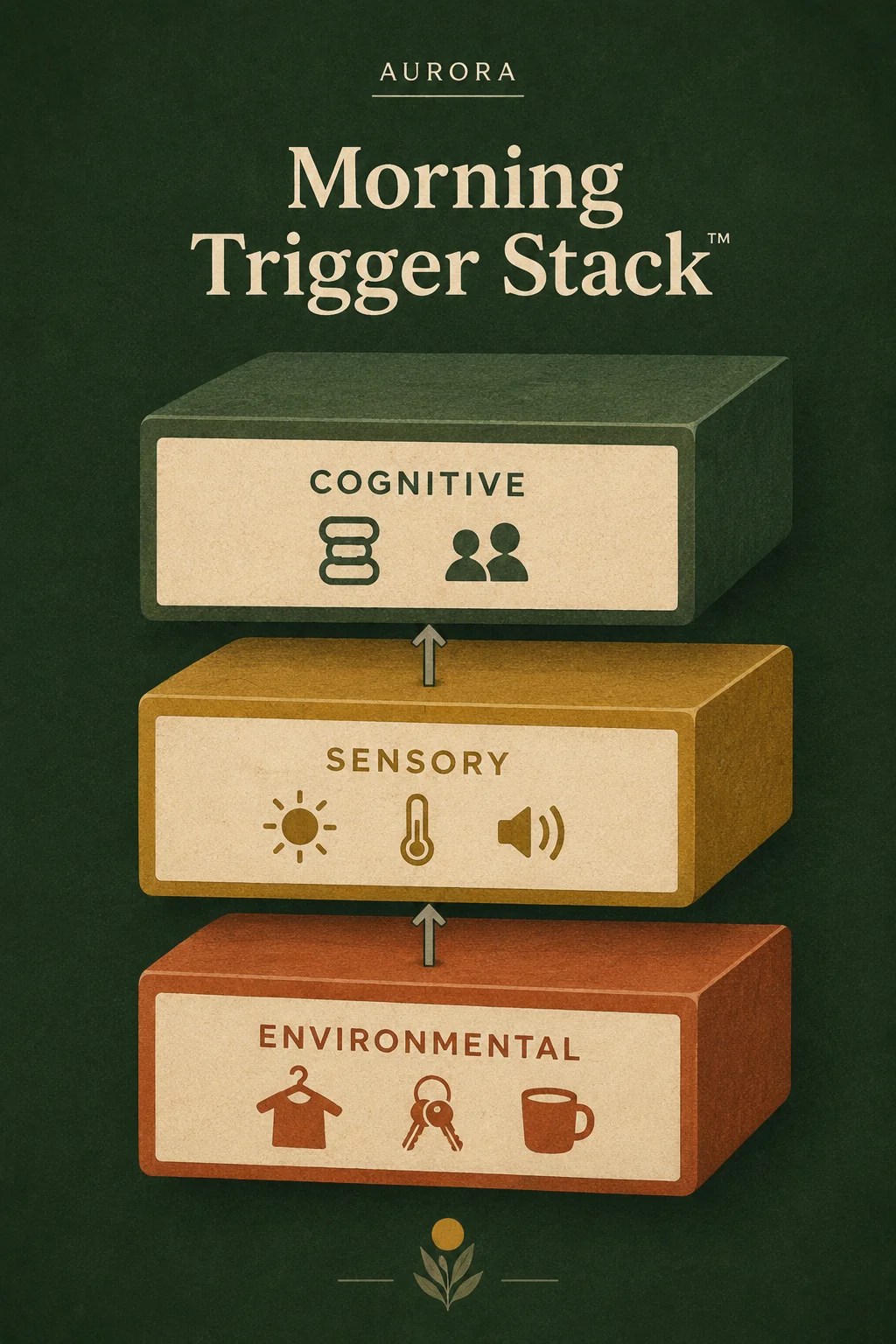
The Morning Trigger Stack™ is a three-layer protocol — under my broader Atom Method™ framework — for sequencing morning actions so each one is triggered by the previous one, rather than requiring its own dopamine-fueled decision.
The reason it’s a “stack” and not a “list” is critical. A list assumes the prefrontal cortex can pick the next item and execute it. The stack assumes it can’t — and engineers each item to be triggered by the one before it, so the morning becomes a falling-domino sequence rather than a series of independent decisions.
Each strategy below maps to one of the three layers. Apply Layer 1 first, then Layer 2, then Layer 3. Skipping Layer 1 is the most common reason morning routines collapse for ADHD brains — and the next section names why.
5 Strategies for ADHD Morning Routine
These are not five tips. They’re five engineering interventions, in order, that together compose the Morning Trigger Stack™. The first two are non-negotiable. The last three are stackable depending on your specific mornings.
1. Pre-Position Tomorrow Tonight (Layer 1 — Environmental)

The most important morning move you’ll make is the one you do at 9 PM tonight.
Lay out tomorrow’s outfit, completely. Pack the bag, completely. Pre-load the coffee machine. Put your keys, wallet, phone, and meds on a single visible spot (a Launchpad, as covered in You’re Not Broken Week 1). Pre-decide breakfast — even if it’s just oatmeal and a banana on the counter. Put your alarm across the room.
Why this is Layer 1 and why it’s non-negotiable: an ADHD brain at 6:42 AM operates on a fraction of the executive function capacity it has at 8:30 PM. The decisions you offload to last-night-you are decisions your morning-you literally cannot execute reliably. This isn’t about being organized. It’s about choosing to make decisions when your brain has the dopamine to make them. Evening-you has the resource. Morning-you doesn’t. Use the asymmetry.
The cultural script will tell you this looks excessive. It’s calibrated for neurotypical brains. Yours isn’t one. Pre-position everything you can. The strategies that follow will not work without this layer in place.
2. The 3-Sensory Wake Stack (Layer 2 — Sensory)

The second your alarm goes off, three things should already be happening to your body without you having to decide anything: light (a sunrise lamp or blackout curtains timed to open), temperature (a fan, the alarm cuing your thermostat, or a glass of cold water on the nightstand), and sound (an alarm placed across the room so getting up is the only way to stop it).
This isn’t optimization. It’s compensation. Your circadian system is running on a later phase and your morning dopamine is near its daily low.¹ The 3-Sensory Wake Stack feeds the brain external signals that simulate, briefly, the neurochemistry of an already-awake state. You’re not asking the prefrontal cortex to fire the start signal. You’re asking the body to react to sensation, and using that physiological activation to bridge the gap until executive function comes online.
Most adults with ADHD have tried one of these (usually the alarm-across-the-room). Trying one isn’t the stack. The stack is all three, simultaneously, because no single sensory input is reliable enough to anchor an ADHD-brain wake — but three together create a redundancy your body cannot ignore.
3. The First-Action Anchor (Layer 2 — Sensory)

The first physical action of your morning should be pre-decided and automatic — never chosen at the moment. Most ADHD adults default to checking their phone, which is the single worst possible first action because it floods the dopamine system with novelty before your prefrontal cortex has come online to regulate it. The morning is over before it began.
A good First-Action Anchor is: stand up, walk to the bathroom, splash cold water on your face. Or: pour the pre-loaded coffee. Or: feed the pet. Each takes less than 90 seconds, requires zero decisions, and physically moves your body through space — which, neurologically, is what wakes the system up. Body movement raises norepinephrine, which raises dopamine availability, which raises prefrontal cortex activation. The chain is biological. You’re not trying to be motivated. You’re trying to fire the first link.
Pick yours once. Use it every morning. Don’t deviate. The whole point is that it’s not a decision.
4. Habit Stack the Decisions Out (Layer 3 — Cognitive)
Once Layers 1 + 2 have done their work, your morning still contains four to eight micro-decisions that — left to your prefrontal cortex at 7:15 AM — will collectively eat 15-25 minutes of unrecoverable time. Which shirt? Which mug? Coffee or tea? Lunch leftovers or buy?
Habit-stack them out. Tie each decision to a non-decision trigger:
- When the coffee finishes brewing, I pour it in the same mug every day.
- When I sit down at the table, I open the same breakfast.
- When I close the front door, I check the same three things — keys, wallet, phone.
Implementation intentions in this format — “When X, I will Y” — are a well-established way to improve follow-through on intended actions, with a medium-to-large average effect across studies, by removing the in-the-moment decision step that the morning prefrontal cortex doesn’t have resources for.⁴ This finding is general rather than ADHD-specific, but it’s especially useful when your scarce morning executive-function budget is the bottleneck. This isn’t restriction. It’s freeing that budget for the things that genuinely matter.
5. Body Doubling Your Morning (Layer 3 — Cognitive)

On the mornings when Layers 1 + 2 still aren’t enough — the cycle-phase mornings, the post-burnout mornings, the after-a-bad-night mornings — the highest-leverage Layer 3 intervention is another human presence.
This is body doubling: a friend on a video call doing their own morning, a coworker in the kitchen, a Focusmate session, even a “morning routine with me” YouTube stream running on your tablet. You don’t need them to coach you, talk to you, or pay attention to you. You need the regulating presence of another nervous system in shared time.
CHADD describes body doubling as a strategy that can help adults with ADHD start, focus on, and finish a task simply by having another person present.⁵ The mechanism appears to involve social-presence regulation of prefrontal circuits — the same circuits that struggle to fire from internal motivation alone tend to fire more reliably when there’s another person in the implicit social field. For late-diagnosed women who grew up internalizing “needing help is shameful,” this strategy is both the most powerful and the hardest to allow. The shame is the problem here, not the strategy.
The Hidden Cost (Why Generic Routines Make It Worse for Women)
Late-diagnosed women carry a version of the morning problem that men with ADHD often don’t experience in the same texture. The morning isn’t just biological — it’s autobiographical. Every bad morning sits on top of every previous bad morning, and underneath all of them is the years of being told you were “just bad at this.”
Dr. Sari Solden — the psychotherapist who pioneered clinical work with late-diagnosed women starting in the 1990s, before the field had a vocabulary for what she was seeing — names the part most experts don’t:
“Women with ADHD have spent their lives trying to fix the parts of themselves that didn’t need fixing — and ignoring the parts that did. The shame is older than the diagnosis.”
Every “I just need a better morning routine” you’ve ever told yourself sits inside this larger pattern. The strategies above work. They work better when you stop fighting the wrong opponent.
The “wrong opponent” is the version of you who is supposedly broken, lazy, or undisciplined. That version doesn’t exist. What exists is a brain with a measurably different circadian curve, dopamine baseline, and EF capacity in the early-morning window — and an identity built decades ago to compensate for what nobody could name. The Trigger Stack works on the architecture. The deeper work — the part that lets the strategies actually stick — is letting go of the identity that was built around fighting yourself. That identity work is what connects ADHD deadline paralysis and morning struggle and time blindness into one cluster, not separate problems.
Common Mistakes That Break the Stack
Skipping Layer 1 because it “shouldn’t be necessary.” Cultural perfectionism whispers that an adult should be able to do mornings without staging an evening setup. The ADHD brain pays for this in 15-25 lost morning minutes every day. Build Layer 1. Stop apologizing for it.
Reaching for the phone before the First-Action Anchor. The dopamine flood from notifications hijacks the prefrontal cortex before it’s online. Within 90 seconds your morning is reactive instead of structured. Move your phone out of the bedroom or use airplane mode on a timer. This single change has the largest second-order effect of any strategy on this list.
Over-customizing. Trying to design a “perfect” morning routine — the kind women’s wellness content endlessly produces — adds the exact decision-load the stack is designed to remove. The stack is mediocre, repetitive, and boring on purpose. That’s the feature, not the bug. Reserve novelty for the afternoon, when dopamine has caught up.
Treating shame mornings as data points to fix. Time blindness and morning failure both intensify around hormonal phases, post-burnout recovery, and grief windows. These aren’t the data you should be optimizing against. They’re noise. Let them happen. Apply the stack again the next morning.
When to Get Professional Help
If morning struggle is significantly impairing your work, relationships, or wellbeing, professional support can make a substantive difference. Medication — when appropriate and well-supervised — closes the morning dopamine gap for many late-diagnosed women in a way no strategy alone can match. An ADHD-trained therapist or coach can help separate the strategy work from the identity work that usually runs underneath it.
You don’t need to wait until things are catastrophic. The threshold for getting help is “this is harder than it needs to be.”
Frequently Asked Questions
Why is my ADHD morning routine so much harder than other people’s?
Adult ADHD brains run on a delayed circadian phase, lower morning dopamine, and reduced executive function capacity in the early-morning window.¹ ² Three biological factors compound before 9 AM. It’s not laziness or willpower failure — it’s measurably different neurobiology.
Does an ADHD morning routine for women really need to be different?
Functionally, yes. Late-diagnosed women carry decades of internalized shame on top of the biological cascade, and many also experience additional hormonal influences on dopamine across the menstrual cycle that can affect morning performance. The strategies are biologically the same, but the identity layer tends to be much harder for women who grew up being told to “just be more organized.”
What’s the most important strategy if I can only do one?
Layer 1 — Pre-Position Tomorrow Tonight. Without the evening setup, every downstream strategy collapses because morning-you doesn’t have the executive function budget to compensate. If you can only build one habit, build the night-before staging habit.
Can ADHD medication replace the Morning Trigger Stack?
No, but it can dramatically improve how reliably the stack fires. Stimulant medication closes the morning dopamine gap that makes self-initiation hardest, which means Layer 2 + Layer 3 strategies start working consistently instead of intermittently.
Why does my morning routine work for two weeks and then fall apart?
Because most morning routines are designed for the prefrontal cortex, which means they require ongoing decision-making to maintain. The Morning Trigger Stack™ is designed to not require decisions — each layer triggers the next one biologically. If your routine reliably collapses after 2-3 weeks, the most likely cause is that you skipped Layer 1.
Is hyperfocus useful in the morning?
Almost never. Morning hyperfocus on a low-stakes task is one of the most predictable reasons women with ADHD arrive 45 minutes late to their actual day. The Trigger Stack is designed to prevent morning hyperfocus by anchoring the first action to a physical move, not a cognitive one.
Where should I start if I have ten minutes today?
Tonight: lay out tomorrow’s outfit, pack tomorrow’s bag, put your keys + wallet + phone on a single visible surface, and move your phone alarm across the room. That’s Layer 1. Tomorrow morning: do whatever the alarm being across the room makes you do. That’s the smallest viable Trigger Stack. Build from there.
A steady morning is one of the strongest levers for a delayed clock — ADHD and sleep explains why.
📚 The ADHD Library by Dr. Morgan Reed

The Morning Trigger Stack™ is one tool inside a broader system. The strategies above come from the framework I teach across three books.
★ 4.5 on Amazon (55 ratings)
“Reading this workbook felt like someone finally explaining my mornings — and my entire life — in a way that wasn’t about fixing me.”
Save this. You’ll want to come back to it.
📕 You’re Not Broken: 7-Week Executive Function Workbook — 134 strategies including the Atom Method™, the Morning Trigger Stack, and the EF rebuild protocol. For women diagnosed in their 20s-40s.
📗 ADHD Mastery for Adults: 3-in-1 — Daily coaching system covering focus, emotional regulation, and EF.
📙 Executive Function Rescue — 9-week DBT workbook focused on RSD, emotional overwhelm, executive collapse.
References
- Coogan, A. N., & McGowan, N. M. (2017). A systematic review of circadian function, chronotype and chronotherapy in attention deficit hyperactivity disorder. Attention Deficit and Hyperactivity Disorders. Link
- Volkow, N. D., Wang, G. J., Newcorn, J. H., Telang, F., et al. (2009). Evaluating dopamine reward pathway in ADHD: clinical implications. JAMA. Link
- Boonstra, A. M., Oosterlaan, J., Sergeant, J. A., & Buitelaar, J. K. (2005). Executive functioning in adult ADHD: a meta-analytic review. Psychological Medicine. Link
- Gollwitzer, P. M., & Sheeran, P. (2006). Implementation intentions and goal achievement: A meta-analysis of effects and processes. Advances in Experimental Social Psychology, 38, 69–119. Link
- CHADD. (2022). ADHD Body Doubling. Children and Adults with Attention-Deficit/Hyperactivity Disorder (CHADD). Link
Related Articles
- The “Everyone Has a Little ADHD” Myth — Continuum vs Disorder, the foundation underneath this post.
- ADHD Time Blindness: Why 5 Minutes Feels Like 2 Hours — the time-perception layer that compounds morning lateness.
- ADHD Deadline Paralysis — the task-initiation problem that morning struggle shares with deadline freeze.
⚠️ Educational content, not medical advice. This article shares research-based strategies and is not a substitute for professional diagnosis or treatment. If your morning struggle is significantly affecting your work, relationships, or wellbeing, please consult a qualified clinician experienced with adult ADHD.
Last reviewed: May 12, 2026, by Dr. Morgan Reed and The ADHD Truth editorial team.
As an Amazon Associate, I earn from qualifying purchases — at no extra cost to you. Full disclosure.
Leave a Reply